Figure 1. The spend/refuse gate. Inputs become EV_net. Unknown or non-positive means capital stays home.
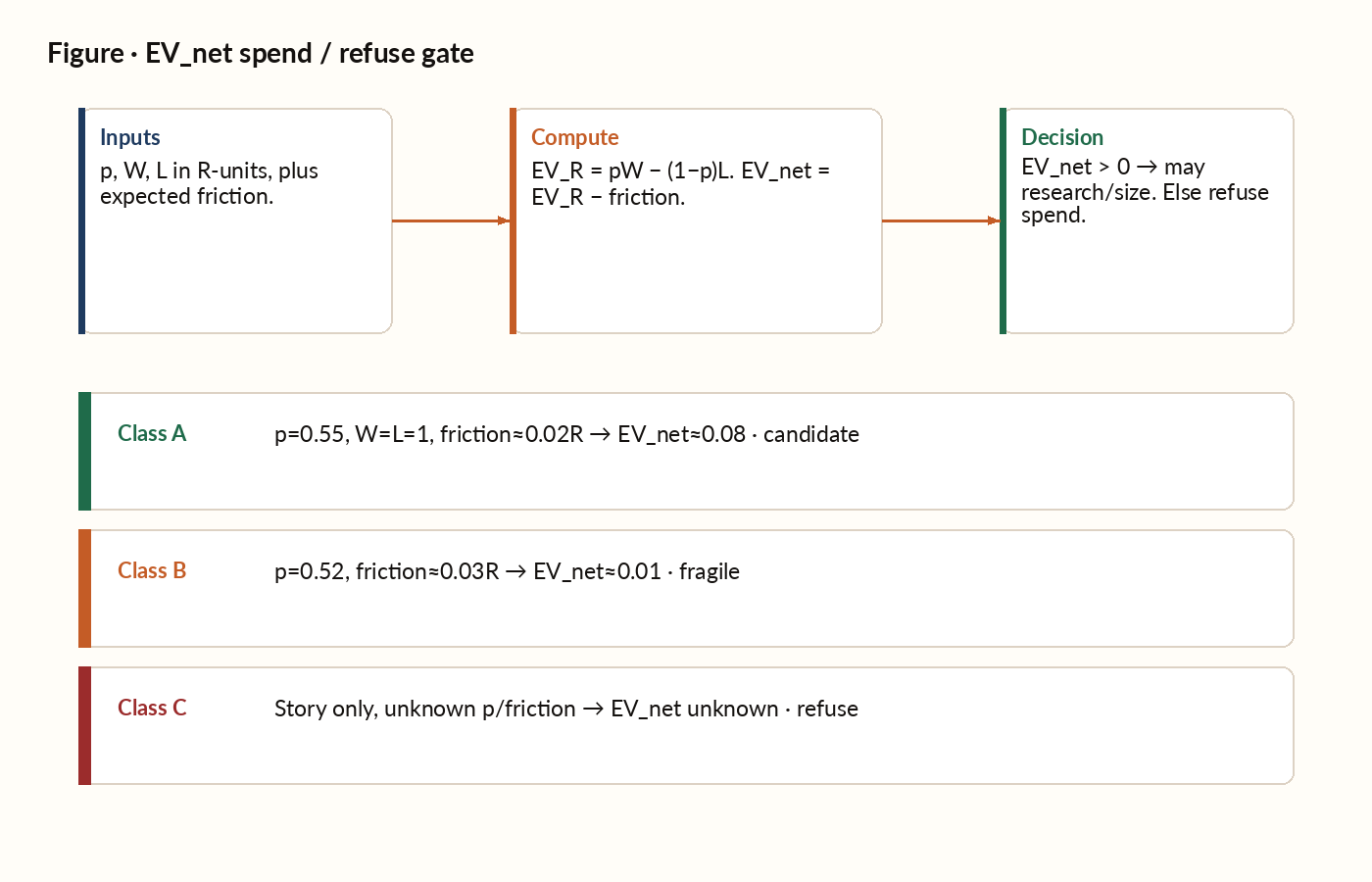
If you forced this series to keep one concept and ban every other, keep this one. Expected value decides whether a class of trades is allowed to take risk. Everything else (signals, LLMs, dashboards) is machinery attached to that gate.
Building EV from the coin
Take a binary trade for a moment. Let:
- p = probability the trade wins
- W = profit if it wins, in units of capital at risk (R-multiples)
- L = loss if it loses, in the same units (often L = 1 by construction of the stop)
Even money (W = 1, L = 1): EV_R = 2p − 1
At p = 0.55: EV_R = 0.10
That is Ep01’s “ten paise per rupee,” now written as a gate. Notice the rhyme with Kelly on even money (f* = 2p − 1). Same spine. Ep08 will show why.
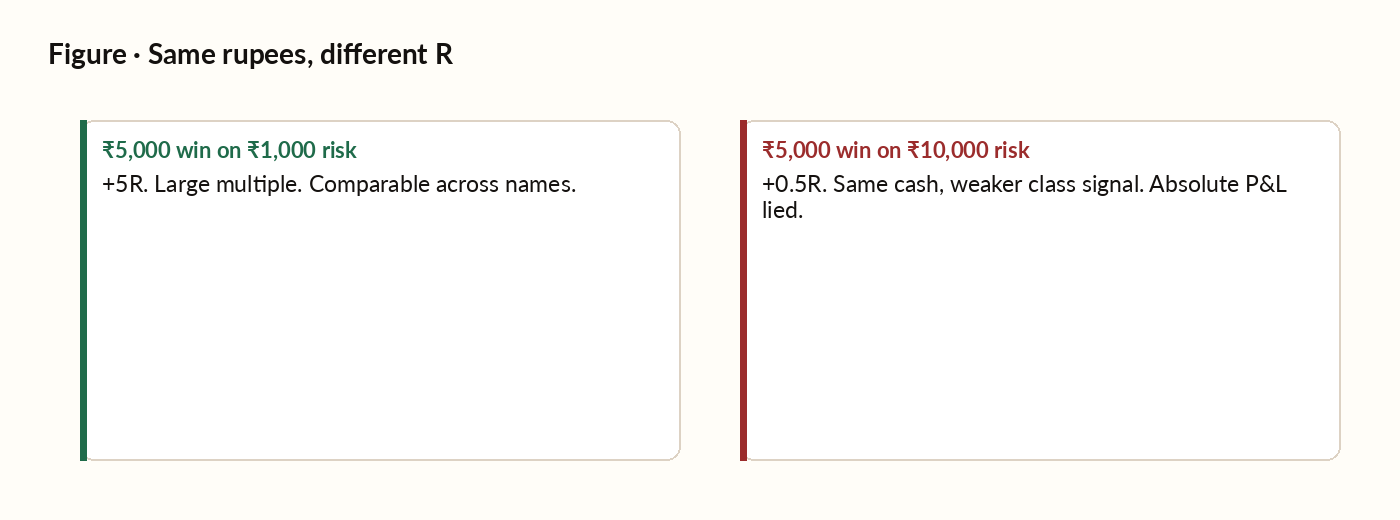
Figure 2. Same cash P&L can be +5R or +0.5R. Absolute rupees hide the risk unit.
Why R-multiples
Talking in raw rupees hides the risk unit. A ₹5,000 win on a ₹1,000 risk is +5R. The same ₹5,000 on a ₹10,000 risk is +0.5R. R-units make different names and notionals comparable. Desks that only quote absolute P&L systematically confuse luck on large size with quality of class.
| Object | Question it answers |
|---|---|
| p | How often does this class win? |
| W, L | How big are wins and losses in risk units? |
| EV_R before costs | Is the game positive in a frictionless dream? |
| EV_net after costs | May capital actually spend? |
Friction-adjusted EV
A setup that looks like EV_R = 0.08 before costs and bleeds 0.09 in friction is a negative-edge machine with good marketing. Any gate that scores “edge” without a friction model is incomplete.
Break-even win rate. Payoff ratio b = W/L, with L = 1 so W = b. Set EV to zero and solve: p·b − (1 − p) = 0, so p·(b + 1) = 1, giving p* = 1 / (1 + b). Example: risk 1 to make 2 (b = 2), break-even p* = 1/3. Below that, the class loses in expectation even before psychology.
The no-trade decision is part of EV
Refusing a trade is an action with EV = 0 (ignoring opportunity modelling). A desk that only evaluates taken trades and ignores correct skips will overfit aggression.
- take: EV_net
- skip: 0 (or a modelled opportunity cost, stated explicitly)
If take is not better than skip after costs and uncertainty, skip. Refusing is not a failure of nerve - it's the correct answer whenever the numbers don't clear the bar, and a desk that can't say "skip" out loud will eventually take a trade it shouldn't.
Necessary, not sufficient
Positive EV_net is necessary. It is not sufficient. You still need sizing that survives paths (Kelly / fractional Kelly), dependence-aware N, regime honesty, and operational discipline. But without positive EV_net, those later chapters are jewellery on a losing coin.
How this shows up in production
1. Conviction without EV. “I really like this name” with no p, W, L, costs. Refuse.
2. Backtests that omit friction. Gross EV looks positive; live fills convert it to house advantage.
3. Mixing R and rupees. Dashboards that celebrate absolute P&L while risk units drift.
4. Promoting on path luck. Unclear EV_net but a recent green equity curve.
5. LLM or scorecard confidence standing in for EV. A high model score is not EV_R. Translate or refuse.
- Every trade class that may spend must publish p, W, L (or equivalent) and a friction assumption.
- Gate on EV_net, not on narrative confidence.
- Express performance in R where risk is the denominator.
- Treat skip as EV = 0 unless you explicitly model opportunity.
- Do not let LLM scores, chart aesthetics, or last-week P&L bypass the EV gate.
- Remember Ep01: even a true positive-EV class will lose often. Path pain is not a veto of EV; thin N is a veto of certainty.