Figure 1. Three primitives in order. Skip any one and “edge” collapses back into mood.
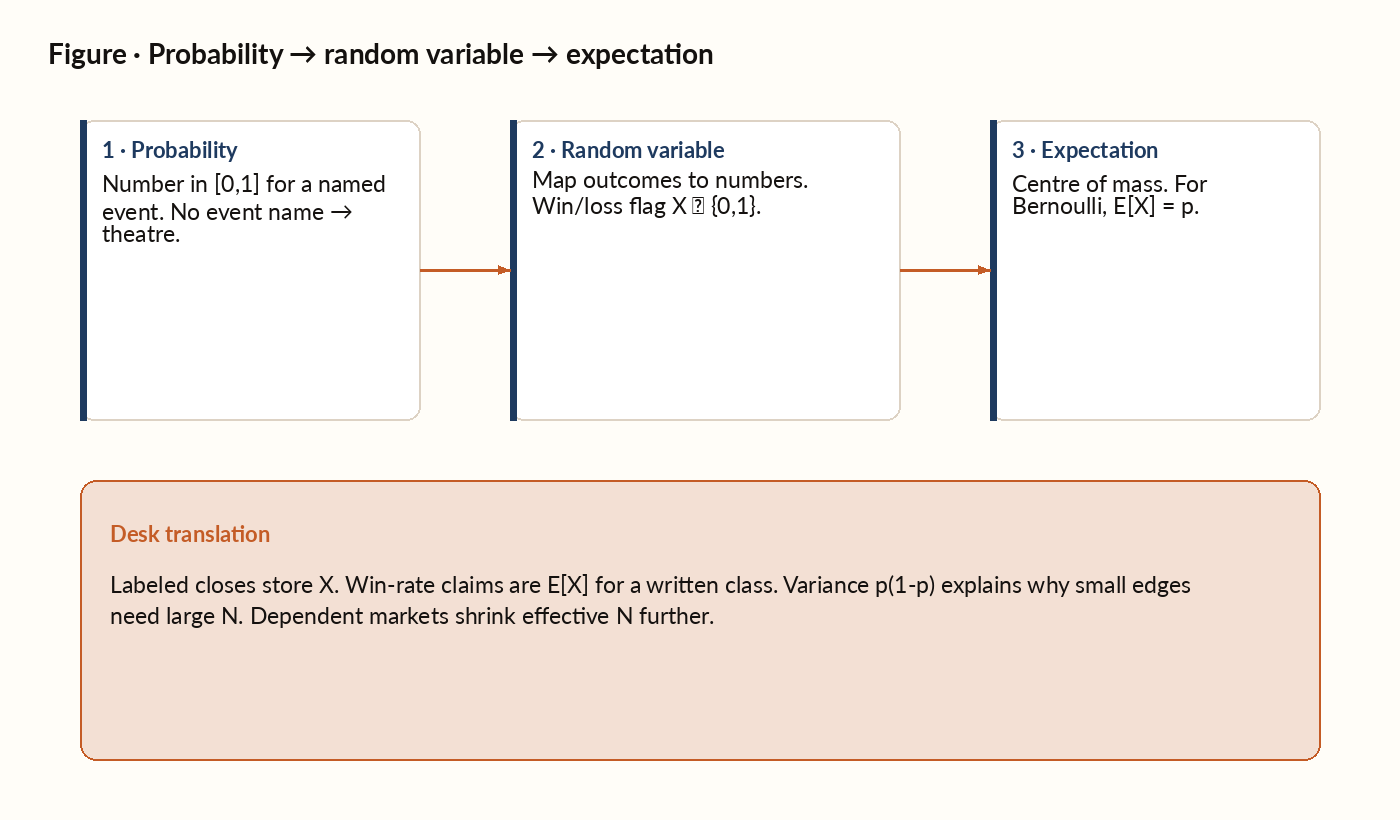
Ep01 left a wound: conviction on a single print is not measurement. To heal it you need three words that every later chapter reuses. Skip them and Kelly becomes a slogan, information coefficient becomes a spreadsheet decoration, and convergence cards become green theatre.
What a probability is
A probability is a number between 0 and 1 assigned to an event.
- 0: treated as impossible under the model
- 1: treated as certain under the model
- 0.5: long-run balance between an event and its complement (for a binary split)
Philosophers argue about what probability means (long-run frequency versus degree of belief). Desks cannot wait for that war to end. What desks need is the arithmetic: numbers that obey non-negativity, normalization, and additivity for mutually exclusive events. Frequentist or Bayesian, the gates later in this series still consume those numbers.
and P(A or B) = P(A) + P(B) when A and B cannot both happen.
Critical production rule: every probability float must name its event. “Model confidence 0.73” with no horizon, no win definition, and no cost treatment is not a probability a desk can spend.
The Bernoulli random variable
A random variable maps outcomes to numbers. The workhorse for trades is Bernoulli:
P(X = 1) = p, P(X = 0) = 1 − p
E[X] = p
That is Ep01’s coin, now named as an object. Labeled closes, win/loss flags, and many gate inputs are Bernoulli samples or transforms of them. When someone says “our sleeve wins 55% of the time,” they are claiming E[X] = 0.55 for the class definition they wrote down.
Expectation: the centre of mass
For a general random variable Y:
Weight each possible number by how strongly the model believes it, then add. That weighted sum is the centre of mass of the uncertainty.
Two properties you will use constantly:
- Linearity. E[aY + b] = a E[Y] + b. Scaling risk and shifting by a constant fee behave cleanly.
- Not the median, not the mode. Expectation can sit where no single outcome lives. A rare large loss can drag E[Y] negative even if most days look fine. “Most trades feel okay” is not EV.
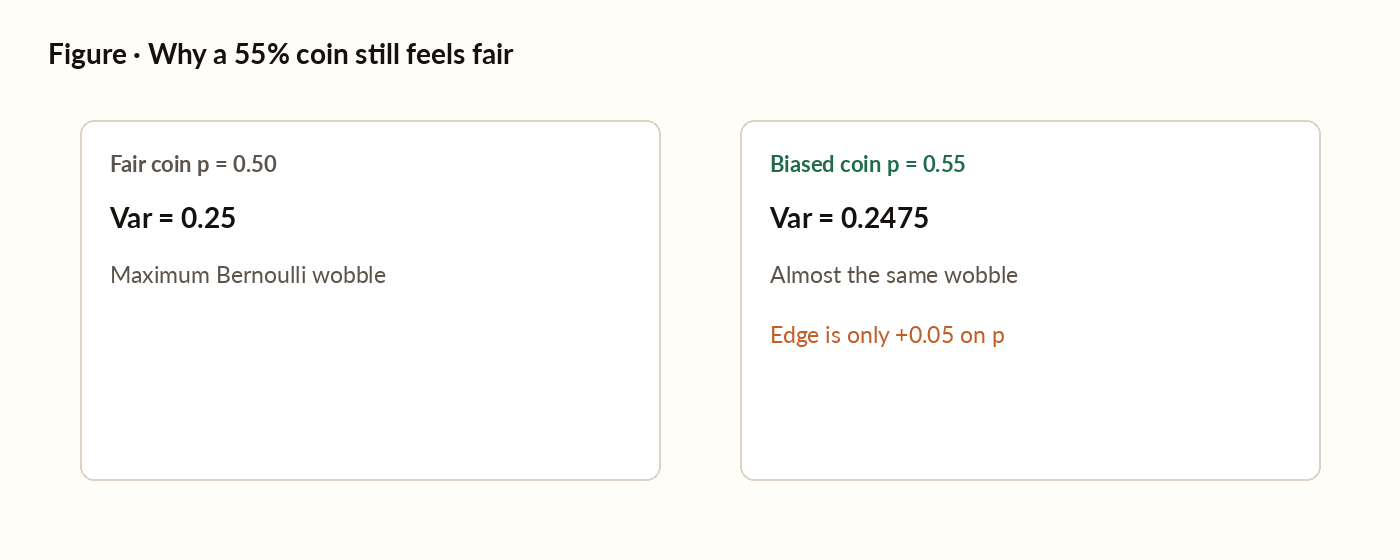
Figure 2. Why a 55% coin still feels almost fair. The wobble barely shrinks while the bias is tiny.
Variance: how much the outcome wobbles
For Bernoulli X: Var(X) = p(1 − p)
At p = 0.50: 0.25 | At p = 0.55: 0.2475
Small edges drown in noise because the wobble is comparable to a fair coin while the bias is only a few points. Ep05 turns this into the square-root rule for standard errors. Lock the intuition now: small edge plus Bernoulli variance means you need large N.
| Word | Desk translation |
|---|---|
| Probability p | Claimed win rate of a defined class |
| Random variable X | Numeric encoding of the outcome |
| Expectation E[·] | What the class is supposed to average to |
| Variance | How violently individual prints deviate |
Independent versus dependent samples
Classical sample-size talk assumes independent flips. Markets are not polite. Clustering, regimes, and overlapping holdings make effective N smaller than calendar trade count. Part III will harden that (HAC, effective N).
How this shows up in production
1. Probability as decoration. A model emits 0.73 with no event definition.
2. Confusing a forecast with an expectation of P&L. A directional score is not automatically E[R-multiple after costs]. Ep03 forces that translation.
3. Averaging incompatible beliefs. Two agents publish p for differently defined events, then someone averages them into “consensus.” That invents a third geometry.
4. Green win-rate tiles with no Var language. A dashboard that shows only p̂ without wobble or N trains humans to overreact to noise.
- Every probability float must name its event (horizon, win definition, costs).
- Store outcomes as random variables you can audit.
- Separate E[·] claims from single prints in UI and promotion memos.
- When you quote N, ask whether samples are close to independent.
- Do not average probabilities across differently defined events.
- Next: attach money. EV in R-units is how these words become a spend/refuse gate.