Every chapter in this Part has converged on the same operational question: given the strategy's realised performance to date, how much should I trust it? The Convergence Card is the practical instrument that answers this question on a single dashboard. It is the operational distillation of everything in Parts I-VI of this book - Bernoulli statistics, expected value, the law of large numbers, the central limit theorem, Newey-West HAC, Brier-style calibration, Monte Carlo, walk-forward. The card is not a new theory - it is Parts I-VI wired together:
Figure 1. Concept map for this episode: fight, desk translation, what to lock.
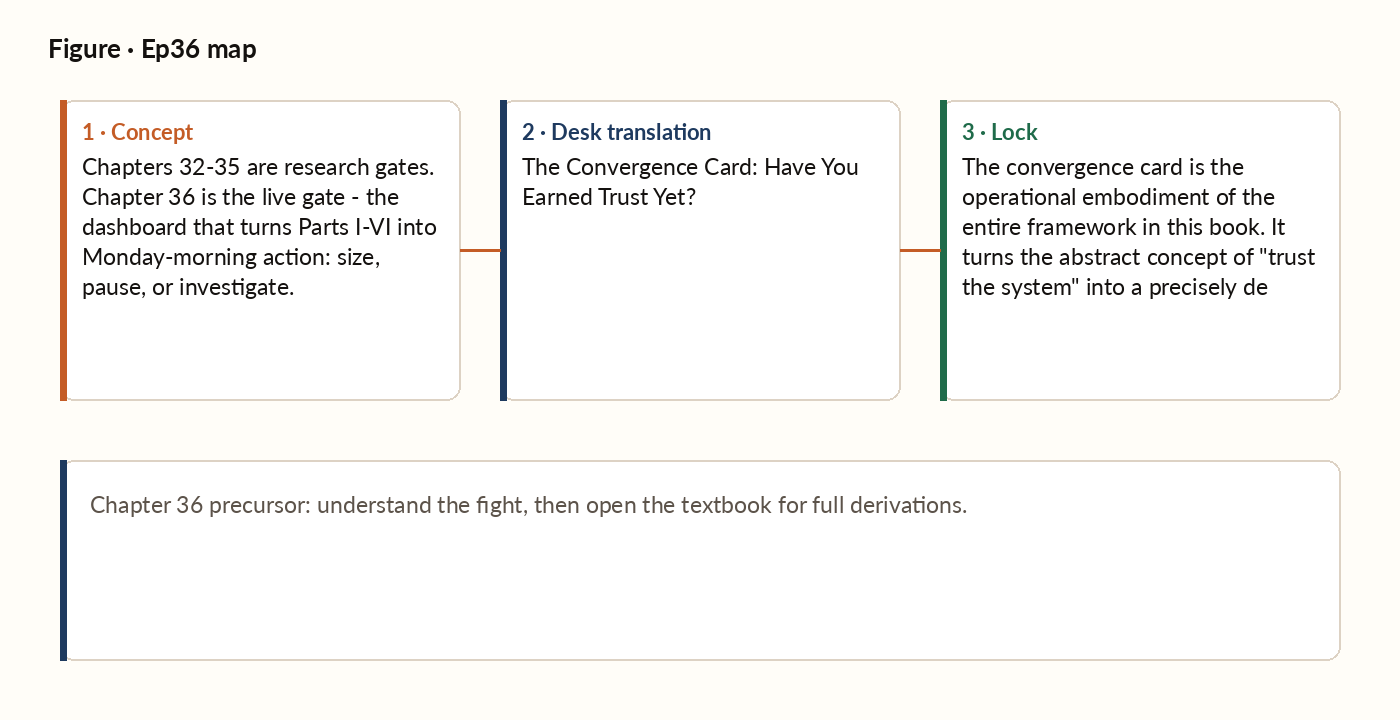
Which part of the book feeds which card field
The card is not a new theory - it is Parts I-VI wired together: sample size and mean R come from the law of large numbers, the standard error and p-value come from the Newey-West correction for clustered trades, the regime and sizing multiplier come from Bayesian Kelly, and drawdown gets checked against the Monte Carlo band. One green metric buys nothing. Brier can look fine while mean R is negative; mean R can look fine while drawdown violates Monte Carlo; infrastructure can be green while edge is dead (§36.5 health card). All dimensions, one decision.
The four core numbers
N - the number of trades to date. The denominator of every statistical claim about the strategy. Realised mean R - the average R-multiple across those trades, which converges toward the strategy's true expected value as N grows. Standard error - how much the realised mean would plausibly shift if you re-ran history, corrected for the fact that trades cluster rather than arrive independently. p-value - the odds you'd see a mean R this strong by pure luck if the strategy actually had zero edge; a small p-value is evidence the edge is real.
The convergence regimes
The convergence card classifies the strategy into one of four operational regimes: cold start (fewer than 30 trades - size tiny, keep collecting data), validated (100+ trades AND p < 0.05 - size normally), failed (100+ trades AND p ≥ 0.20 - suspend and investigate), and provisional for everything else - the catch-all that covers 30 to 100 trades regardless of p-value, and also covers 100+ trades whose p-value falls in the 0.05-to-0.20 gap between validated and failed (size conservatively, watch closely). Every (N, p-value) pair lands in exactly one regime; there is no undefined gap where a strategy with a lot of data and a mediocre p-value falls through the cracks. The regime determines the multiplier on the Bayesian Kelly bet sizes (Chapter 9). Cold-start strategies bet 0.1× normal; provisional bet 0.5×; validated bet 1.0× (subject to fractional-Kelly cap); failed strategies bet 0.0× (no entries).
The forward-projection columns
Beyond the four core numbers, a useful convergence card includes two forward-looking columns: Trades until significance - the number of additional trades needed (assuming the current realised mean continues) before the p-value would cross the 0.05 threshold. A strategy with very low current p-value needs no additional trades; a strategy with marginally significant performance might need 200 more. Weeks until significance simply converts that trade count into a calendar estimate, using the strategy's current trading pace - a concrete answer to "when can I trust this?" instead of a vague one.
Worked picture
Strategy X has been live for 9 months. Convergence card: N = 140, mean R = 0.18, HAC SE = 0.04, p-value = 0.000004. Regime: validated. Yesterday's trade: -3.0R. Cumulative P&L: down 8R from the recent peak. The operator is uncomfortable. What does the card say? Nothing has changed about the regime. The strategy is still validated. The p-value is still vanishingly small. The drawdown is well within the Monte Carlo distribution from Chapter 33. The card's verdict: no action; continue normal sizing. The card converts emotional discomfort ("I want to halve my size after this loss") into mechanical discipline ("the card says continue; I continue"). Operators who follow the card outperform operators who do not - not because the card is magic, but because it removes the systematic bias toward acting on noise.
What breaks in production
A common mistake is to tweak the regime thresholds based on a strategy's specific behaviour. "For this strategy, I want validated to require N 200 because it has more trade clustering." This is reasonable in moderation but dangerous in excess. Tweaking thresholds per strategy means there is no single objective standard for "validated." Every strategy then has a custom story for why it deserves to be live. The discipline collapses into ad-hoc justification. A better approach: keep the thresholds standard (N=30, N=100, p=0.05) and adjust the Kelly multiplier per strategy based on its idiosyncratic risk. This separates the question of "is this strategy real?" (standard answer) from "how big should the bet be?" (strategy-specific).
The convergence card discipline
The convergence card is the operational embodiment of the entire framework in this book. It turns the abstract concept of "trust the system" into a precisely defined set of numbers and a precisely defined response. It is what allows a systematic operator to sleep well through a drawdown: the card says "you are still in the validated regime, sizing remains normal, no action required." Without the card, the drawdown is psychologically intolerable. With it, the drawdown is just data. A system without a convergence card is a system without discipline. A system with one - and the institutional commitment to obey it - is a system that survives the inevitable bad stretches that destroy most other systems. The card is the last gate between research and production, and it is the first thing the operator looks at every Monday morning.