Kelly's insight, when translated to gambling, was profound: the bet size that maximises expected long-run wealth is not the bet size that maximises expected dollar return on a single bet. The two are different, sometimes dramatically. Kelly betting is what professional gamblers (and serious quantitative funds) actually do. It is also psychologically brutal, which is why almost no one bets full Kelly in practice. This chapter derives the formula, explains the brutality, and lays the groundwork for the Bayesian Kelly in Chapter 9. You have an edge: a binary bet that wins some percentage of the time, paying out a certain amount for every unit wagered. What fraction of your current capital should you bet on each play?
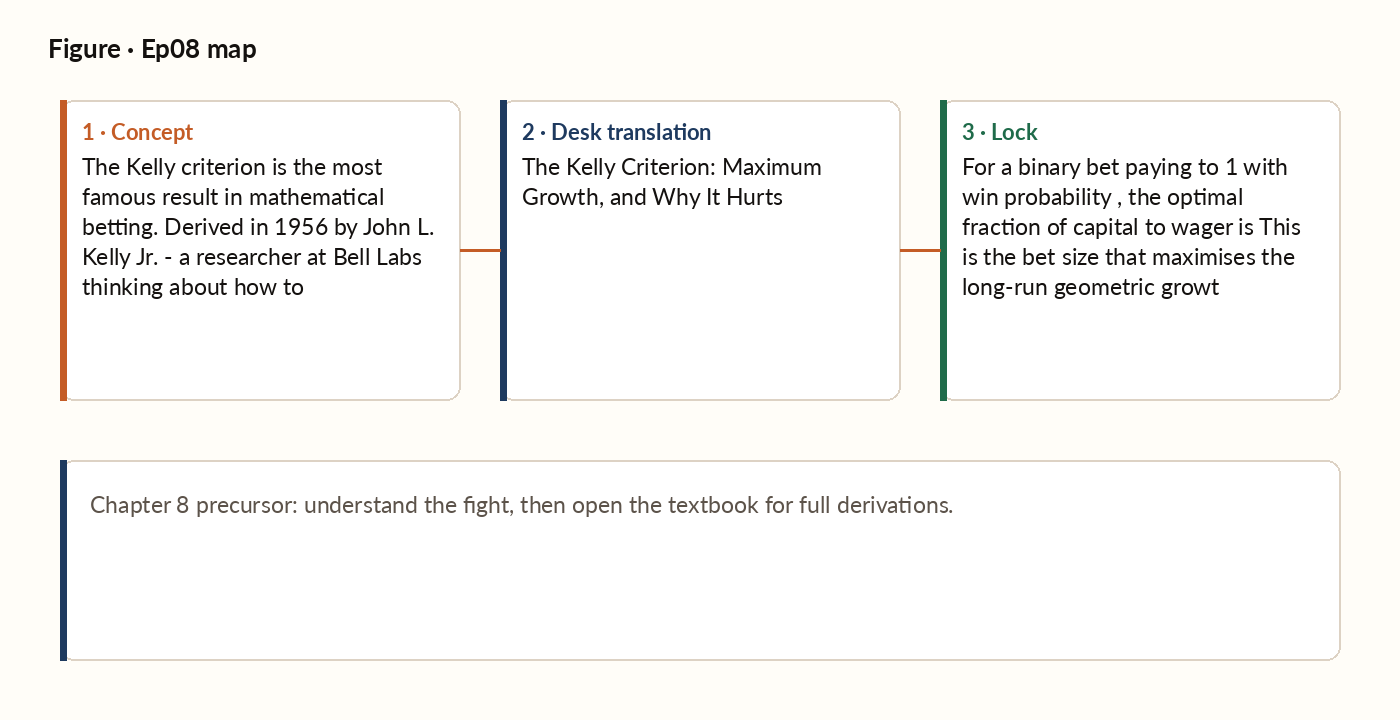
Figure 1. Concept map for this episode: fight, desk translation, what to lock.
The setup
You have an edge: a binary bet that wins with some probability, paying out a certain amount for every unit wagered on a win, and losing the full stake on a loss. What fraction of your current capital should you bet on each play? The naive answer: bet to maximise expected profit per play, which, worked out, says bet everything you have on every play if your edge is positive. That advice is obviously absurd: one bad outcome wipes you out completely. The naive answer is wrong because it maximises the wrong thing. Wealth compounds multiplicatively, so what actually matters for long-run growth is not the arithmetic average return but the geometric average, and the geometric average can be far lower than the arithmetic one, even negative, when bet sizes are too aggressive.
Deriving Kelly from log-utility
The Kelly criterion falls out naturally from the assumption that you want to maximise expected log wealth (equivalently, the expected geometric growth rate of your capital). Working through the calculus of maximising expected log-wealth over your bet size leads to a clean result: for a bet that wins with probability p and pays b to 1, the optimal fraction of capital to wager is (p(b+1) - 1) / b. For an even-money bet, this simplifies further to twice your win probability minus one.
Why nobody bets full Kelly
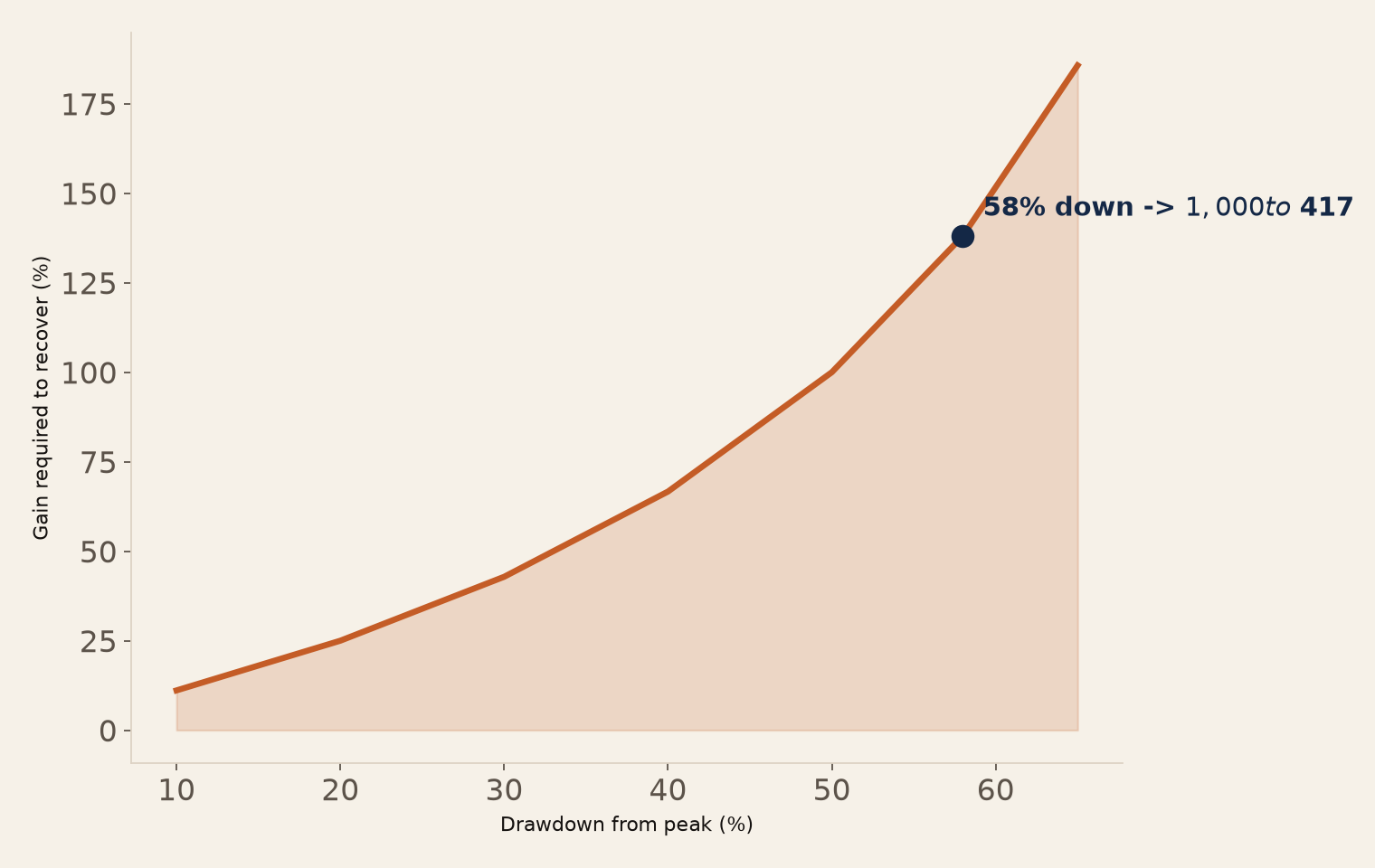
The Kelly fraction maximises the geometric mean. But the variance around that mean is enormous. A full-Kelly bettor will experience drawdowns that no human can stomach. For a 55% edge at even-money odds (a 10% Kelly bet) firing 25 times a year, the expected annual return is about 13%, but the volatility of that log-growth path is also about 50% -- and a bad-but-plausible two-standard-deviation year, computed honestly in the same log units rather than by naively subtracting percentages, produces about a 58% drawdown, almost certain to break the operator psychologically even if they survive it financially.
Figure. Full-Kelly drawdown math — a 25-flip year's log-path vol produces a real 58% drawdown ($1,000 to ~$417) at 2-sigma down.
The growth-variance trade-off
To make the fractional-Kelly choice precise, think in terms of betting some fraction of full Kelly rather than full Kelly itself. It turns out that betting at half-Kelly captures about 75% of the full-Kelly growth rate (not 50%, since the growth curve is concave near its peak) while cutting the variance to a quarter of full Kelly's, a much better trade-off for any operator who isn't a billionaire with infinite patience. This approximation holds well for well-behaved, close-to-normal return distributions; for return series with fatter tails, the real numbers drift somewhat from this clean picture.
Worked picture
55% win rate, 1:1 payoff: bet 10% of capital. 60% win rate, 2:1 payoff: bet 40% of capital. 51% win rate, 1:1 payoff: bet just 2% of capital. The Kelly fraction scales with edge and inversely with payoff variance. Tiny edges call for tiny bets; large edges call for large bets. Payoff structure matters too. A generous 2:1 payoff allows much larger Kelly fractions than even-money for the same win rate.
What breaks in production
Kelly maximises log-growth in the limit. For finite horizons (a few years, not forever) and for any actual human psychology, full Kelly is far too aggressive. The drawdowns that occur with positive probability under full Kelly are deep enough to cause most operators to abandon the strategy mid-drawdown, locking in the loss permanently. This is why almost every professional fund operates at a fractional Kelly, typically half-Kelly or quarter-Kelly. The expected log-growth at half-Kelly is 75% of the full-Kelly maximum (not 50%, because the growth function is concave near the optimum), and the variance is one-quarter, a much better trade-off for any operator who is not literally a billionaire with infinite patience.
The Kelly formula
For a binary bet with a given win probability and payoff ratio, there is one bet size that maximises the long-run geometric growth rate of capital, and it scales up with your edge and down with the payoff's variance. Bet less than that and you leave growth on the table; bet more and you actively destroy long-run wealth, even with a genuine edge.