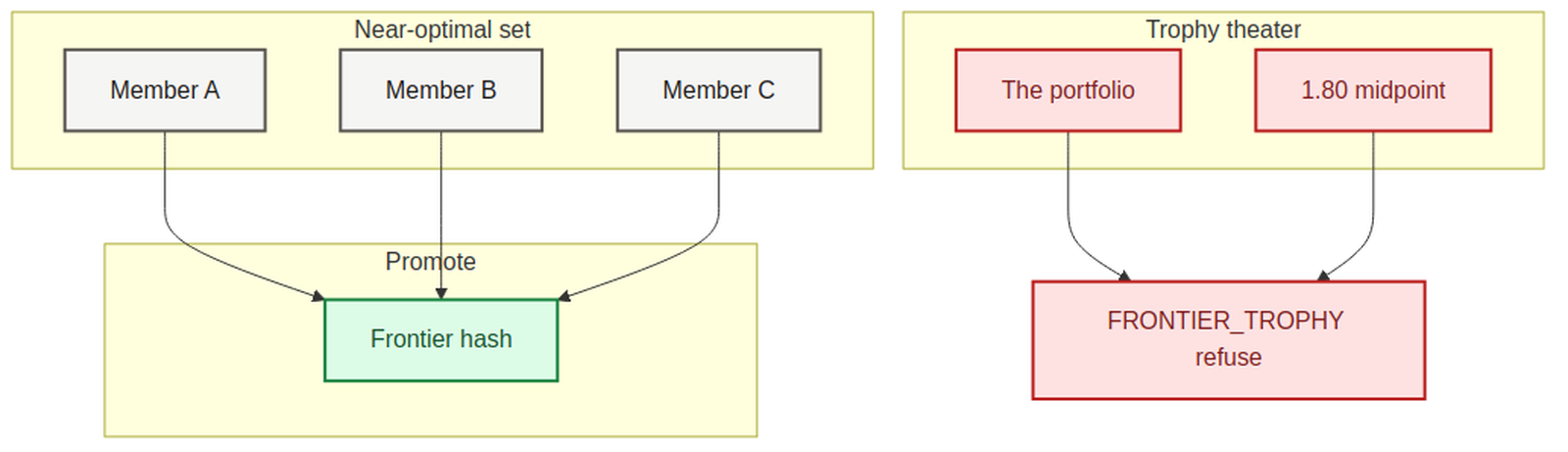
Simple claim: promote the hashed near-optimal set and test membership; crowning a unique trophy portfolio is theater when fourteen basis points of vol separate books that differ by a fifth of capital. The trench is frontier hash under Clearance.
The problem we left open
Problem in one line: fourteen basis points of volatility separate portfolios that differ by a fifth of the book. Crowning a unique trophy portfolio is theater; promote the hashed near-optimal set.
The last two posts were both versions of one failure: an optimiser producing a risk number that describes its inputs rather than the world. Rank-deficient covariance gave 167 basis points of return at unchanged volatility. A clipped correlation of minus one gave a two-name portfolio with no variance at all and a 9.33 percent riskless return that the risk-free rate flatly contradicts.
Both essays ended in the same place: the frontier is a geometry for reasoning, not a source of tickets. But saying that leaves the operational question open. Desks need allocations. Agents will keep proposing weights. Something has to be promoted.
The mistake underneath all of it is smaller than any of the numerical pathologies and much more widespread. It is the definite article. The optimal portfolio. Once a single point is the deliverable, every estimation artefact becomes a decision, and every disagreement becomes an argument about whose point is right.
The solution, as one stack
Promote the set. Five moves.
### 1. Make the frontier a card before it is a curve
The card holds everything that determines the geometry: the covariance recipe hash from the loss card, the expected-return card, the shorts policy bit, the gross-exposure cap, the target grid, and one field that is usually missing, the admissibility tolerance. That last field states how much objective degradation still counts as optimal, and it is a desk decision, not a solver default.
Without a declared tolerance, "optimal" means "whatever the solver returned to machine precision," which is a statement about numerical libraries rather than about risk.
### 2. Compute the near-optimal set, not the argmin
Here is the working example. Three assets with expected returns of 6, 10 and 14 percent, volatilities of 12, 18 and 26 percent, pairwise correlation 0.30, a 10 percent target and weights summing to one. The certified optimum, the one carrying a clean KKT certificate, is 29.87, 40.26 and 29.87 percent, at 13.85 percent volatility.
Now ask what else is admissible. With two equality rows and three assets, the feasible set is a line, and moving along it changes volatility quadratically away from the optimum. Allow volatility up to one percent worse, 13.99 percent instead of 13.85, and the admissible set runs from 24.8, 50.5, 24.8 all the way to 35.0, 30.1, 35.0 percent. Those two portfolios are 20.4 percent of the book apart in one-way turnover, and 14 basis points apart in the objective.
Loosen the tolerance to two percent and the set spans 22.6 to 37.1 percent in the first asset, 28.9 percent turnover. At five percent it spans 18.4 to 41.4 percent, 46.1 percent turnover.
Fourteen basis points is the number to sit with. No covariance recipe in existence is accurate to fourteen basis points of portfolio volatility, not with sixty monthly observations, not with shrinkage, not with a factor model. So the entire 20 percent turnover band is statistically indistinguishable under the very estimate that produced the ranking. The argmin is not the best member of that set. It is the member that won a coin toss weighted by estimation noise.
This is predictive multiplicity, the same Rashomon phenomenon that shows up when many near-equally-accurate models disagree case by case. The honest object is the crowd.
### 3. Promotion becomes a membership test
The verdict logic changes shape and gets simpler. An agent proposes weights. The harness checks three things: feasibility against the constraint cards, a KKT certificate within tolerance, and membership in the hashed admissible set for the declared target and tolerance.
Pass all three and the verdict is allow, as a member, explicitly, with the crowd's width recorded beside it. That phrasing matters more than it sounds. "Allowed as a member of the admissible set at 10 percent target, tolerance one percent, set width 20.4 percent turnover" is a claim that survives next quarter. "The optimal portfolio" does not, and when it fails to reproduce, the failure looks like a modelling error rather than what it was, a set presented as a point.
Fail feasibility and it is refuse. Fail the certificate and it is refuse with the reason named, as with the stale-correlation case that reported 12.60 percent risk on a 13.85 percent portfolio. Miss membership only because the tolerance field was never set: inconclusive, because nobody declared what optimal means.
### 4. Choose within the crowd on declared, secondary criteria
A set is not an answer to "what do I trade." So pick, and put the picking rule in the hash: minimum turnover from the current book, borrow-light, capacity-aware, fewest names, whatever the desk actually values. Those criteria are cheap to satisfy, you have 20 percent of turnover to spend without meaningfully moving the objective, and enormously valuable operationally.
The important part is that the tie-break becomes an auditable field instead of a solver artefact. Two runs of the same job now differ because a declared rule changed, not because a library changed its iteration order.
### 5. Report crowd width as a risk metric, and never average across cards
Set width is information, and it should ride on the promotion artefact like an interval rides on an estimate. A narrow crowd means the objective genuinely identifies a portfolio. A wide crowd means the objective is nearly indifferent across allocations the desk would consider very different, which is a statement about how much your risk model is actually deciding, and it belongs in front of a human.
Then the rule that this whole series keeps returning to, stated precisely. Averaging within one admissible set is unremarkable, the set is convex here, so the average is a member and carries no special status. Averaging across two different cards is the illegal move, because the two cards have different feasible sets and the average is generally a member of neither. That distinction is what makes the midpoint denial a rule rather than a preference.
The example: CEH-001 through the frontier hash
| Tolerance on σ* | Admissible weight span (asset 1) | One-way turnover vs optimum |
|---|---|---|
| KKT point (σ*≈13.85%) | w≈29.87 / 40.26 / 29.87% | 0 |
| +1% vol (13.99%) | ~24.8% ... 35.0% | ~20.4% of book |
| +2% vol | ~22.6% ... 37.1% | ~28.9% |
| +5% vol | ~18.4% ... 41.4% | ~46.1% |
| Reading | 14 bp objective gap vs 20% turnover | Promote set + membership test, not one seed |
Same three-asset card as S2-05 (μ 6/10/14%, σ 12/18/26%, ρ=0.30, target 10%). The entire 20% turnover band is statistically indistinguishable under the estimate that produced the ranking. Series 1 Rashomon in portfolio clothes. Dual CEH marks still require dual-frame constraints inside the set; 1.80 is not a member.
The structured book, and the two mark frames that have run through every post in this arc: near 1.50 under the spread frame, near 2.10 under the curve frame, each citing its own cashflow-contract hash.
Take the allocation job first. The agent proposes 33, 34 and 33 percent. Under the old regime that gets compared to the certified 29.87, 40.26, 29.87 and someone argues about whether a three-point deviation matters. Under the frontier hash it is a two-second check: feasible, certificate within tolerance, volatility 13.9 percent, inside the one-percent band. Allowed as a member, crowd width recorded, tie-break rule noted as minimum turnover, which the proposal happens to satisfy better than the argmin does, because it is closer to the current book. No argument, no trophy.
Now the marks, where the same machinery does the more valuable work. Each frame gets its own admissible set under its own card. The spread frame's card-consistent marks span roughly 1.46 to 1.55. The curve frame's span roughly 2.04 to 2.14. Both are hashed. Both are reported with their widths.
And look at what that construction does to the compromise. The union of the two admissible sets has a hole in the middle. 1.80 is not in the spread frame's set and not in the curve frame's set; it is in the gap between them, which means no card on file can produce it, and the membership test rejects it without anyone needing to argue about judgement or courage. The midpoint of a multiplicity structure is not privileged, and when the structure is disconnected the midpoint is not even admissible. That is the cleanest statement of the denial I have: 1.80 fails not because it is unreasonable but because it is not a member of anything.
What the desk gets instead is two hashed bands, two widths, and an escalation, which is exactly what a never-traded structure with two defensible construction paths honestly supports.
The flow in one breath
Problem: PSD / correlation phantoms and untyped diversifiers made unique “optima” look sharp; they are not. Solution: hash the near-optimal frontier under carded tolerance ε, promote the set, test proposals for membership, require KKT on representatives. Example: 14 bp of vol vs 20% turnover, crowning one weight vector is theater.
What to lock
frontier_hash= (job card + Σ recipe + shorts policy + ε-tolerance + member set summary).- Promote membership tests, not a single trophy portfolio id.
- ε is a rights parameter (Series 1 A(ε) spirit); undeclared ε is refuse.
- Proposals outside the set fail even if they “beat” a single champion seed in a noisy re-run.
- CEH dual-frame constraints remain inside every member; 1.80 is never in the set.
- KKT certificates required on sampled members before lease (S2-05).
Clearance coupling: this is Series 1 underspecification applied to portfolios. Next wave: beta, hedge-first, measure change (S2-11+).