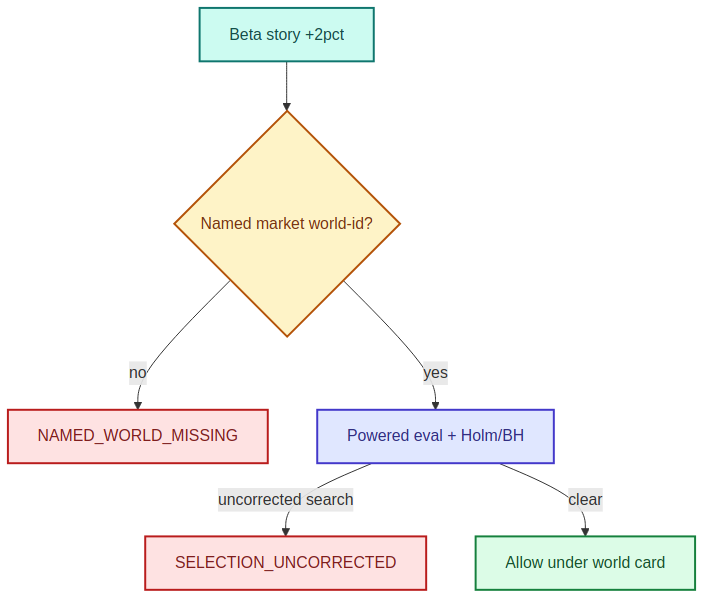
Simple claim: beta without a named market portfolio is a proposal with no world to be true in. The trench is CAPM as a named-world card, not a free ratio.
I keep reading agent output that sounds like equilibrium finance and is actually a sentence with no world attached.
The line arrives clean. CEH-001's hedge sleeve screens cheap on CAPM: beta 0.62, expected excess 3.4%, roughly two points of pickup versus the current mark. There is a table. There is a regression R² in a footnote. Someone forwards it with the word interesting. Nobody in the thread asks the only question that makes the sentence mean anything: cheap against which market?
That question is not pedantry. In the model that produced the number, the market is not a decoration. It is the entire load-bearing structure.
What beta actually owes you
Problem in one line: CAPM beta without a named market portfolio is a proposal with no world to be true in. Change the proxy and “edge” flips without model code changing.
| Object | Under proxy A | Under proxy B |
|---|---|---|
| CEH hedge sleeve beta | ~0.62 | ~0.9+ |
| Quoted expected excess | ~3.4% (looks cheap) | Sign/size vs mark can flip |
Same feature store field market | Undeclared series | Different series, same name |
| Rate convention mismatch in β vs pricing | Part of “excess” is ruler noise | Equilibrium costume on S2-01 failure |
The capital asset pricing model does not begin with a regression. It begins with a world you are asked to accept.
Put a risk-free asset next to the risky frontier. Mix weight α into some efficient risky portfolio P and 1−α into the risk-free rate, and the achievable set in mean-standard-deviation space becomes a straight line out of Rf. The one-fund theorem says something strong about that picture: every efficient investor holds the same risky fund plus some amount of cash. CAPM then makes the identification that gives the model its teeth, that shared fund is the market portfolio M, because in equilibrium everyone's holdings have to add up to what exists.
Only then does beta appear. The capital market line has slope (R̄_M − Rf)/σ_M, the market price of risk. The security market line follows from a tangency argument: mixing asset i with M cannot produce a curve that crosses the CML, so the slopes must agree at the pure-M point, and out drops
R̄_i − Rf = β_i (R̄_M − Rf), with β_i = Cov(R_i, R_M)/σ_M².
Read the right-hand side slowly. Every symbol is indexed to M. The covariance is with M. The normalizer is M's variance. The premium is M's premium. Beta is not a property of the asset. It is a property of the asset's relationship to a specific declared portfolio, in a world where everyone optimizes mean-variance, everyone shares the same beliefs, and M is observable.
Strip out the declaration and you have not simplified the model. You have deleted it and kept the arithmetic.
Why proxy markets feel free
In practice nobody holds the market portfolio, so somebody picks a proxy. That choice is made once, early, usually by whoever wrote the data loader, and then it becomes invisible.
The trouble is that the proxy is not a rounding decision. Swap a cap-weighted large-cap index for a broad total-market series and the covariance numerator moves. Swap either for a sector-heavy benchmark that happens to overlap the note's underlying and the numerator moves a lot. σ_M² in the denominator moves too, in the same direction or not. A beta of 0.62 under one proxy is a beta of 0.9-something under another, and the expected-excess sentence built on top of it flips sign against the current mark without a single line of model code changing.
The same silence covers Rf. Overnight rate, three-month bill, and the discount frame already locked by the note's own cashflow contract are three different numbers on three different as-of clocks. If the beta fit uses one and the pricing engine another, part of the quoted "excess" is a rate-convention artifact in an equilibrium costume.
How this shows up in production
- World-free screening. An agent computes betas across a candidate list against whatever series the feature store calls
market. The output is ranked. The ranking is treated as a finding. The world-id is nowhere in the artifact, so it cannot be checked, reproduced, or disagreed with.
- Proxy shopping. Three benchmarks are available. Two make the note look fairly marked. One makes it look cheap. The cheap one appears in the memo. This rarely happens as deliberate fraud; it happens as one plausible-looking rerun that produced a more interesting answer, and nobody logged the other two.
- Two-point theater. The pickup number becomes the whole claim. Plus two points, therefore act. There is no interval on the beta estimate, no statement of what lift would change desk behavior, and no world card saying under what assumptions the two points are even defined.
- Uncorrected search. Betas get estimated over several windows, several return frequencies, several winsorization choices, several proxies, and the best-looking combination gets written up. That is a best-of-N search without correction: the winner is the luckiest survivor of the grid, not the truest specification.
SELECTION_UNCORRECTEDis the same code the eval harness already applies to model promotion. Nobody thinks of a beta fit as a model sweep, which is precisely why it escapes the gate that would catch it.
A CEH-001 beta story that looks like progress
| Failure | Gate |
|---|---|
| No world / market card on β job | MARKET_UNDECLARED refuse |
| β window / frequency / proxy not hashed | Rashomon β (Series 1 multiplicity) |
| “Two points of pickup” without CI / MDE | No powered claim (Part I eval bar) |
| Using β story to force dual marks to 1.80 | Deny midpoint peace |
Same never-traded note. CEH-001 has an embedded equity-linked leg, which is why anyone reached for CAPM in the first place. The spread frame marks it near 1.50. The curve frame marks it near 2.10. Those two marks have not converged for weeks, and the desk's standing policy denies 1.80, the midpoint is not a reconciliation, it is an invented peace that makes disagreement disappear from the blotter without resolving it.
Now the beta memo lands. Beta 0.62 against the house equity proxy, expected excess 3.4%, implied fair value comfortably above the spread mark. The narrative writes itself: the note is cheap, the spread frame is stale, and the curve frame at 2.10 is closer to right.
Check the world card and there is nothing on it. The proxy is the default series, unleased, never registered as the market portfolio for this instrument. Rf came from a different as-of than the note's own discount frame. The 0.62 was the best of nine window-and-frequency variants; the other eight ranged wide enough that the sign of the "cheapness" was not stable across them. And the whole exercise sits on top of an equilibrium in which everyone is a mean-variance optimizer holding the observable market, a world in which a never-traded structured note with two irreconcilable marks would not have two irreconcilable marks.
The dangerous outcome is not that the memo is wrong. It might be directionally fine. The dangerous outcome is that it is the first artifact in the chain that sounds decisive, and decisiveness is what moves a mark. If 1.50 versus 2.10 gets resolved by a beta story with no world-id, the desk has not settled the disagreement. It has laundered it, and 1.80, or something near it, arrives through the side door the policy was written to lock.
What stacks quietly assume
That a covariance ratio is a fact about an asset. That any broad index is close enough to the market. That equilibrium language earns equilibrium authority even when the equilibrium's premises are visibly false for the instrument in question. That a beta estimate is a measurement rather than a fit, and therefore exempt from the selection honesty demanded of anything called a model. On thin never-traded structures, those are wishes.
What a solution must do
Problem: beta is treated as an asset property; it is a regression against a named market in a named world. Solution: card the market portfolio (or explicit proxy with owner), hash estimation recipe, report uncertainty, and never let a CAPM sentence override dual-frame CEH marks or invent 1.80.
What to lock
- Every β job cites a
market_world_hash(index/proxy, currency, as-of, return definition). - Estimation recipe hash: window, frequency, winsorization, regression form.
- Proxy ≠ theoretical market unless the card says so; silent feature-store “market” is refuse.
- Excess-return claims need interval / decision threshold, not a single float.
- CEH dual marks ~1.50 / ~2.10 stay dual; β cannot force midpoint 1.80.
- Agents propose screens; harness refuses β without world card.
Clearance coupling: equilibrium stories without a world are untyped. Next: hedge first, premium second (S2-12), replication before narrative edge.