Most teams I meet can say the word shadow with a straight face and still ship on hope.
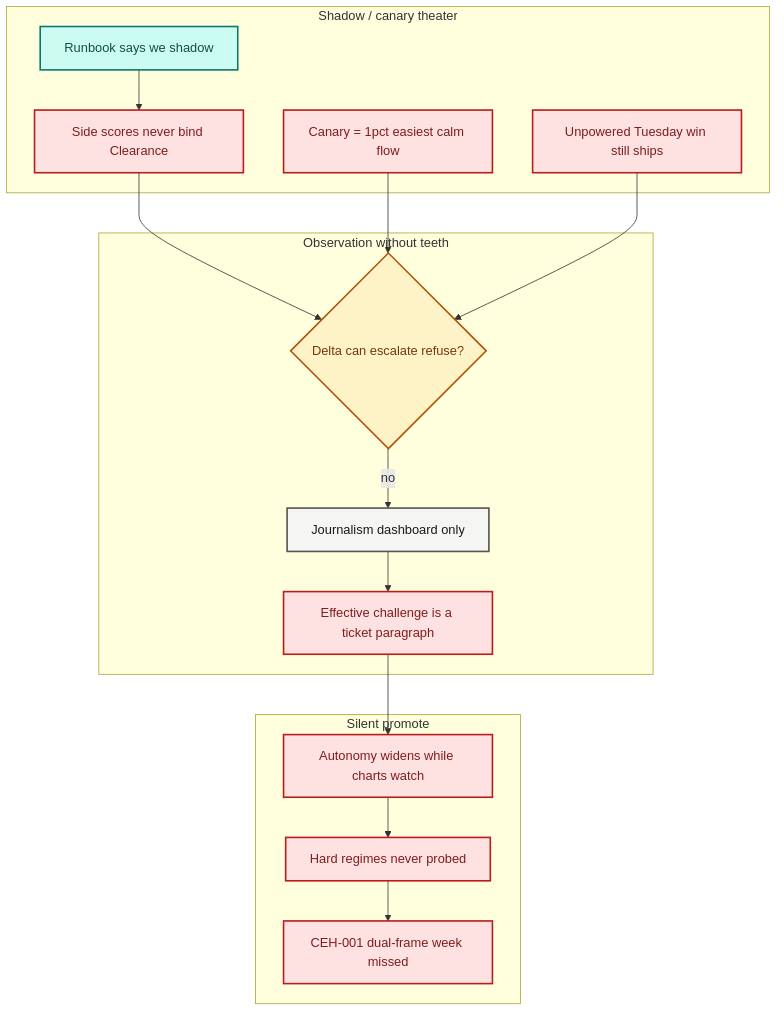
The runbook says we shadow. The dashboard says we canary. The release notes say gradual rollout. Look closer. Shadow scores never bind. Canary is one percent of the easiest flow. Promotion still happens because an unpowered eval won on Tuesday. Effective challenge is a paragraph in a ticket, not a live parallel path with teeth. That is not cautious deployment. That is theater with better verbs.
This post is about deployment geometry that never converts observation into Clearance power. Monitoring already warned that live shift and silent updates kill coverage. Eval theater already warned that point scores are not evidence. The new hole is simpler: you can watch a disagreement and still lack any machine that can refuse the ship.
What shadow owes you that a side score does not
A real shadow is a parallel judgment on live traffic that can escalate when the delta exceeds policy. A side score that nobody is allowed to block on is journalism. Journalism can be interesting. It cannot stop autonomy from widening.
A real canary is hard traffic with a regime mix, not only calm flow that flatters the new champion. One percent of quiet marks is a comfort blanket. It does not probe co-breaks, missing curves, or dual-frame weeks. Calling that a canary teaches the org that canary means small, not hard.
I care because foundation-model and vendor updates love this theater. A silent bump lands under "infrastructure." Shadow looks fine because shadow cannot fail closed. Canary looks fine because canary never saw stress. Promotion language still says we validated in production. The blotter hears we watched a polite slice and then spent.
There is also a social trap. Once executives hear shadow and canary, they experience the feeling of caution. Feelings are not gates. If the only path from disagreement to refusal is a meeting that can be postponed, you built a suggestion box around a rights change.
Why theater feels like governance
Observation is visible. Binding is expensive. Teams can show a shadow chart in a review. They cannot easily show the promote that never happened because shadow had teeth. Under delivery pressure, visible observation wins. Binding rules look like blockers. Blockers get renamed advisory. Advisory is how silent promote returns wearing a canary badge.
Unpowered eval wins complete the costume. The lab said plus two. Shadow is "watching." Canary is "live." The chain of words sounds like science. The chain of power still runs from a calm pack to a token widen with nothing in between that can say no.
How this shows up in production systems
1. Non-binding shadow. Parallel scores stream to a dashboard. Deltas exceed policy. Tickets open. Tokens still spend. Shadow was a camera, not a brake.
2. Easy-flow canary. One percent of calm CEH-001 marks. Hard weeks stay on the champion. The canary never meets the regime that would embarrass the challenger.
3. Promote-on-eval, decorate-with-ops. The real gate was an unpowered scoreboard. Shadow and canary are slide furniture added after the rights decision.
4. Silent vendor / foundation bumps. Model id looks stable. Weights or tools underneath moved. Shadow had no packet language for that change, so nothing escalated. The update inherited the old Clearance as if identity were substance.
5. Challenge as paperwork. An independent review writes concerns. There is no live parallel authority that can keep size escalate-only until the concern clears. Paperwork loses to calendar.
A CEH-001 week where shadow disagreed and the desk still shipped
Keep the never-traded family. Dual frames still live near 1.50 and 2.10. Midpoint peace near 1.80 is still deny-by-default in the written policy.
Challenger C clears a calm eval pack by two points. Interval honesty is weak. Hard pack was thin. Still, the meeting hears promote. Ops adds comfort: we will shadow for a week and canary one percent.
Live week arrives ugly. Shadow marks diverge from champion marks. Dual-frame gap reopens. Shadow edges toward a compromise number the desk already mistrusts. Canary traffic, being calm and tiny, stays quiet. Vendor embedding service also bumped on Wednesday under a shared library train. Nobody filed a change packet because the model card name did not change.
Friday: shadow red, canary green, eval slide still in the thread. Size widens anyway. Someone says we are watching it. Watching is not refusing. Effective challenge never converted into Clearance power. Silent promote completed the costume.
Read that carefully. Monitoring saw something. Eval theater supplied the courage. Deployment vocabulary supplied the alibi. The missing object was a binding path from observation to rights. Without it. CEH-001 can invent 1.80 live while the org congratulates itself for having a shadow job.
What stacks quietly assume
Many stacks assume that naming shadow and canary is almost the same as installing deployment control. They assume small calm traffic represents live risk. They assume dashboards escalate themselves. They assume vendor identity stability means behavior stability. On thin structured products, those assumptions are how autonomy expands during the exact week observation was trying to warn you.
Another quiet assumption: that inconclusive live disagreement should default to ship because rollback is available. Rollback after spend is not the same as refuse before spend. Theater loves the first. Capital prefers the second.
What I take from this as systems work
I do not trust a rollout story whose shadow cannot escalate Clearance and whose canary never touches hard regimes. In engineering language: observation must bind, canaries must include stress mix, promotion must survive live disagreement without defaulting to yes, and silent vendor bumps must travel as change packets, not as invisible inheritance of old rights.
Building reliable AI infrastructure, at least for me, is less about collecting parallel charts and more about refusing to let unpowered courage spend while the charts watch.
Curious where others still ship after shadow disagreement, what finally gave their parallel path enough teeth to stop a Friday promote, and whether vendor bumps still inherit old rights because the model card name never changed.