The problem we left open
In the last post I named a failure mode that survives every careful model-card checklist.
Two teams can "train the same model" and still disagree because the discrete approximation differs. Time grid, integrator family, and residual recipes act as silent rulers. On CEH-001, a weekly coarse loop can flatter residuals and hedge cost while a finer scheme reopens the dual-frame gap near 1.50 and 2.10. Tired rooms then invent 1.80 peace to paper over scheme conflict. Path budgets alone do not catch it. The geometry of the step was never versioned.
That creates real production headaches. Champions look comparable while measuring different worlds. Greeks minted on a coarse ladder mis-size hedges. Residual honesty flips when live replay uses a different step. Promotion has no object that can fail closed on scheme fan-out.
So the question for this post is simple. If scheme choice is measurement geometry, what does a real AI solution look like?
The solution, as one stack
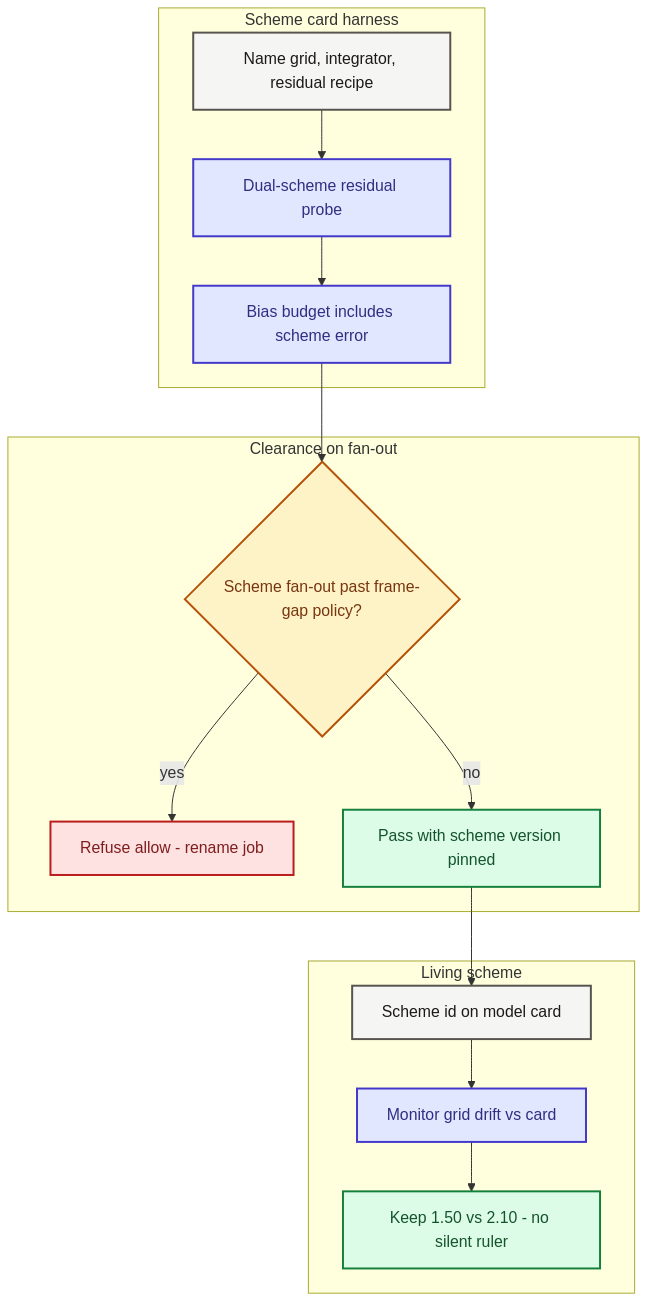
The core idea: make discretization declare itself the way a loss card declares an objective. Name the grid. Name the integrator family. Probe disagreement across schemes. Budget scheme-induced bias, not only Monte Carlo noise. Refuse promote when fan-out exceeds frame-gap policy. Keep the scheme version alive next to the model card. Five moves, one stack.
- 1.
A scheme card that seeds discretization assumptions
Before training starts, write a short card: time grid, integrator family, how residuals accumulate, how sensitivities are computed from discrete steps, and which continuous story the card claims to approximate. The trainer refuses to start without a scheme-card id. "Same model" without the same scheme card is not the same experiment. For CEH-001 the card also notes whether dual-frame marks are evaluated on the same grid the hedge loop uses.
- 2.
A dual-scheme residual probe
Do not trust one integrator's cleanliness. Run a named secondary scheme on the same seeds and cases: coarser versus finer, or simple update versus a better family. Report residual and hedge-cost fan-out as a first-class artifact. If Weekly looks saintly and Fine looks angry, that gap is information. It is not a reason to keep the prettier chart.
- 3.
A budget that includes scheme-induced bias, not only sampling noise
Monte Carlo width still matters. Add a second envelope: how much of your claimed honesty is an artifact of the step. If shrinking the grid or changing integrator family moves residuals outside the envelope you allow for desk risk, the run is over budget even when path count looks large. More paths on a biased scheme is louder bias, not more truth.
- 4.
Clearance refuses promote when scheme fan-out exceeds frame-gap policy
Promotion consumes the scheme card and the dual-scheme probe. If scheme disagreement exceeds the same spirit of gap you already refuse between 1.50 and 2.10, rights do not widen. No averaging the two scheme marks into a midpoint to "unstick" the release. Fan-out past policy is escalate-only. The blotter already knows what invented peace costs.
- 5.
A living scheme version tied to the model card
The model card names the scheme-card version the champion was trained and evaluated under. Changing grid, integrator family, or residual recipe is a change packet, not a silent library bump. Monitors that compare live replay under the declared scheme versus a shadow finer scheme can trip degrade when the living system drifts from its card. Documentation that cannot block a mismatch is decoration.
Put together: scheme card, dual-scheme probe, bias-aware budget, Clearance on fan-out, living scheme version. That is the scheme harness. Learning still happens on discrete loops. Risk permission happens only when the loop admits what ruler it used.
None of these five moves works as a footnote in a README. The card has to be able to stop a trainer. The probe has to be able to fail a build. The budget has to treat scheme tilt as spend. Clearance has to see fan-out. The living version has to match runtime. Soft versions of all five are how silent rulers return wearing better vocabulary. Path budgets still matter; they just stop being enough once two schemes mint different worlds from the same named dynamics.
The example: CEH-001 through the scheme stack
Return to Team Weekly and Team Fine. Without the stack, Weekly's clean residual chart wins the room. Dual frames soften. Someone eyes 1.80. Tiny size opens on a coarse ruler.
Now run the same week through the solution.
First, both teams must attach a scheme card before training. Weekly declares weekly steps and a simple update family. Fine declares a finer grid and a better integrator family. The cards make "same model" claims falsifiable.
Second, the dual-scheme probe runs on Weekly's candidate. Fine-scheme residuals reopen. Hedge cost rises. Fan-out is visible next to the pretty weekly chart instead of buried in a rival team's laptop.
Third, the bias-aware budget fails. Path count was fine. Scheme-induced move in residual and hedge cost was not. The run is over envelope before anyone debates courage.
Fourth, Clearance reads fan-out against frame-gap policy. Disagreement large enough to tempt a 1.80 average is exactly the disagreement that blocks promote. Humans keep marking near 1.50 and 2.10. Autonomy stays escalate-only.
Fifth, whatever eventually ships carries a living scheme version on the model card. A later library change that quietly swaps integrator behavior is a packet, not a silent improve. If live fine-scheme shadow drifts past policy, rights shrink without a hero meeting inventing peace.
End state: you still discretize. You still train. You just stop letting the step size hide inside "implementation" while capital treats the residual as nature.
The flow in one breath
Problem: continuous stories become discrete loops whose grid and integrator silently rewrite the claim. Solution: scheme cards, dual-scheme residual probes, budgets that include scheme bias, Clearance refusal on fan-out past frame-gap policy, and living scheme versions on the model card. Example: CEH-001's weekly flatter chart cannot promote when the finer probe reopens 1.50 versus 2.10 and tempts 1.80 theater.
Curious how others version discretization without turning every trainer into a numerical-analysis seminar, and where they still see "identical" models disagree only because their schemes did.