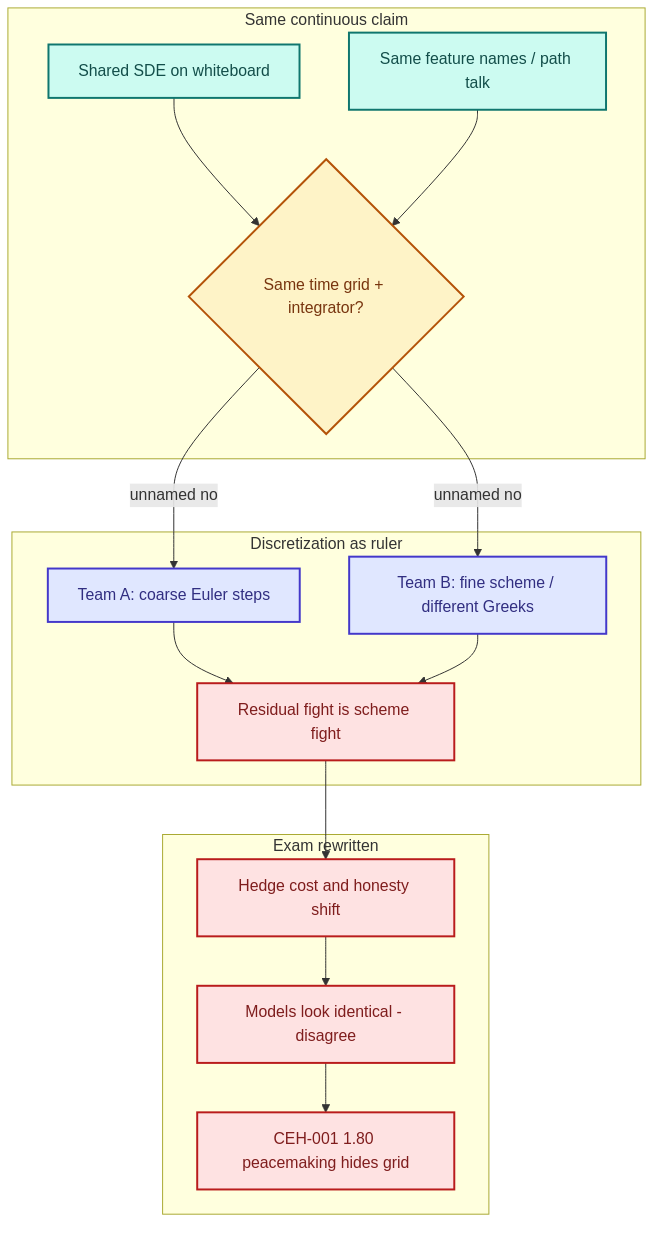
I keep watching two teams swear they trained the same dynamics model and still fight about residuals like they live on different planets.
Same SDE story on the whiteboard. Same feature names. Same "path" language in the design doc. Different time grids. Different integrators. Different recipes for how Greeks and hedge errors get computed from discrete steps. Then the meeting argues about which model is honest, when the real disagreement was never the network. It was the silent ruler that turned continuous finance into a training loop.
This post is about discretization as measurement geometry. Path budgets already taught us that how many worlds you run is part of the claim. Scheme choice is the cousin people skip: the grid and the integrator decide which approximate world you even trained against.
What continuous stories become when code has to step
Continuous finance loves paths, hedges, and differential equations that look clean on a slide. Production systems do not train on continuum. They train on a sequence of updates. The step size, the update rule, and the way you accumulate residual error are not implementation trivia. They are part of the measurement. Change them and you changed the exam, even if the model class kept its name.
There is an old spirit here that I keep returning to. When people argue about randomness without naming how they measured it, they can all be locally careful and still disagree. Discretization is that spirit inside time. One team steps coarsely with a simple update. Another steps finer with a better family of integrators. Both report "the same" hedge residual. Both believe the number. The numbers are answers to different questions.
I care because promotion language usually freezes the model card and forgets the scheme. The card says architecture, loss, data cut. It does not say weekly steps versus hourly, or which integrator family minted the training targets. Then two champions look comparable on paper. Live, one was taught a coarser lie about how paths move.
There is also a Greek trap. Discrete finite differences on a coarse grid invent sensitivities that a finer scheme would not recognize. Teams then hedge against a ghost derivative, score themselves on that ghost, and call the result risk reduction. The blotter keeps the receipt.
Why scheme disagreement feels like model disagreement
Humans read a residual chart and assign blame to weights. That is natural. Weights are the named object. Schemes are infrastructure. When Team A and Team B disagree by more than Monte Carlo noise, the first instinct is to retune the network. Sometimes the network is fine and the grids are cousins, not twins. Retuning then teaches the model to match a ruler the desk never agreed was the desk's ruler.
Coarse schemes can also manufacture midpoint peace. A weekly step can smear a dual-frame gap into something that looks settled. Finer steps reopen the gap. People then accuse the fine scheme of being noisy, when it was only refusing to average away a disagreement the business already knows is real.
How this shows up in production systems
1. Same-model theater. Two groups claim identical training. One uses a coarse Euler-style loop. The other uses a finer integrator family. Residual tables disagree. The postmortem debates hyperparameters for a week before anyone diffs the time grid.
2. Greek cosplay from the step. Sensitivities computed on a weekly ladder look smooth. Intraday replay shows jagged truth. Hedges sized on the smooth object look cheap in training and expensive live.
3. Residual honesty that flips with the grid. A candidate looks martingale-clean under coarse steps and dirty under fine ones. Promotion used the clean chart. Live used the world.
4. Silent midpoint from scheme conflict. When two schemes disagree, tired teams average the marks. The average is not a third measurement. It is a social peace number wearing a decimal.
A CEH-001 week where the scheme was the argument
Keep the never-traded structure. Spread-frame work still lives near 1.50. Curve-frame work still lives near 2.10. The desk still denies invented peace near 1.80.
Team Weekly trains a hedge model with a coarse weekly update and simple residual accounting. On their chart, dual-frame tension softens. Hedge cost looks modest. Residual series looks almost honest. They want tiny auto size.
Team Fine uses a finer time grid and a better scheme family on the same named dynamics. Same loss card language. Same feature kitchen. Their residuals reopen. Hedge cost rises. Dual-frame gap stays visible near 1.50 and 2.10 instead of collapsing into a polite middle. On a hard week with co-breaks, Team Weekly's "honest" residual blows out toward the Fine chart, and someone suggests splitting the difference at 1.80 so the release can move.
If you promote Weekly because its training loop looked cleaner, you did not pick a better model. You picked a coarser ruler that flattered peace. The scheme disagreement was the signal. Averaging it into 1.80 is how discretization failure becomes governance failure.
Notice what the model card never forced into the room. It never asked whether weekly Euler-style updates and the finer scheme were even the same experiment. Path count might have matched. The geometry of time did not. That is the new idea relative to path budgets: more paths on a wrong grid is still a wrong measurement, only louder.
What stacks quietly assume
Many stacks assume the continuous story on the whiteboard transfers to code without becoming part of the claim. They assume integrator choice is an implementation detail. They assume Greeks computed from discrete steps are the same object the desk hedges. They assume two "identical" trainings that differ only in grid are comparable champions. On structured products with dual frames, those assumptions are wishes.
Another quiet assumption: that Monte Carlo noise is the only budget that matters. Scheme-induced bias is not noise. It is a systematic tilt of the world you optimized against. Budgets that only talk about sample size miss the ruler that minted the samples.
What I take from this as systems work
I do not trust a dynamics or hedge claim that cannot name its time grid, integrator family, and residual recipe as first-class objects. In engineering language: treat scheme choice as measurement geometry for dynamics, probe fan-out across schemes the way you probe near-winner crowds, and refuse promotion stories that average scheme conflict into midpoint peace.
Building reliable AI infrastructure, at least for me, is less about prettier continuous narratives and more about refusing silent rulers inside the training loop.
Curious where others still treat discretization as plumbing, and what broke first when two "identical" models disagreed only because their schemes did.