The problem we left open
In the last post I named a failure mode that survives every careful single-name gate.
You can promote CEH-001 on its own exam, promote its cousins the same way, and still wake up to correlated mark error across the book. Independently trained models can share objectives, features, regimes, and eval criteria. Separate repos then look like diversification while the joint week behaves like one bet. Single-instrument greens miss portfolio risk. Evaluative compression at book scale makes many champions rhyme.
That creates real production headaches. Joint stress never blocks a release. Shared liquidity cues stay invisible until they die together. Book budgets stay soft while per-name limits look strict. Red monitors on cousins become three local tickets instead of one retirement decision. Challengers swap one name and leave the family story untouched.
So the question for this post is simple. If single-name courage is the failure mode, what does a real book-level solution look like?
The solution, as one stack
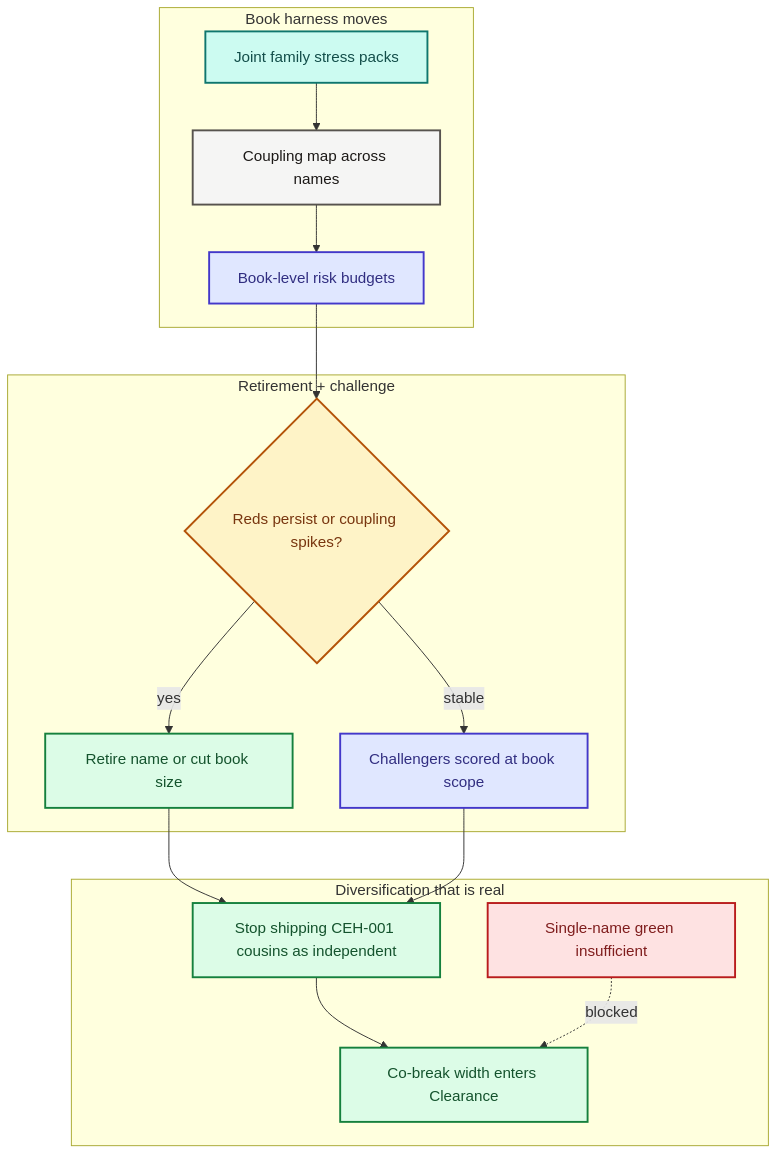
The core idea is older than model registries: concentration risk is a first-class object. In engineering language: treat the structure family as one coupled system, prove joint behavior under stress, budget the book, and retire what keeps failing together. I turn that into five moves. Together they are one solution, not five optional dashboards.
- 1.
Book-level joint stress packs across the structure family
Stop asking only whether CEH-001 survives one dial. Build named joint packs that move funding, spreads, quote intensity, and related cousins as a bundle. The pack is a release artifact. If the family co-breaks outside the allowed book envelope, the build fails even when every marginal scorecard stayed pretty.
- 2.
A shared-driver / shared-objective coupling map
Write down what the champions share on purpose: features, loss cards, regime years, eval packs, vendor tools. The map is not a wiki decoration. It is an input to gates. High coupling raises the bar for joint stress and lowers patience for synchronized red monitors. Low coupling has to be earned by evidence, not by folder structure.
- 3.
Book budget gates beside per-name gates
Per-name limits still matter. They are not enough. Hold explicit book budgets for co-move error, family frame gap, and concentrated cue exposure. A row of single-name greens that violates the book budget does not ship. Autonomy is a portfolio lease, not a pile of individual trophies.
- 4.
Retirement and sunsetting rules when monitors stay red or coupling spikes
If family monitors stay red past a named window, or the coupling map spikes because a shared driver took over live behavior, sunset by rule. Shrink size, revoke tokens, freeze retrains on the poisoned cue, or retire the champion set for that family. Patch theater that only refreshes one cousin is how correlated failure becomes institutional habit.
- 5.
Challenger at book scope
A challenger that replaces CEH-001 alone can still share the family's blind spot. Book-scope challenge means alternate objectives, alternate driver sets, or an intentionally de-coupled recipe evaluated on the same joint packs and book budgets. Champion status is family-relative under stress, not a single-name beauty contest.
Put together: joint stress packs, coupling map, book budgets, retirement rules, book-scope challenger. That is the book harness. Learning still happens name by name. Risk permission happens at the scale where dependence actually bites.
None of these five moves works as a slide. The joint pack has to be able to fail a build. The coupling map has to change gate thresholds. The book budget has to block promotion. Retirement has to fire without a hero meeting. The challenger has to sit the family exam. Soft versions of all five are how correlated failure returns wearing better vocabulary.
The example: CEH-001 week walked through the stack
Return to the never-traded family. Without the stack. CEH-001 and two cousins each clear calm single-name packs. Dual frames still whisper 1.50 versus 2.10. People get tired and eye 1.80. Shared liquidity cues stay unnamed. Co-break week arrives. Errors rhyme. The desk discovers concentration after the blotter does.
Now run the same week through the solution.
First, joint stress packs are frozen before promotion. The pack moves quote intensity, funding, and spread stress across CEH-001 and cousins together. A candidate that looks heroic on CEH-001 alone but co-breaks the family envelope never gets a lease.
Second, the coupling map shows the shared liquidity cue and the shared loss shape that rewards peace midpoints. That map raises the joint bar. Nobody gets to call three champions "diversified" while they drink one cue.
Third, book budget gates sit beside per-name gates. Even if each cousin's marginal frame gap looks manageable, the family co-move error and concentrated cue exposure must clear the book envelope. A pretty row that blows the envelope fails closed.
Fourth, when live monitors stay red across the family, or coupling spikes because the shared cue dominates, retirement rules fire. Size cuts. Tokens revoke. The peaceful 1.80 average is denied as a promotion story. Humans keep dual frames visible near 1.50 and 2.10 while the coupled set sunsets.
Fifth, a book-scope challenger is required before the family returns to autonomy: different driver set, different objective card, same joint packs. If it cannot beat the coupled failure mode on the family exam, the old chorus does not get a sequel.
End state: you still mark names. You still train locally. You just stop mistaking a choir of single-name greens for independent book risk.
How this sits with the neighboring harnesses
This completes a dull but necessary triangle. An eval harness that freezes packs and refuses unpowered score theater keeps one name honest. A pipeline harness that binds data expectations, training contracts, serving rights, and living cards keeps one path from demo culture. The book harness asks the joint question those two still leave open: what happens when many honest-looking names fail together? Without it, careful single-name machinery can still concentrate risk. With it, promotion, monitoring, and retirement speak the same language the blotter already speaks: the book.
The flow in one breath
Problem: separate greens can still be one coupled bet. Solution: joint family stress, a coupling map, book budgets, retirement when reds persist or coupling spikes, and challengers at book scope. Example: CEH-001 and cousins stop shipping as a diversified story until the co-break pack and the book envelope say they earned it.
That is the systems work I care about once single-name gates start looking too clean. Curious how others fail a release on book co-break even when every name still looks green alone.