The problem we left open
In the last post I used quiet failure in time to name a failure mode that promotion ceremonies cannot see.
Certificates expire. Market, data, and model clocks desynchronize. Coverage slips without exceptions. Hosted models update under you. On CEH-001, yellow dashboards and fluent agents reopen the 1.80 temptation while tiny size is still on. Monitoring that cannot turn autonomy off is journalism.
That creates three real headaches in production:
- The illusion of a living certificate: promotion day treated as a permanent blessing.
- Ghost candidates: behavior changes while registry hashes stay still.
- Meeting-shaped kill switches: yellow becomes red P&L because revoke required consensus.
So the question for this post is simple. If that is the failure mode, what does a real AI solution look like?
The solution, as one stack
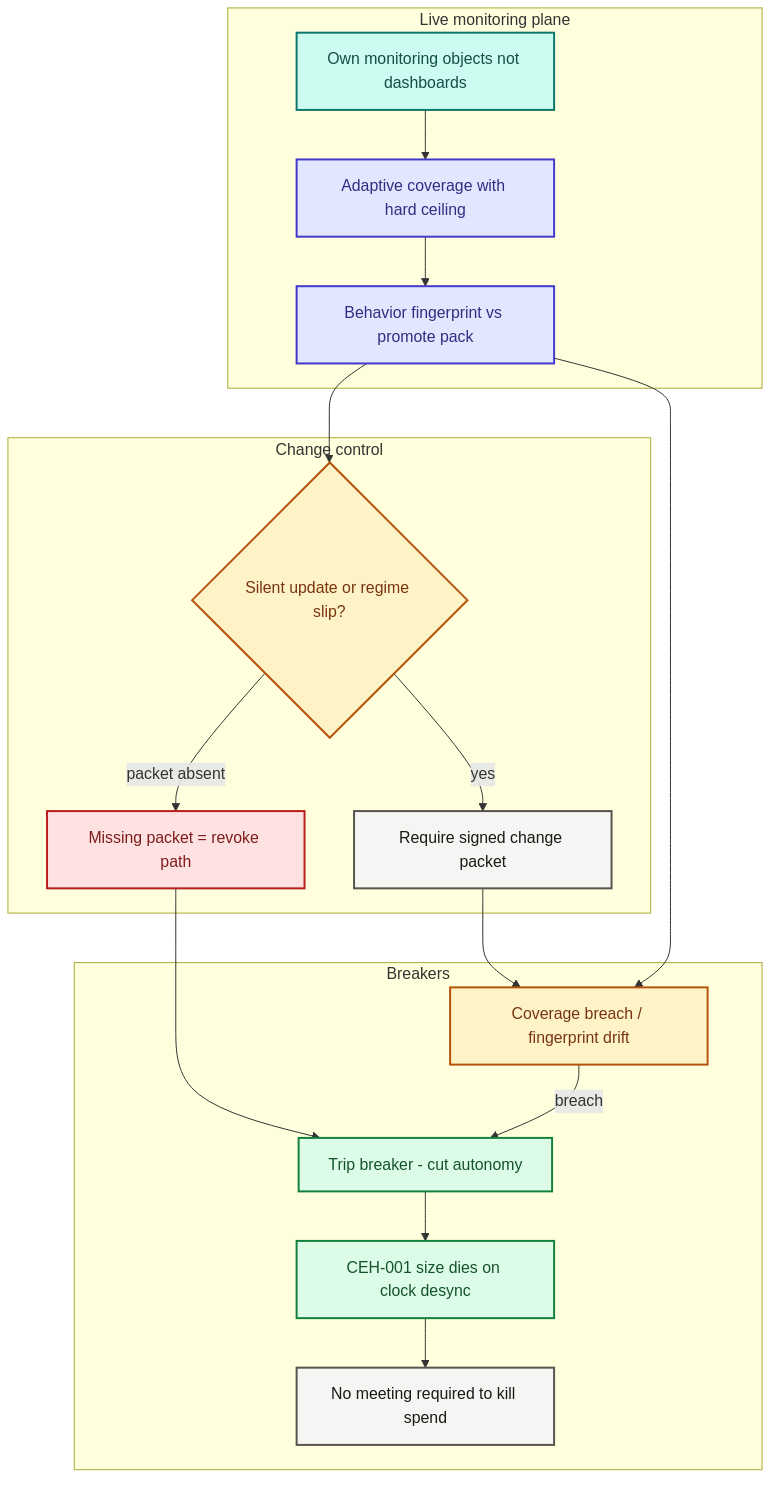
The core idea: make expiry physical. Define what you monitor, adapt coverage with a ceiling, probe behavior, require change packets, and degrade tokens automatically. Five moves, one stack.
I want monitoring to feel slightly annoying in peacetime. If it only feels urgent after P&L pain, it was never a control plane. It was a museum of charts.
1. Make monitoring objects first-class
For CEH-001 track realized coverage versus target, live crowd-width proxies, shortcut cue health, residual edge probes on hedges, tool-error rates, and provider model fingerprint diffs. Dashboards are not enough. Each object has a threshold, an owner, and a linked action. Unowned monitors rot. Owned monitors page people.
Publish the object map next to the architecture diagram. If a monitor can only open a ticket and cannot touch tokens, it is a newsletter.
2. Adaptive coverage with a kill switch
When misses cluster, widen bands or raise escalate rates automatically. You need long-run honesty under shift, plus a hard stop if widening exceeds desk tolerance. Widening forever is not control. It is surrender wearing math. If live crowd proxies explode, escalate even when coverage still limps along.
3. Behavior and provider fingerprint probes
For hosted models, pin versions when possible. When not, hash behavioral fingerprints on a frozen probe pack daily. If fingerprints move beyond tolerance, treat as a new candidate: no spend until replay passes. Include tool-argument fingerprints. A model that suddenly prefers different tools is a different system even if text tone looks similar.
4. Change packets before behavior changes ship
Any change to loss card, information contract, features, prompt bundle, tool gateway, measure card, or model provider needs a packet: reason, replay diff, residual risk, approver. No packet, no production. Detected changes without packets are incidents. Do not wait for P&L to teach the lesson. This is the frozen-exam idea living in time.
5. Token degrade rules that do not need a meeting
If coverage breaker red, revoke auto allows and return to escalate-only. If provider fingerprint drifts, revoke. If cue-health collapses, revoke. If a change is detected without a packet, revoke. Size step-downs can come before full revoke when policy allows. Pre-agree the kill switch. Test it with drills.
Put together: monitoring objects, adaptive coverage with a ceiling, fingerprints, change packets, automatic degrade. Autonomy becomes a lease, not a trophy.
The example: CEH-001 over three weeks
Week 1: tiny allow under green monitors. Dual frames managed. No midpoint. Week 3: coverage slips on the UL family. Bands widen once, size cuts. Still red: tokens revoked, escalate-only. Same week a vendor chat model fingerprint shifts. Packet required. Replay fails. Stay dark. Human path continues with dual frames. 1.80 still denied.
End state: the live system did not need a heroic incident review to rediscover caution. The lease expired on schedule. That is what I want from monitoring. Not prettier charts. Earlier dullness.
Drill the revoke path the way you drill incident response. A kill switch nobody has fired in six months is a rumor. Fire it on purpose in a canary lane. Prove tokens die. Prove humans can still mark dual frames without the peace number.
The flow in one breath
Problem: certificates expire quietly. Solution: own monitoring objects, adapt coverage with a ceiling, fingerprint behavior, require change packets, revoke without meetings. Example: CEH-001 size dies when clocks desync instead of waiting for blotter pain.
Change packets deserve a little more teeth than documentation culture usually gives them. A packet is not a wiki page. It is a gate. No packet means no production path, including hotfixes that somehow never count. Hotfixes are where silent updates love to hide. If a provider model changed under you, that is a packet even when your repo did not move.
On CEH-001 I want the packet to show dual-frame replay, not only mean error. If the update preserved averages but widened the live gap toward something uglier, or suddenly made midpoint talk more fluent, that is residual risk. Write it down. Then decide whether tiny size still deserves a lease.
The lease metaphor is doing real work. Leases expire. Trophies decorate. Autonomy that cannot expire becomes decoration with a blotter attached.
One more practical detail: keep the breaker set small enough that people trust it. Twenty yellow lights train everyone to ignore yellow. Five owned breakers that can actually revoke tokens beat a museum of ignored alerts.
That small set has to stay boring and enforceable. Boring is how autonomy stays a lease instead of a trophy ceremony.
Curious how others revoke autonomy without a meeting, and how small they keep the breaker set so it stays trusted.