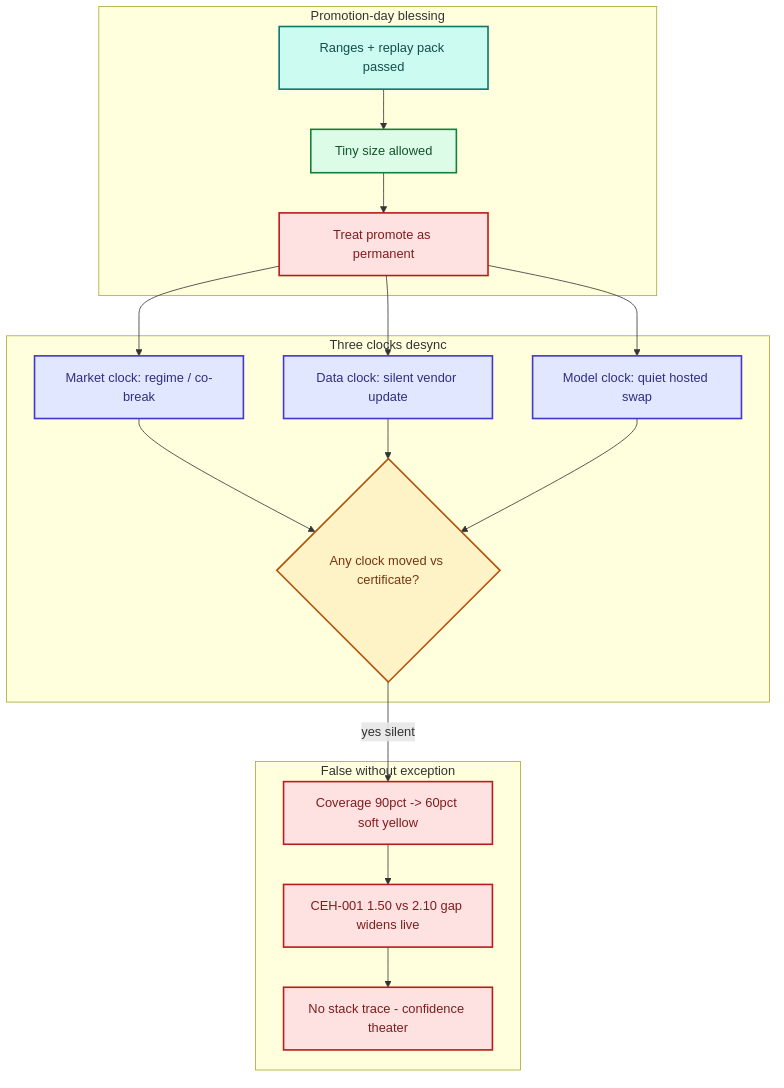
I keep watching models go false without throwing an exception, because promotion day was treated like a permanent blessing.
Everyone treats promotion day like the end of model risk. The ranges looked honest. The replay pack passed. Tiny size was allowed. Then weeks later the model is false without throwing an exception. No stack trace. No red build. Just a quiet mismatch between the world the certificate assumed and the world that arrived.
Distribution shift is the polite name. Under the hood the joint law of features and outcomes moved. Exchangeability assumptions that made coverage stickers honest stopped holding. A range that was ninety percent last quarter can be sixty percent this month while dashboards stay politely yellow.
I care about this because frozen exams and multi-gate releases are necessary and still insufficient. They answer Friday negotiation. They do not answer Tuesday quiet decay.
Quiet decay is worse than loud failure because loud failure creates tickets. Quiet decay creates confidence. People point at last month's promotion pack while this week's coverage is already soft and this week's hosted model is already a stranger.
Three clocks that desynchronize
1. Market clock. Regimes change. Co-break weeks arrive. Shortcut cues die. Crowds widen. Measure stories drift relative to live P. Path budgets trip more often. None of that waits for your quarterly revalidation meeting.
2. Data clock. Vendors revise histories. Feature pipelines improve. A silent join change reintroduces illegal conditioning. Parity greens go stale. Loss cards still look approved while the population underneath mutated.
3. Model clock. Hosted LLMs and vendor scores update under you. The artifact hash in your registry did not change because you never owned the weights. Behavior changed anyway. Frozen exams assumed a stable candidate. The candidate walked.
When those clocks drift at different speeds, dashboards can look coherent while the decision object is already a different animal. That is how autonomy stays on after truth left.
How this shows up when people still trust the certificate
Coverage monitors nobody watches. Drift dashboards without kill switches. Canary traffic that cannot disable tokens. Agents that keep spending on a prompt template while the underlying chat model shifted tone, tool choice, and swagger. Teams say we will revalidate next quarter while size stays on.
There is also claim-power decay. Rare-event slogans need sample honesty. We never saw a fail on thirty quiet days is not a tail certificate. Live monitoring must track whether your safety claims still have statistical teeth, not only whether mean error moved a little.
A CEH-001 week that looks ordinary until it does not
Day 0: CEH-001 ranges hit coverage target. Tiny size allowed. Dual frames still disagree near 1.50 and 2.10, managed without a midpoint. Day 30: regime shift. Realized coverage slips. Dashboard yellow. Day 31: vendor model silent update. Tool arguments change. Day 32: under fluent agent prose, the 1.80 temptation returns because the live system feels less coherent than the promotion story. Root: no breaker tied to tokens. Promotion treated as permanent blessing.
Read that carefully. Nobody necessarily disabled the frozen exam. Time disabled the assumptions the exam depended on. That is a different failure mode from Friday negotiation. It needs a different kind of teeth.
Why promotion-day thinking fails
Promotion is a snapshot. Risk is a process. Modern model-risk practice increasingly treats development, validation, monitoring, and retirement as one chain. If your architecture only has a gate at day zero, you built a ceremony, not a control plane in time.
Silent foundation-model updates are especially rude because they break the mental model of a fixed artifact. Behavior fingerprinting has to become part of monitoring, or your gate will notarize a ghost.
On CEH-001 the ghost shows up as fluent midpoint talk. The dual-frame gap is still there in the artifacts. The agent prose starts sounding like the gap is socially inconvenient. That tone shift is often the first fingerprint that something upstream moved.
What I take from this as systems work
I do not trust autonomy that cannot expire. In engineering language: define live monitoring objects with owners and actions, adapt coverage or widen bands when misses cluster, fingerprint behavior and providers, require change packets for anything that can change decisions, and revoke or shrink tokens without waiting for a meeting.
Curious which clock burned others first: market, data, or a silent foundation-model update.
I also watch for false comfort from mean metrics. Average mark error can stay flat while coverage collapses in the tails that matter for size. Averages are how quiet decay hides inside green. If your live monitors only watch means, you built a compliment machine.
Connect that to powered claims. Thirty quiet days without a breaker trip is not a certificate that the next co-break week is safe. Sample honesty belongs in monitoring the same way coverage does. Otherwise rare-event slogans become part of the theater promotion day left behind.
The practical systems question is simple and rude: what automatically reduces size when any of the three clocks desync? If the answer is we meet, you do not have a control plane in time. You have a calendar.
So the systems habit I want is lease thinking from day one. Promotion grants a lease with monitors attached. It does not grant a permanent blessing. If that feels too cautious for the demo calendar, the demo calendar is the risk.
If you only instrument one clock, instrument the one you do not own. Hosted model updates are the ones that invalidate your mental model of a fixed artifact while leaving your registry hash looking virtuous.