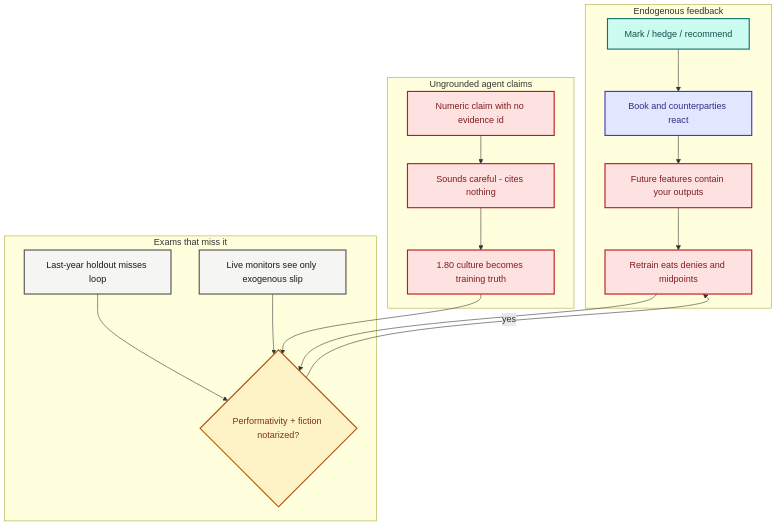
I keep seeing two failures finish each other: predictions that change the data you retrain on, and agent claims that were never tied to evidence.
They watch market shift. They catch silent vendor updates. They can revoke tokens. Good. Then the system still poisons itself from the inside. Predictions change the world the next model trains on. Agents make numeric claims that cite nothing while sounding careful. Classic ML stories pretend the world is a fixed exam. Deployed financial AI often helps write the next exam.
That endogenous loop is performativity. Alongside it sits ungrounded claim risk. If you leave either unaddressed, the rest of a careful stack can be perfect on paper and still teach itself theater.
Feedback loops under the hood
You mark, hedge, or recommend. The book moves. Counterparties react. Future features shift because of you. Retraining on that trail can amplify error, entrench a shortcut, or create a self-confirming midpoint culture around 1.80 because the desk kept averaging and the data now contains those averages as truth.
Holdout from last year does not see this loop. Live monitors catch exogenous slip. Feedback is endogenous slip. Continuous training without anti-feedback rules becomes a machine for eating your own outputs.
A practical tell: labels that originated as denies, panic midpoints, or unverified agent marks quietly re-enter training as market. The system teaches itself theater and then cites the theater as evidence. At that point the loss card is optimizing the wrong world, the near-winner crowd is a crowd of self-echoes, and ranges wrap fiction.
Another tell: action-conditioned features. Inventory, quote pressure, and spreads move because your hedges ran. Tomorrow's model treats those moves as weather. They were partly climate you created. Without action tags, offline eval lies.
I have watched teams celebrate continuous learning as modernity while the learning set slowly filled with their own denied midpoints. The model got more confident about theater. That is not adaptation. That is inbreeding.
Ungrounded claims under the hood
An agent says the curve implies 2.10. Which curve version, which as-of, which tool receipt. An agent says research supports 1.50. Which document id, which paragraph hash. Without verification at write time, audit logs store theater that cannot be replayed into evidence.
Numeric claims are the sharpest risk. A wrong 18.4 looks like a right 18.4 in a log. Grounding must pass or fail per claim, not per paragraph vibe. System-level validation work keeps repeating the same point: benchmarks are not validation when retrieval, tools, and provenance are the real failure surface.
Ungrounded claims also poison feedback. A fictional number that becomes a blotter print becomes a training label. Fiction hardens into distribution. That is how this failure couples to every earlier headache: bad evidence becomes bad data becomes bad models becomes bad autonomy.
The scary version is not a dramatic blow-up. It is a slow cultural shift where 1.80 stops feeling like politics and starts feeling like market. People forget the midpoint was born as a meeting compromise. The dataset remembers.
How both failures cooperate on CEH-001
An ungrounded agent proposes 1.80 peace. A human launders it under time pressure. Blotter prints become training labels. The next model learns midpoint as market. The feedback loop hardens theater into data. Rights tokens cannot finish this alone. A tokenized act grounded in fiction still writes fiction into tomorrow's training set. Monitoring may see drift without naming that the drift is self-inflicted.
Why teams miss this
Feedback is slow. The incident is rarely same-day. Ungrounded claims look like productivity. Benchmarks glow. Continuous training feels modern. Each incentive points away from the boring controls: anti-feedback eval packs, claim verification, independent challenge, and refusal to retrain on your own unverified outputs.
Agent stacks amplify this because prose is cheap and receipts are expensive. A team under delivery pressure will accept a careful-sounding paragraph. Careful-sounding is not grounded. Grounded means a verifier can fail the claim before the blotter sees it.
What I take from this as systems work
I do not trust continuous learning loops that cannot tell self-printed labels from market, and I do not trust agent prose that cannot point at receipts. In engineering language: quarantine unverified outputs from production training, keep delayed or counterfactual eval packs, verify numeric claims at write time, and keep an independent challenger who does not share the builder's incentives.
Action tags are the unglamorous fix for one half of this. If inventory and quote pressure moved because your hedges ran, tomorrow's features should know that. Otherwise offline evaluation will keep congratulating models for predicting weather they helped create.
Claim verification is the unglamorous fix for the other half. I do not need the agent to sound less fluent. I need each numeric claim to die without a receipt. Fluency without receipts is how 1.80 gets laundered into the blotter and then into the next training set.
Put those together and you see why endogenous risk is not a niche research topic. It is how a careful stack can slowly replace market with self-echo and still look modern while it does it.
If you only remember one diagnostic, remember this: when the desk starts treating 1.80 as market rather than politics, ask where that number entered the data. If the answer is our own prints, you are already inside the loop.
Catch that early and you still have a systems problem. Catch it late and you have a culture that defends theater with charts.
Curious whether feedback contamination or ungrounded numeric claims bit others first in agent-heavy stacks.