The problem we left open
In the last post I used measure confusion to name a failure mode that turns hedge studios into drift casinos.
Train under the physical world without removing tradable drift and the optimizer often farms simulator edge. Incomplete markets then kill uniqueness even after frames are locked. On CEH-001, a P-trained policy can make 1.80 look hedgeable in a friendly sim, laundering a peace number that was never honest.
That creates three real headaches in production:
- The illusion of hedge quality: demo PnL that is partly a drift bet.
- The arbitrage trap: policies that look like risk management while encoding statistical gambles.
- Uniqueness theater: a single AI price demanded from an incomplete book.
So the question for this post is simple. If that is the failure mode, what does a real AI solution look like?
The solution, as one stack
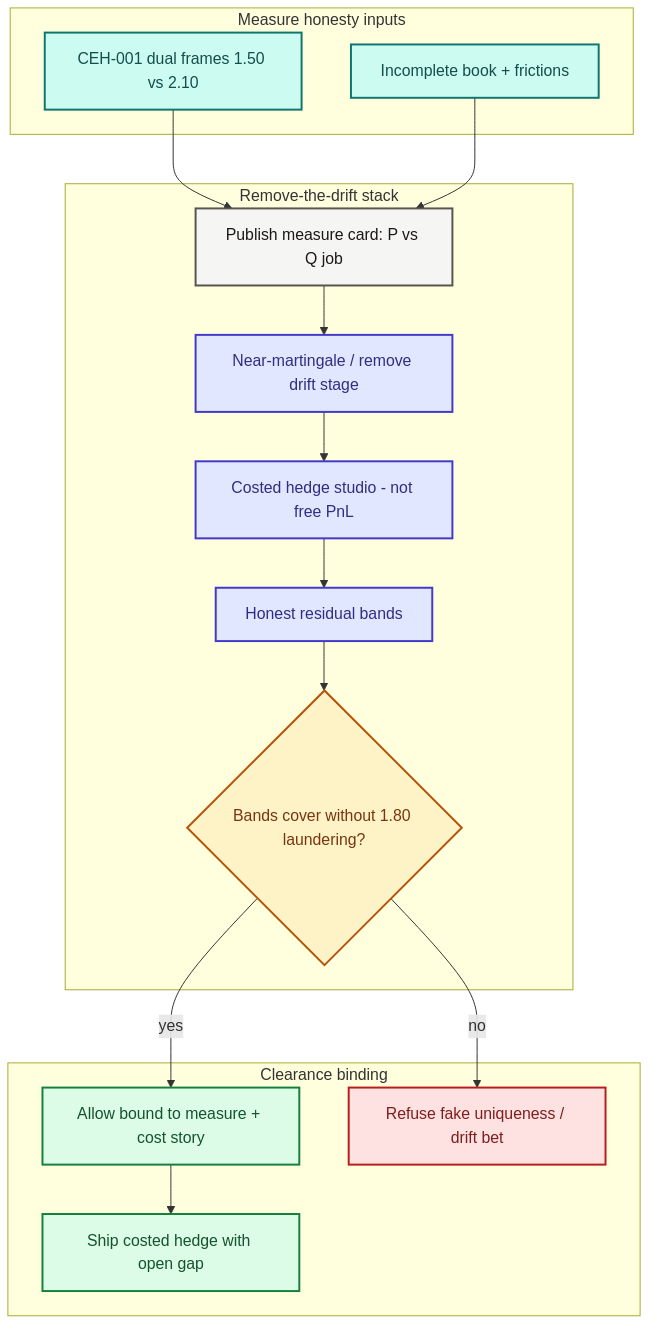
The core idea: separate remove-the-drift from learn-the-hedge, then keep incompleteness honest with bands and costs. Five moves, one stack.
If your team only has appetite for one hard stage, make it remove-drift before capital hedge training. Everything else in this stack gets easier once that casino door is closed.
1. Write a measure card before capital hedge training
Name the physical simulator sources, the target hedging-clean story, which instruments are treated as tradable, which frictions are on, and whether uniqueness is claimed or refused. If the card is missing, hedge autonomy cannot start. Research toys can play. They cannot mint allow tokens for size.
I want the uniqueness claim written as a boolean humans own. If someone writes unique because the network converged, that is not a measure card. That is wishful naming.
2. Put an explicit remove-drift stage first
Before optimizing hedge actions for capital use, project or reweight paths so tradable gains are near fair after costs in the sense your card declared. Call it remove-the-drift, near-martingale, or entropy projection. The name matters less than the stage existing as a separate, testable artifact. Skipping it is how drift hunting wears a Greek.
Publish the before/after residual probes on tradable directions. If they barely move, you probably did not remove much. If they move a lot, your old demo PnL was partly a bet. Both outcomes are useful. Hiding them is not.
3. Train the hedge with costs on and residuals watched
After the measure stage, train the policy under the cleaned story with transaction costs, liquidity penalties, and inventory terms live. Publish residual edge probes. If leftover predictable edge remains on tradable directions, you did not finish remove-drift, or the policy reintroduced a bet.
4. Publish bands when the market is incomplete
If several hedging-clean measures remain plausible, do not ship a unique CEH-001 point. Ship a band, or ship dual-frame bands plus measure sensitivity. 1.50 versus 2.10 can stay as managed disagreement. A forced 1.80 is still theater even if a network can trade around it in a friendly sim.
5. Bind allow scope to the measure story
Hedge allow tokens carry measure card hash, remove-drift artifact id, cost model id, and the world pack used in validation. Change the measure story, re-enter promotion. That is how you stop a drift-farming policy from inheriting a hedge token.
Put together: measure card, remove-drift stage, costed hedge with residual probes, incomplete-market bands, story-bound allows. Deep hedging still happens. It just cannot pretend a drift bet is insurance.
The example: CEH-001 hedge without the casino
Without the stack, a friendly simulator leaves mild drift, a policy farms it, promotion glows, and someone uses hedgeability to bless 1.80.
Now run the same case through the solution.
First the measure card refuses uniqueness theater for this incomplete family and names tradable instruments and costs.
Second, remove-drift produces a cleaned path pack. Policies that only looked good by harvesting the old drift lose their demo magic immediately.
Third, costed hedge training on the cleaned pack shows wider residuals and honest path budget breaches. That pain is information, not a reason to restore the casino.
Fourth, bands stay dual: spread-side and curve-side ranges, plus measure sensitivity. No peace point.
Fifth, allow tokens bind to that story. A new simulator with leftover drift is a new card, not a hot fix. End state: you still hedge with learning. You stop calling drift PnL hedge quality.
A desk habit that helps: never present hedge demo PnL without the measure card id on the same slide. If the id is missing, treat the number as entertainment.
The flow in one breath
Problem: hedges under P often gamble on drift, and incomplete markets kill uniqueness. Solution: card the measure, remove drift, cost the hedge, publish bands, bind allows to the story. Example: 1.80 loses its fake hedgeability passport.
The stack also changes what good looks like in promotion meetings. Good is no longer the largest demo PnL. Good is residual honesty after remove-drift, costs on, and bands that refuse uniqueness theater. That will make some champions look worse on slides. Those champions were often casinos. I would rather promote a duller hedge that still works when drift flips.
For CEH-001 specifically, this means hedge autonomy cannot be used as a passport for 1.80. If the peace number only looks hedgeable before remove-drift, it was never hedgeable in the sense risk management needs. It was a bet with good lighting.
Curious how others keep remove-drift as a hard stage instead of a paragraph in a model doc nobody reads.