Say you win five trades in a row. Are you good, or were you lucky? Say you lose five in a row. Is your strategy broken, or is that just what a good strategy looks like on a bad week? Almost nobody can answer these questions from the trades alone. You need the mathematics underneath them. That mathematics is what this series teaches, one honest step at a time: probability and expected value first, then how much to bet and when to stop, then how to tell whether a trading signal is real, and finally how all of it runs together as a working, automated system.
Nothing here is hypothetical. Every idea in this series is something a live trading desk actually has to decide, in plain terms, before it risks a single rupee.
Figure 1. Two surfaces, one spine. The blog teaches the picture. The book keeps the full algebra.
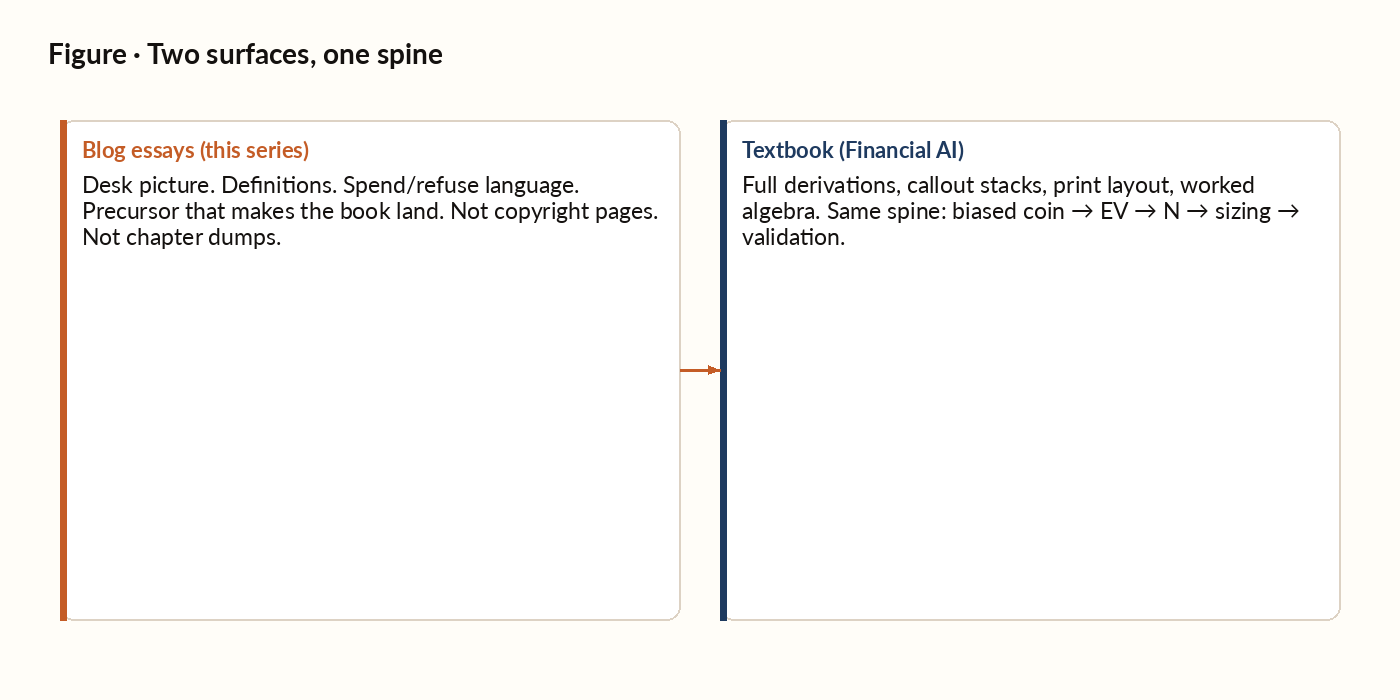
This series is the public teaching layer for Financial AI, the companion textbook. The blog is deliberately not a paste of the book's PDF: no dense proofs, no wall of formulas. What you get here is: one concrete question per episode, plain definitions before any jargon, just enough math to actually change a decision, diagrams that build on each other, and a short list of what to remember before you'd trust any of this running on autopilot.
Blog versus book
| This blog | The textbook | |
|---|---|---|
| Job | Make the idea usable and memorable | Make the idea derivable and complete |
| Depth | Rich explanation; diagrams; desk trenches | Full callouts, proofs, print layout |
| Math | Formulas that earn a size / refuse decision | All of it |
| Case | The biased-coin desk (continuous across Part I) | Same ideas plus formal objects |
If you only read the blog, you should still leave able to explain why one winning trade proves nothing, write expected value in R-units, and say when capital must refuse. If you need the derivation for a sample-size formula or Kelly algebra, open the matching chapter.
One running example: the biased-coin desk
Instead of switching case studies every episode, Financial AI leans on one simple, honest picture: a trading desk that only has to answer questions about a biased coin. A sleeve claims it has edge. A backtest looks green. A recent winner feels like proof it works. A recent loser feels like proof it's broken. Episode by episode, this series names the actual rulers that decide whether that sleeve is allowed to keep risking capital.
Part I (Ep01 through Ep06) builds the single-trade spine: the coin, probability, expected value, the law of large numbers, square-root uncertainty, and ruin. Everything that comes later (signals, combining them, validating them, machine learning, and the fully automated closed loop) attaches to that spine. It does not replace it.
Where this eventually goes
By the end of the series, the same ideas from Part I scale all the way up to a real, running system: how to tell when a trading signal has earned enough trust to size up, and how a desk closes the loop on an entire trading day, start to finish, without a human re-deciding everything from scratch each morning. None of that will make sense yet, and it doesn't need to. It will, once Part I is solid. Don't skip the coin.
How to move through an episode
- Read the lead: the fight in one sentence.
- Study each figure: hold the picture before the prose expands it.
- Walk origin, then the math that earns its place, then production trenches.
- Finish at What to lock: those lines are the gate language a live desk may implement.