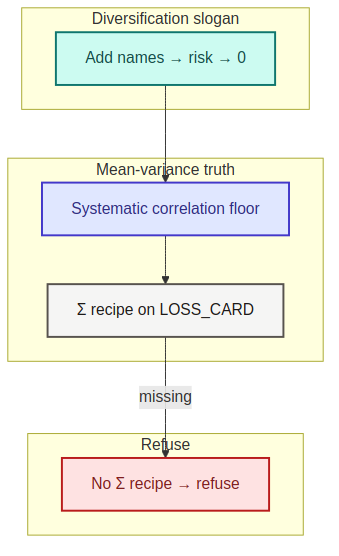
Simple claim: adding names drives portfolio variance toward a systematic floor, not toward zero; a diversification claim without a declared covariance recipe is marketing wearing a square root. The trench is the floor math and the recipe card.
The sentence I have learned to distrust most on a risk slide is "the book is well diversified."
Not because it is usually false. Because it is usually uncheckable. It is a claim about a covariance matrix, made without showing one, in a stack where nothing anywhere records how that matrix was estimated. Someone counted positions, observed that there were many of them across several sectors, and produced a conclusion about joint behaviour from a fact about cardinality.
Then a co-break week arrives and the book behaves like a third of the number of independent bets it advertised. Nobody was lying. Nobody had a covariance recipe either.
What a diversification claim actually owes you
Problem in one line: adding names drives portfolio variance toward a systematic floor, not toward zero. A diversification claim without a declared covariance recipe is marketing.
| n names (equal w, σ=20% each) | ρ = 0 (vol %) | ρ = 0.30 (vol %) |
|---|---|---|
| 5 | 8.94 | 13.27 |
| 10 | 6.32 | ~12.0 |
| 25 | 4.00 | 11.45 |
| 100 | 2.00 | 11.08 |
| 1000 | 0.63 | 10.97 |
| Limit n then ∞ | 0 | 10.95 (= 20%√0.30) |
At ordinary correlation 0.30 you never leave the neighbourhood of 11% vol no matter how many names you add. The floor is the claim; the name count is not.
Portfolio variance is a quadratic form: weights times covariance times weights. That is the whole object. Expected return is linear in the weights and forgiving; variance is quadratic and unforgiving, and it depends on every off-diagonal entry, the terms nobody estimates carefully and everybody uses.
The equal-weight case makes the stakes arithmetic. Take n names, each with 20 percent volatility, equal weights, common pairwise correlation. Portfolio variance is the individual variance times one-over-n plus the correlation times one-minus-one-over-n. Two regimes fall out, and they are not close to each other.
With zero correlation, the one-over-n term is the whole story and it goes to zero. Five names give 8.94 percent volatility, ten give 6.32, twenty-five give 4.00, a hundred give 2.00, a thousand give 0.63. This is the textbook picture, and it is the picture in everyone's head: keep adding names, keep shrinking risk, asymptotically approach a free lunch.
With correlation of 0.30, a modest, unremarkable, entirely typical number, the second term never goes away. Five names give 13.27 percent. Twenty-five give 11.45. A hundred give 11.08. A thousand give 10.97. The limit is 20 percent times the square root of 0.30, which is 10.95 percent, and you reach it long before you run out of names.
Look at what that does to the marginal argument. Going from twenty-five names to a hundred, quadrupling the book, quadrupling the operational surface, quadrupling the number of models to govern, buys 37 basis points of volatility. The uncorrelated fantasy promised 200 basis points for the same work. And in the other direction: leave the book at twenty-five names and let correlation drift from 0.30 to 0.55, which is an ordinary stress-week move, and volatility goes from 11.45 percent to 15.07 percent. That is 362 basis points, ten times what adding seventy-five names bought you.
So the honest summary is blunt. Beyond roughly twenty names, you are not buying diversification. You are buying exposure to your correlation assumption, and that assumption is the thing you never carded.
Why the count feels like evidence
Because the number of names is observable and free, and the covariance recipe is neither.
Cardinality is in the position file. Anyone can produce it, in any meeting, without a data request. Sector labels are also free, and they feel like independence, energy is not technology, so surely those errors are unrelated. The covariance recipe, by contrast, requires decisions somebody has to own: what window, what frequency, exponential weighting or flat, shrinkage or raw sample, how to handle names with short histories, which regime the estimate is meant to describe. Every one of those choices moves the off-diagonals, and therefore moves the answer, and therefore has to be declared before the answer means anything.
There is a second reason, and it is about the shape of the maths. Mean-variance optimisation is usually shipped as a machine that produces the portfolio: returns and covariance in, allocation out, allocation is the deliverable. That framing hides the fact that a loss function was chosen. Variance as the risk measure is a binding, it says upside and downside dispersion are equally bad, that the second moment is what the desk fears, and that co-movement enters only through the covariance terms you estimated. Strong commitments, all invisible in an output that looks like a decision rather than a consequence of one.
How this shows up in production
- The uncarded diversification claim. A risk report asserts diversification benefit without stating the covariance recipe. There is no field for it, so there is nothing to review, so the claim renews itself every quarter by inheritance.
- Name count as a governance metric. Limits and mandates get written on position counts and sector caps, because those are auditable. The book satisfies every one of them and still has a single dominant driver, because caps constrain the diagonal and risk lives off the diagonal.
- Correlation estimated in calm and used in stress. The window covers a quiet stretch, so pairwise correlation comes in near 0.30, and the resulting portfolio is sized for 11.45 percent volatility. The regime that matters runs at 0.55. The book is running 30 percent hotter than its own report, and monitoring reads the excess as an unlucky week rather than a mis-specified input.
- Silent covariance drift between research and live. The research notebook shrinks the matrix; the production service does not, or uses a different window. Two covariance matrices, one set of weights, and every risk number in the stack now depends on which service you asked. This is exactly the mismatch the proposal audit catches as a stationarity residual, and only catches because the card names one recipe.
- Averaging treated as diversification. Two frames disagree, so someone averages them, on the intuition that errors cancel. Averaging cancels independent errors, and two frames built on the same missing information are one gap observed twice.
A walkthrough on CEH-001
| Claim | Without Σ recipe | With carded Σ |
|---|---|---|
| “We diversified CEH book with 25 names” | Uncheckable marketing | Floor vol bound published from carded ρ |
| Dual marks 1.50 / 2.10 | Averaged as if independent risks | Joint stress under one Σ hash |
| Promote diversification score | Name-count proxy | Only if off-diagonals match card |
The never-traded family, and its cousins. CEH-001 marks near 1.50 under the spread frame and near 2.10 under the curve frame, both card-consistent, both citing their own hash.
The structured book holds CEH-001 and about twenty-five relatives: different underliers, different tenors, same grammar. The count supports the diversification sentence, and the calm-period covariance supports it numerically at 11.45 percent volatility. But every one of those structures is marked by a construction, not a tape, and those constructions share inputs, the same bootstrapped curve, the same convention decisions, the same quote-intensity proxy standing in for liquidity. The correlation that matters here is not correlation of underlying market risk. It is correlation of mark error, and mark error is driven by shared machinery.
When the shared machinery moves, it moves everywhere at once. That is the 0.55 week: correlation climbs, the book runs at 15.07 percent, and the twenty-five-name argument contributes nothing because the floor was never about the count.
Then the second failure lands on top. Both frames have just been visibly wrong, disagreement is at its widest, and 1.80 gets proposed again, this time with a diversification flavour, as though averaging two frames were a way of spreading model risk. It is the same error one level up. The two frames rest on the same curve and the same conventions; their errors move together; the midpoint keeps the full error and throws away the only signal the desk had, which was the width of the gap.
What stacks quietly assume
They assume many names means many bets. They assume sector labels imply independence. They assume the covariance matrix is a technical detail rather than the entire risk claim. They assume a correlation estimated in calm describes stress. They assume variance is the right loss because it is the loss the tooling implements. And they assume averaging disagreement is conservative, when it is the one operation that destroys the disagreement without reducing the error.
What a solution must do
Problem: diversification is asserted by name count while variance has a systematic floor set by average correlation. Solution: card the covariance recipe (estimation window, shrinkage, as-of), publish the attainable floor under that recipe, and refuse diversification claims that ignore off-diagonals. Dual-frame CEH risk is joint under one Σ hash, not two independent stories averaged to 1.80.
What to lock
- Every diversification claim cites a
covariance_recipe_hash(window, estimator, as-of). - Publish systematic floor σ_floor under carded average correlation; name count alone never promotes.
- Portfolio reports show contribution of off-diagonals, not only diagonal “vol”.
- CEH dual marks stress jointly under one Σ; no midpoint peace as diversifier.
- Agents may propose name lists; harness refuses “more names so safer” without Σ card.
Clearance coupling: diversification without Σ recipe is untyped risk language. Next: shorts policy as a separate feasible set (S2-07).