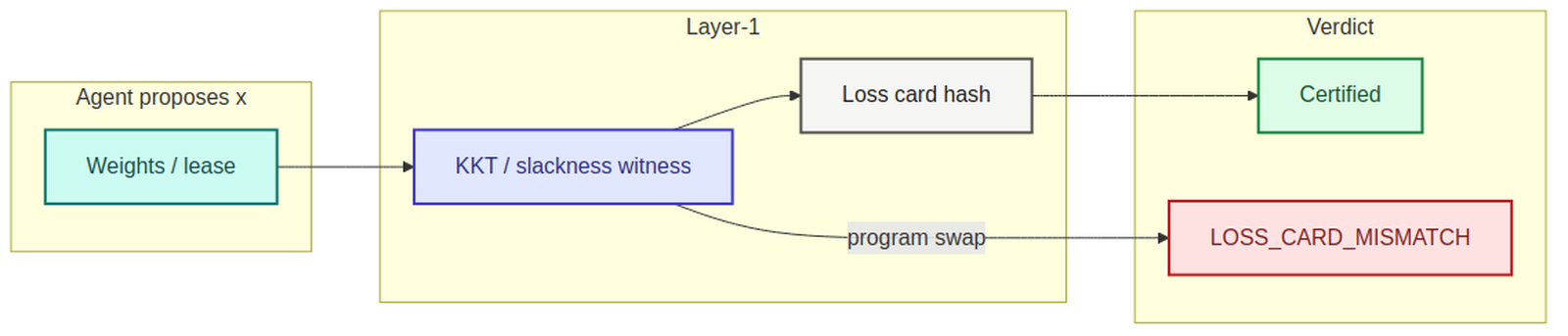
Simple claim: proposed weights are a claim of optimality; stationarity and complementary slackness turn that claim into allow, refuse, or degenerate, not a vibe. The trench is KKT as proposal audit under Clearance.
The problem we left open
Problem in one line: an agent proposal is a claim of optimality. Without stationarity and complementary slackness as machine-checkable fields, the harness can only vibe-review the answer.
Last post the job got a type: objective, constraint cards, declared domain, declared structure. That closed the class of failures where a solver answers a question nobody asked, and it exposed the uncomfortable fact that "make the two CEH-001 frames agree" is a sentence whose literal optimum is the forbidden 1.80.
But a typed job still leaves the last hop unguarded. Something proposes an x. In this stack that something is increasingly a Layer 2 agent with tool access, a covariance estimate of its own, and a paragraph of justification. The proposal arrives as a vector of weights and a sentence claiming it is optimal for the declared job. The sentence is not evidence. And re-solving the whole problem inside the harness to compare answers is both expensive and beside the point, because the harness would then be trusting its own solver rather than checking the claim.
What I want is a certificate: a cheap, local, arithmetic test that a proposal either passes or fails, independent of who produced it or how.
The solution, as one stack
Constrained optimality has exactly such a test, and it has had one since 1951. The Karush-Kuhn-Tucker conditions are usually taught as a way to find optima. In an orchestration stack their more valuable use is to audit them. Five moves.
### 1. Feasibility before optimality, always
Cheapest check, run it first. Does the proposal satisfy the equality rows and the inequality rows on the card?
Concretely, in the three-asset world I will use throughout, expected returns of 6, 10 and 14 percent, volatilities of 12, 18 and 26 percent, pairwise correlation 0.30, target return 10 percent, weights summing to one, an agent proposes 55, 10 and 35 percent. Sum is one, so the budget row passes. Expected return is 9.20 percent. The target was 10. The proposal misses a declared equality by eighty basis points, and no discussion of optimality is warranted or needed. Refuse, with the violated row named.
This sounds too obvious to state as a move. It is the single most common thing skipped, because proposals arrive with prose attached and prose is persuasive in a way that a constraint residual is not.
### 2. Verify the constraint qualification before you trust any multiplier
Multipliers are only meaningful when the geometry at the proposed point is well behaved, concretely, when the gradients of the active constraints are linearly independent. That is not a formality. If the return row and the budget row become parallel, which happens when the expected returns you handed the solver are effectively identical across assets, the active constraint gradients collapse and the multipliers stop carrying information. The Fritz John conditions still yield multipliers in that case, but with the possibility that the objective's own multiplier is zero, which is the mathematics telling you that at this point the objective is irrelevant and the constraints alone determine everything.
That distinction maps onto verdicts cleanly. A failed constraint qualification is not a refuse; nothing has been violated. It is an inconclusive with a specific diagnosis: degenerate geometry, so the certificate cannot be issued and a human has to look at why the inputs collapsed.
### 3. Check stationarity against the card's numbers, with a declared tolerance
This is the core of the audit. At an optimum, the objective gradient must be a linear combination of the active constraint gradients, for a minimum-variance job under a budget and a return target, twice the covariance times the weights must equal the budget multiplier times the ones vector plus the return multiplier times the expected-return vector.
Solving that system on the card's inputs gives the certified point: weights of 29.87, 40.26 and 29.87 percent, volatility 13.85 percent, with a return multiplier of 0.473 and a budget multiplier of minus 0.009 under that sign convention. At those numbers the stationarity residual is zero to machine precision. The multipliers are worth reading, not just checking, the return multiplier is the shadow price of the target, telling the desk what a hundred basis points of extra required return costs in variance.
The tolerance is a card field, not a taste. The natural scale of the gradient terms here is about 0.05, so a residual of a few times ten to the minus four is one percent of scale, not machine noise, and not acceptable.
### 4. Check complementary slackness sign by sign
For every inequality: either the constraint is tight and its multiplier may be positive, or the constraint is slack and its multiplier must be zero. You cannot have both a positive multiplier and strict slack.
This is where the interesting failures live once feasibility passes. An agent proposing 45, 60 and minus 5 percent under a shorts-forbidden card fails feasibility outright. Subtler: a proposal that reports a positive multiplier on a nonnegativity row for an asset it holds at 15 percent. Nothing is infeasible; the certificate is simply incoherent, and an incoherent certificate usually means the proposal was assembled from a different problem than the one on the card.
### 5. Only then may the word "optimal" appear : and only agents propose
For a convex objective over affine equalities and convex inequalities, a feasible KKT point is a global optimum. That is the theorem the whole audit rests on, and it is why the structure field from the last post matters: on a declared convex job, passing the audit licenses the word "optimal" as a claim. On a non-convex job the same passing certificate licenses only "stationary and feasible," which is a much smaller thing and should be reported as such.
The division of labour that follows is the constitution of this series. Agents propose x, and may propose their multipliers too, a helpful hint that costs the harness nothing to verify. The harness certifies, and spends only on a certified optimum or a certified infeasibility. There is no verdict called "the reasoning looked sound."
The example: CEH-001 through the KKT audit
| Object | Card / result | Gate |
|---|---|---|
| Three-asset toy (μ 6/10/14%, σ 12/18/26%, ρ=0.30, target 10%) | KKT point w≈29.87 / 40.26 / 29.87%, σ≈13.85% | certify if residuals within scale |
| Multiplier residual ~10⁻³ on gradient scale ~0.05 | ~1% of natural scale | fail certificate (not “looks sound”) |
| Proposal 45% / 60% / −5% under no-shorts | Infeasible | refuse feasibility |
| Positive mult on nonnegativity with w=15% held | Slackness violated | refuse KKT |
| CEH dual marks ~1.50 / ~2.10 in book constraints | Dispersion diagnostic, not objective | deny 1.80 as optimum of untyped job |
The typed job is the hedge-and-allocation problem around the structured book, with CEH-001's two card-consistent marks near 1.50 and 2.10 feeding the risk inputs.
The agent returns weights of 30.31, 39.37 and 30.31 percent, with a tidy write-up and a reported portfolio volatility of 12.60 percent. Feasibility passes: the weights sum to one and hit the 10 percent target exactly. Constraint qualification holds. So far this looks like a promotion.
Stationarity is where it dies. Against the card's covariance and the card's multipliers the residual comes back at roughly four times ten to the minus four, about one percent of gradient scale, far outside tolerance. Re-scoring the same weights under the card's covariance gives a volatility of 13.85 percent, not 12.60.
Read that gap carefully, because it is the reason this audit earns its keep. The weights are nearly right. The risk claim is wrong by 125 basis points, and the reason is that the agent solved the problem with pairwise correlation 0.15 instead of the card's 0.30, a stale covariance recipe from a research notebook. A reviewer eyeballing the weights against the certified optimum would have waved this through, because the weights differ in the third decimal. The stationarity residual is what notices, because it tests the proposal against the card's geometry rather than against a reviewer's intuition. That failure is LOSS_CARD_MISMATCH: right shape, wrong world, understated risk.
And the midpoint stays impossible. There is no covariance recipe, no multiplier pair and no active-set story under which a mark of 1.80 emerges as a stationary point of any card on file. Under the old regime 1.80 was a compromise. Under the audit it is a proposal that cannot produce a certificate, and the verdict is refuse with a named reason rather than a disagreement about judgement.
The flow in one breath
Problem: typed jobs still need an audit of the proposed point, not only of the sentence. Solution: run KKT as proposal audit, stationarity residual, complementary slackness, primal feasibility, and return certify / refuse / degenerate. Example: CEH allocation around dual frames: clean KKT point vs infeasible shorts and slackness lies, no verdict for “the reasoning looked sound.”
What to lock
- Every promoted weight vector carries a KKT certificate object (residuals, active set, multipliers).
- Feasibility fail and slackness fail are hard refuses, not review comments.
- Stationarity residual scaled to problem units; “small looking” is not enough without scale.
- Agents propose; harness certifies. No spend on uncertified points.
- CEH: dual-frame dispersion is diagnostic; never an objective that optimizes to 1.80.
- Next twin: portfolio policy cards (shorts, diversification) inherit the same certificate shape.
Clearance coupling: KKT audit sits after typed job (S2-04) and before lease. Degenerate / singular Σ cases escalate to S2-08–09 gates.