The problem we left open
In the last post I used confidence theater to name a failure mode that keeps showing up after people think uncertainty is handled.
A score between zero and one looks like a probability. Teams write thresholds around it. Agents route to the loudest number. Two models can both sound sure while marking near 1.50 and 2.10, then someone invents 1.80 as reconciliation. Ranking can still be useful. Staking requires a frequency story the score never owed you.
That creates real headaches in production:
- Threshold superstition: 0.9 becomes policy by vibes.
- Beauty contests: under shift, max-confidence routing prefers the sharp liar.
- Disagreement laundering: two high scores invent a midpoint that sat in neither cloud.
- Crowd blindness: a champion swagger float makes near-winner width feel optional again.
So the question for this post is simple. If a 0..1 score is not automatically a stakeable probability, what do you put in the gate instead?
The solution, as one stack
The core idea is older than today's agent demos, and it still holds: separate ranking from staking. Keep swagger for sorting if you want. For capital, require a range or set with an explicit coverage target on a named population, watch whether that coverage holds when the world moves, and combine it with crowd width so two sharp liars cannot launder a midpoint.
I turn that into five moves. Together they are one solution, not five optional add-ons.
1. Measure frequency honesty before you write thresholds
Before any allow rule mentions 0.9, build a simple honesty check on a held-out slice that resembles the desk's decisions. Bucket predicted confidence and compare to how often the claim came true. If 0.9 buckets land near 0.6, you do not have a threshold problem. You have a meaning problem. Fix meaning first, or every threshold is superstition.
Do this on the decision slice, not only on a generic dataset. Never-traded structures deserve their own honesty plot. A globally pretty curve can hide a rotten local curve. If the GPU budget only allows one honesty plot, pick the slice that spends.
2. Prefer ranges with a coverage promise over lone floats
A stakeable object for a mark looks like: a low, a high, and a target like about ninety percent of similar cases should land inside. The desk may still see a point for conversation. The gate consumes the range. If building a range needs a held-out calibration stream and a rule that widens when data is thin, that is a feature. Thin data should not sound precise.
In plain terms: the system must sometimes say I only know a band. Methods that wrap black-box models with finite-sample coverage promises exist for exactly this job. You do not need to recite their names in a design review. You need the property: when the recipe is followed, the long-run hit rate matches the sticker on the band.
3. Monitor coverage under shift like you monitor uptime
A coverage promise is a living claim. Track hits and misses on live marks. When realized coverage falls below target for the tagged population, trip a breaker: widen bands, force escalate, or disable auto-mark for that structure family. Offline hard-slice packs probe once. This breaker watches online.
Without it, teams recalibrate once, ship, and slowly drift into theater again. With it, the gate gets a time-varying honesty signal, not a one-time certificate. Treat the breaker with the same seriousness you give to an auth outage. Honesty downtime is also downtime.
4. Combine ranges with crowd width, do not replace one with the other
Crowd width asks how much near-winners disagree. A coverage range asks how wide a band must be to keep a promise for one recipe. You need both. A single model can emit a tight band and still sit inside a wide near-winner cloud. A crowd can look narrow while each member's swagger is miscalibrated. The gate should see the union of worries: cloud too wide, or coverage broken, or frames disjoint.
This is where midpoint culture tries to sneak back in. People see two ranges and average their midpoints. That is still invented peace if the ranges do not overlap. The stack only works if overlap is a first-class predicate, not a suggestion in a design doc.
5. Encode the midpoint ban and the overlap rule
Policy language that satisfies a desk:
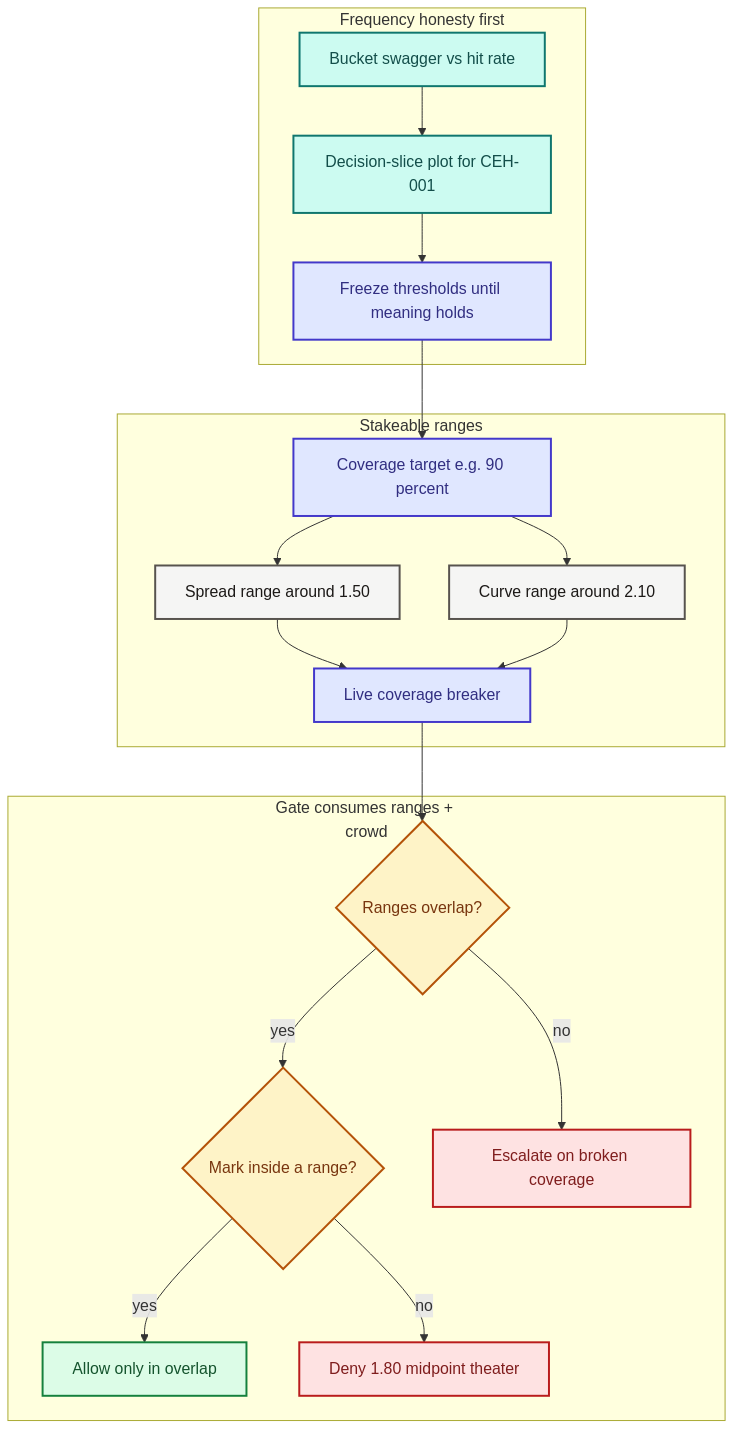
IF coverage monitor is broken for this structure family escalate
IF spread range and curve range do not overlap escalate
IF proposed mark sits in no range deny
IF overlap exists and cloud width within tolerance allow only inside overlap
NEVER treat max(confidence) as a spend license
That last line is the cultural fix expressed as code. Swagger can remain a diagnostic. It must not be a blotter key.
A concrete walkthrough
Same never-traded structure. Same frames. Now run the stack end to end.
Honesty check: 0.94 bucket on similar marks historically hits ~0.61
thresholds frozen until meaning is fixed
Recalibrate / wrap: emit ranges at 90% target
spread [1.41, 1.63]
curve [1.98, 2.20]
Live coverage last 30 days: on target for vanilla names,
below target for this family to breaker trips
Crowd width: still wide; intervals disjoint
Gate: escalate; deny 1.80; no auto-allow region
The satisfying ending is not a magical point. It is a named deny or escalate with artifacts: honesty plot, ranges, coverage breaker state, crowd width. Anyone can replay why autonomy refused. That replay is the difference between a researched solution and a dashboard that only looked careful.
The flow in one breath
Decision-slice honesty check, then ranges with a coverage target, then a live coverage breaker, then combine with crowd width and frame gap, then allow only on overlap and deny invented midpoints. That is how I want uncertainty to show up in financial AI: as a governable object, not as a confidence sticker.
Curious how others trip breakers when live coverage drifts, without waiting for a blow-up to teach the lesson.