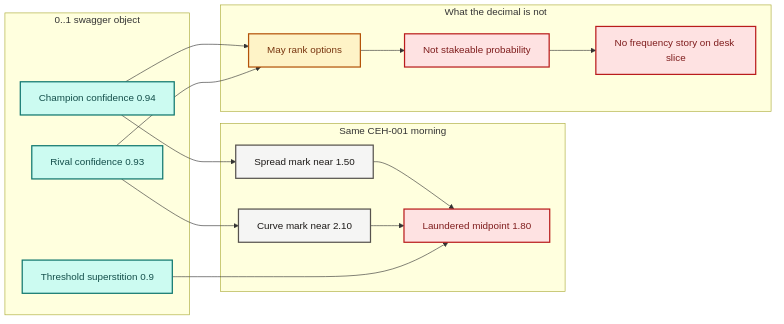
I keep watching teams treat a confidence score like a risk limit, and it keeps ending badly.
You can do the hard work of locking frames and probing near-winners. Width is visible. Frames are named. Then a new object arrives in the UI and everyone relaxes too early: a confidence score. It sits between zero and one. It has two decimal places. It looks like a probability. Teams write thresholds around it. Agents route work to the highest score. Risk committees hear ninety-four percent and hear safety.
Sometimes the number ranks options well. Ranking is not staking. This post is about the gap between those jobs.
What a probability owes you that a score does not
When you say you are about ninety percent sure on a class of decisions, you owe the world a frequency story. On a hundred cases like the ones you will actually mark, about ninety should come out as claimed. If fifty do, the decimal was costume. It may still be useful for sorting easy from hard. It is not a risk limit.
Capital needs frequency honesty on the population that matters, not a prettier thermometer. That phrase, on the population that matters, is where financial AI gets hurt. Quiet training months are not the same population as a jump week on an unlisted structure. A score that looked honest last year can lie this Tuesday without the model breaking in the narrow sense of throwing an exception. It just stops matching frequency while still sounding sure.
I keep meeting teams who treat that mismatch as a monitoring afterthought. They will ship the threshold today and promise to check honesty next quarter. Next quarter never arrives with the same urgency as a release date. By then the score has already been promoted from diagnostic to law.
Why swagger feels like engineering
Thresholds feel like control. Allow above 0.9. Escalate below 0.7. Those rules assume the score means frequency. Modern predictors can be sharp and wrong: tightly opinionated, badly matched to outcomes. Agents can be fluent at the end of a rotten tool path. Final-answer swagger is not the same claim as this mark is safe to auto-post.
Sharpness without honesty is how automation gets louder while risk gets quieter on the dashboard and noisier in P&L. There is also a human factor. A high score ends meetings. A wide honest range prolongs them. Organizations under delivery pressure will prefer the meeting-ending object unless the runtime makes the honest object mandatory. That is not a speech about culture. It is a prediction about defaults.
The same pressure shows up in agent design. A loop that can finish with I am 0.94 sure and here is the mark feels complete. A loop that finishes with here is a band, coverage is slipping, escalate feels unfinished. Product language rewards completion. Desk risk rewards unfinished when unfinished is the honest state.
How this shows up in production systems
1. Threshold superstition. Someone picks 0.8 because it sounds strict. Nobody checks whether 0.8 matched reality on last quarter's marks, let alone on stress weeks. The number becomes policy by vibes. When it fails, people nudge it to 0.85 and call that governance.
2. Beauty contests between agents. Under shift, the louder model can be the worse model. Max-confidence routing then systematically prefers the sharp liar. You did not build a risk system. You built a swagger amplifier. I have watched this happen with two agents on the same book: the quieter one was closer to frequency honesty, the louder one won every routing rule, and the P&L followed the loud one into the ditch.
3. Disagreement laundering with two high scores. A spread-frame mark near 1.50 arrives with confidence 0.91. A curve-frame mark near 2.10 arrives with confidence 0.93. Both look sure. Someone averages to 1.80 because both models agree they are confident. They never agreed on the mark. They agreed on self-regard.
4. Crowd blindness returns through the side door. You published width across near-winners. A single-model confidence gauge can make teams ignore width again: the champion is 0.94, ship it. Confidence on one member does not delete the siblings that also passed. The crowd was the risk object. The swagger float made it feel optional.
A simple pricing example
Keep the never-traded structure from before. Spread-frame work lives near 1.50. Curve-frame work lives near 2.10. Now watch what happens when swagger enters the room.
Point culture
mark = 1.50, confidence = 0.94 allow?
mark = 2.10, confidence = 0.93 allow?
both high, human midpoint 1.80 reconciled
Range culture (coverage target set by the desk)
spread sits in [1.41, 1.63]
curve sits in [1.98, 2.20]
ranges do not overlap escalate
1.80 is not in either range deny as invented peace
The second object is something a gate can compare to tolerance. The first object is a feeling with a decimal point. If your architecture can only consume the first object, you will keep discovering that high confidence and safe to automate parted ways months ago. More model capacity will not close that gap. Capacity makes the costume sharper.
What stacks quietly assume
Many stacks assume the training loss already produced honest probabilities. Sometimes, with huge clean data and a matching deployment world, that is roughly true. On thin structured products, shifting liquidity, and agent pipelines with tools, it is a wish. Softmax outputs, vendor confidence, and LLM self-ratings are especially easy to misread because they are shaped like probabilities in the UI.
Another quiet assumption: that honesty checked on a random holdout transfers to the decision slice. It might not. You can be calibrated on common cases and badly miscalibrated on the exact never-traded tail you automate. Global calibration plots can look fine while the desk's slice is lying. That is why I care about the population sentence as much as the decimal.
What I take from this as systems work
I do not trust a 0..1 score as a spend license on open-ended marks until someone has shown frequency honesty on the population that spends, and until the gate can consume a range with a coverage promise instead of a swagger float.
In engineering language, that means a few boring habits:
- Separate ranking scores from staking objects. Sorting and risk limits are different jobs.
- Check honesty on the decision slice, not only on a generic holdout.
- Prefer bands with a coverage target over lone floats when capital moves.
- Combine honesty with crowd width so two sharp liars cannot invent 1.80.
- Refuse silent midpoints that sit in no honest range.
Building reliable AI infrastructure, at least for me, is less about crowning a confident champion and more about refusing to let costume probability set the risk limit.
Curious where others still let a 0..1 score act as a risk limit, and what broke first when the score stopped matching frequency.