Like a short physical law: a mean is not a path. Once hedges and simulations enter the conversation, path-level AI work invents comfort three different ways, and each one feels quantitative until capital meets the bad day.
Pointwise gates can look fine and the desk can still get hurt across a trajectory. I keep seeing this after teams already did careful work on frames, crowds, ranges, rights, and clocks. Path theater is the next place certainty gets manufactured. On CEH-001, where dual frames still disagree near 1.50 [1.42, 1.58] and 2.10 [2.01, 2.22], path theater is how someone tries to launder the diplomatic 1.80 as "manageable."
Quick definitions
Path budget: an explicit allowance over whole trajectories, breach-day counts, max drawdown, turnover cost, not a mean error that can average one kill day into a green year. Research cousins include conformal risk control (Angelopoulos et al., arXiv:2208.02814): bind expected failure of a monotone loss, not only mean accuracy.
Named world: a simulation (or resampling) environment with declared dynamics, costs, stress pack, and estimation as-of. Unnamed simulators are Bertrand rulers for paths: the "unbiased" hedge depends on which world you never named.
Hedge vs free trade: a hedge is a policy evaluated under costs, constraints, and residual honesty on named worlds. A free trade looks good because friction was set to zero, or because leftovers that still predict P&L were ignored. Deep hedging literature (Bühler et al., arXiv:1802.03042) exists precisely because frictionless delta stories are not desk hedges.
Comfort machine one: averages that hide the day that matters
Ninety-eight percent of days green is a lullaby if the other two percent are the only days the never-traded structure exists in size. Mean reward, mean error, mean hedge quality all invite the law of large numbers to do work it was not hired for. Concentration results tell you when averages settle. They do not tell you that the average is the right objective for a desk that dies on the tail path.
Agents make this worse by optimizing for demo smoothness. A policy that is politely good almost always and violently wrong once will win many leaderboards. You need run-level budgets, not only slice-level smiles. If one breach day can be averaged away, it will be. I have watched teams celebrate a mean improvement that came entirely from making quiet days quieter while the ugly day got worse.
On CEH-001-style structures, the bad day is often the only day the position is large. Averaging across a year of tiny marks is how you convince yourself a rare instrument is tame.
Comfort machine two: unnamed simulation as another ruler
Bertrand said the ruler decides the unbiased answer. A simulator is a ruler for paths. If you do not name the world, you cannot contest it. Friendly noise, wrong dependence, missing jump structure, fantasy liquidity: each produces a different optimal hedge. Training a policy against one unnamed world and shipping it into another is Bertrand with a progress bar.
On the familiar structure, a friendly sim can make a midpoint mark near 1.80 look hedgeable with neat little trades. A second named world, with costs and co-breaks, shows the same policy leaking. If only the friendly world is in CI, promotion is theater. The team did not validate a hedge. They validated a story about a world they never declared.
The undeclared world is especially dangerous because it feels objective. Code ran. Numbers appeared. Charts moved. Nobody had to confess a measurement choice. The measurement choice was still there, buried in the simulator defaults. Multi-environment evaluation exists for a reason: pass rates under one generative process do not transfer when costs, dependence, or liquidity change.
Comfort machine three: free trades wearing hedge clothing
A hedge is a policy evaluated under costs, constraints, and residual behavior on named worlds. A free trade is an action that looks good because friction was set to zero, or because the objective ignored the leftover risk that still predicts P&L. If leftovers are still a free lunch, you did not hedge. You relocated risk into a blind spot.
Deep learning hedge engines are powerful here and dangerous for the same reason: they will optimize whatever story you told them. Tell them a costless fairy tale and they will return a fairy-tale policy with beautiful curves. The curves are not lying about the objective. The objective was lying about the desk. Bühler et al.’s deep hedging framework put transaction costs, market impact, and risk limits into the training story on purpose. Zero-cost demos are tutorials, not promotion evidence.
Vocabulary trap: teams say "hedge" when they mean "trade that reduced a Greek in a frictionless toy." Greeks can be useful diagnostics. They are not a substitute for path budgets, named worlds, and residual honesty. If your language cannot distinguish those jobs, your CI will not either.
How the three machines reinforce each other
| Step | What happens | What gets laundered |
|---|---|---|
| 1 | Unnamed friendly sim | path ruler never declared |
| 2 | Average-green score across paths | kill day hidden in the mean |
| 3 | Costless hedge looks optimal | friction and residual ignored |
| 4 | Promote policy | CI only saw World F |
| 5 | Live path with costs + co-break | surprise P&L; swagger returns |
| 6 | CEH-001 1.80 re-enters as "manageable" | path theater launders midpoint peace |
Read that slowly. Capacity without named worlds, path budgets, and costed objectives just overfits the lullaby. More GPU hours will not invent the missing objects. A sterner system prompt will not invent a second world.
A simple pricing-and-hedge example on CEH-001
| World | Setup | Policy on ~1.80 peace | Gate |
|---|---|---|---|
| World F (friendly) | zero costs, calm noise | mean error green; looks tidy | not enough to promote |
| World S (strict) | costs on, co-break week | path budget breached; residual still predicts P&L | fail |
| Dual honest marks | spread ~1.50 [1.42, 1.58]; curve ~2.10 [2.01, 2.22] | gap 0.60 still real | 1.80 not a mark |
Spread-frame near-winners still live near 1.50. Curve-frame near-winners still live near 2.10. Someone proposes 1.80 as peace and asks for a hedge. If CI only saw World F, you promoted a story about 1.80 being manageable. You did not promote a hedge.
Notice the continuity with earlier posts without needing a map. Midpoint theater tried to invent peace between frames. Path theater tries to invent manageability for that peace. Both are social objects wearing decimals and charts.
Average-green culture has a hiring effect too. It rewards people who make charts smoother. It under-rewards people who force an ugly day into the exam. Over time the org loses the muscle to keep the bad day visible. That is how lullabies become process.
The half-life the lead promised: why thirty quiet days prove nothing
A concrete GARCH(1,1) world with ω = 4×10⁻⁶, α = 0.08, β = 0.90 has a long-run daily variance of ω/(1-α-β) = 0.0002, a daily sd of 1.41%, about 22.4% annualised — against World F's flat 18%. Persistence is α+β = 0.98, which gives a variance-shock half-life of ln(0.5)/ln(0.98) ≈ 34 trading days. That number is worth pausing on, because it indicts a habit this book keeps warning about: a desk that watches thirty quiet days and treats the quiet as certification is watching less than one half-life of a variance shock decay. The calm was not evidence the tail was survived. It was the first half of the decay.
The trap runs deeper than one number, because two worlds can agree on every line a standard risk report prints and still disagree about whether a lease survives. Build a two-regime switching world instead: calm daily sd 0.90%, stress daily sd 2.60%, transition probabilities that put the world in stress 20% of the time. Its unconditional variance works out to 0.8×(0.90%)² + 0.2×(2.60%)² = 0.0002 — identical to four figures to the GARCH world above. Same unconditional sd (1.4142%), same annualised 22.36%, same 99% unconditional VaR of 3.29%. Every summary-statistic row matches.
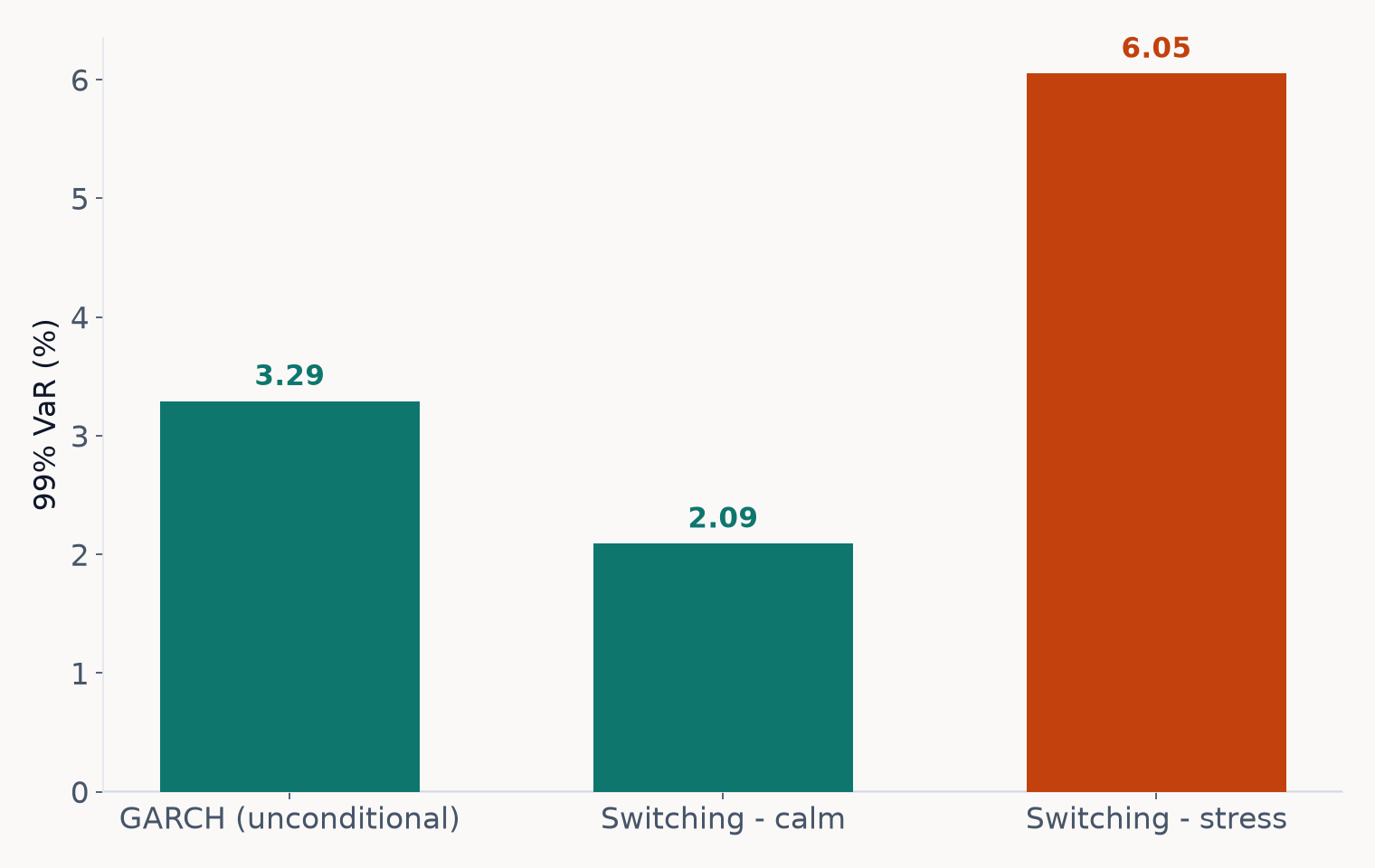
Ask the question a lease actually depends on and they split hard: VaR99 conditional on being in the current state is a smooth continuum for GARCH but jumps to 2.09% calm / 6.05% stress for the switching world, and the switching world's stress state is sticky — a ten-day-or-longer stress run has probability 0.573, and expected time in the bad state is 16.7 days, a quantity GARCH's smooth decay simply has no answer for. A path budget averaged over 250 days cannot tell these worlds apart, because averaging is exactly the operation that erases what differs. That is why dynamics is a required card field naming ω, α, β (or the switching parameters) rather than a free-text description: the two worlds are not two estimates of the same volatility, they are two different processes that happen to share a mean.
Instrument stress: the hedge that was still frozen at last quarter's correlation
The lead also promised this: a path budget that shocks the underlier but never the hedging instrument is free-hedge theater, because a hedge ratio is itself a parameter fit to a named world, and that world can move without anyone re-fitting it.
Fit a futures overlay hedge for CEH-001 on an estimation window where the underlier's daily vol is 1.14%, the future's is 1.05%, and the correlation is ρ = 0.86. The minimum-variance ratio is h = ρ·σS/σF = 0.86×(1.14/1.05) = 0.93, and at that ratio the hedge removes ρ² = 74% of the variance. The card records: instrument named, ratio 0.93, claimed variance reduction 74%. That is a completely honest number, on the day it was fitted.
Now let live correlation decay to ρ = 0.61 while the book keeps running the frozen ratio of 0.93. Recompute the residual variance at the stale ratio against the new correlation and the overlay is removing only 31% of the variance, not 74% — less than half of what the ticket still claims. Worse, the hedged residual's lag-1 autocorrelation against the lagged futures return now prints 0.34, above the 0.25 card threshold this book uses everywhere for residual honesty: leftover edge is still forecastable by the very instrument the ticket claimed to hedge with. Verdict: DRIFT_OVERLAY, refuse, and the instrument card is marked stale pending re-estimation. Nobody lied when the ratio was fitted. The failure is that a hedge ratio without its fitting correlation on the card, and a monitor comparing live correlation against it, cannot later be invalidated — the desk keeps reporting "hedged" off a number that quietly stopped being true weeks earlier.
What breaks in the trenches
- Model trench: hedge nets trained under zero friction; objective never sees residual edge.
- Agent loop trench: demo policies optimized for mean smoothness; one breach day averaged away.
- Harness trench: single unnamed sim in CI; no path budget field; no residual honesty gate.
- Pipeline trench: Clearance tokens with no world scope; 1.80 laundered as "hedgeable peace."
What to lock before automation
- Score trajectories against budgets, not only means (failure budgets / conformal risk control style guarantees where they fit).
- Name simulation worlds; refuse friendly-only promotion.
- Keep costs and trading limits on in anything that can mint a Clearance spend right (deep-hedging discipline).
- Fail packs when leftovers still look like free lunch (residual honesty).
- Scope allows to the worlds that actually passed; never let a hedge launder 1.80 as a mark.
Building reliable AI infrastructure, at least for me, is less about a smoother demo curve and more about making the path ruler and the cost story impossible to leave unnamed.
Curious which of the three comfort machines bit others first: average metrics, simulator mismatch, or costless hedge demos.
A concrete walkthrough on CEH-001
Same never-traded structure. Someone still wants a hedge near diplomatic 1.80. Earlier rules already deny auto-posting that midpoint as a mark. Dual honest centers remain ~1.50 and ~2.10 with bands [1.42, 1.58] and [2.01, 2.22].
| Object | World F (friendly) | World S (strict, costs on) | Gate |
|---|---|---|---|
| Mean metrics | may pass | not the decision | means alone never promote |
| Path budget (ex.: max DD 8%; breach-days ≤ 12; turnover ≤ 60 bp) | may clear calm pack | can breach on co-break week | both worlds required |
| Frame gap under stress | ~0.60 calm | can widen toward ~0.95 | gap cap on card |
| Residual honesty | may look clean | leftover still predicts P&L | fail pack if free lunch |
| 1.80 midpoint as mark | still denied | still denied | hedge cannot launder it |
| Clearance token | scoped to {F, S} pass only | else escalate | |
The satisfying ending is not a smoother mean curve. It is a scoped allow, or an escalate, with named worlds and budget artifacts anyone can replay. That is what a researched path-level solution means on a desk that wants to sleep.
A rollout order that avoids theater: define one failure budget the desk will actually defend, stand up World F and World S with different cost and co-break assumptions, turn costs on in the hedge objective, add one residual check that can fail the pack, then wire Clearance scope to the pass set. Do not start by training a prettier policy in an unnamed world.
Live regime tagging will be imperfect. That is fine. The point is not omniscience. The point is that leaving the scoped set is an escalate event, not a silent continuation. Autonomy that cannot notice it left the exam is not autonomy worth shipping.
If the desk wants one number for a slide, give them the scoped allow region and the budget status. Do not give them a lonely float and call the path problem solved.
Book: Chapter 12 in Rulers Before Models.