The price is the cost of a plan
A European call pays max(ST - K, 0) at maturity, nothing before. The classical seller's problem: charge a premium V0, then trade the stock and a money-market account continuously so the portfolio's value tracks the option and meets the payoff at expiry. If that replicating portfolio exists and the market is arbitrage-free, the unique price is exactly the capital needed to fund the hedge.
That sentence is the whole completeness bargain, and it says something easy to skip: the price is the cost of a plan, not a forecast, not a fair-value opinion, not a consensus. Every assumption that touches execution — continuous trading, zero cost, infinite divisibility, a known volatility — is load-bearing for the number, not decoration around it. A mark that claims replication without producing the actual hedge schedule is an incomplete certificate, whatever it says on the ticket.
The number, computed
Stay inside the toy. S0 = 100, K = 100, r = 0.05, σ = 0.20, T = 1: an at-the-money one-year call, no dividends.
d1 = (ln(1) + (0.05 + 0.5·0.04)·1) / 0.20 = 0.07/0.20 = 0.35, and d2 = 0.35 - 0.20 = 0.15. With Φ(0.35) = 0.6368, Φ(0.15) = 0.5596, e-0.05 = 0.9512:
| Term | Value |
|---|---|
| S0·Φ(d1) | 100 × 0.6368 = 63.68 |
| Ke-rT·Φ(d2) | 100 × 0.9512 × 0.5596 = 53.23 |
| V0 | 63.68 - 53.23 = 10.45 |
Read the two terms as the plan they encode, not as an abstraction. The seller buys 0.6368 shares, costing 63.68, and borrows 53.23 against the discounted strike. The premium of 10.45 is the difference: the equity the seller must actually put up to run this plan. Every number on that table is a step in an executable hedge, which is the entire point of a closed-form price existing at all.
Two toys, two worlds, not two rivals
The book's earlier discrete-tree fixture priced the same style of call at 7.14. Compare the two and it looks like a discrepancy. It is not one: the tree's up-factor of 1.10 implies a volatility of ln(1.10) ≈ 0.095, a 9.5% world, while this continuous toy runs at 20%. Both numbers are exact under their own stated inputs. Neither is a passport to paste a point mark onto a live book — CEH-001's own honest research marks still sit in dual clouds near 1.50 and 2.10, and no amount of Black-Scholes precision closes that gap, because the gap is not a volatility disagreement, it is a frame disagreement the model was never asked about.
Why the closed form exists at all
The reason Black, Scholes, and Merton could publish an exact formula in 1973 is not that they invented new mathematics. The pricing PDE, after a change of variables (x = ln(S/K), τ = T - t, and a strip factor absorbing the drift and discount terms), turns into the ordinary heat equation: uτ = ½σ²uxx. The same equation Einstein wrote down in 1905 for a diffusing molecule. Option prices came out closed-form because heat diffusion has been solved-form since the nineteenth century, and options inherited the answer. That lineage matters practically: it is why the formula is exact rather than approximate, and exactness is exactly the property that makes it useful as contrast rather than as a forecast — a forecast does not get to be exact, a solved boundary-value problem does.
The Greeks, priced as an exchange rate
Greeks aren't quoted for decoration. In a gated system their job is to tell you which data-pipeline field the price is actually sensitive to, which is why a book about gates computes the full set rather than reciting delta.
| Greek | Value | What it forces onto a card |
|---|---|---|
| Delta | 0.6368 | The hedge holding and its rebalance grid |
| Gamma | 0.01876 | How fast the holding goes stale between rebalances |
| Vega | 37.52 per unit vol | The volatility estimator and its measurement grid |
| Theta | -6.41 per year | The calendar convention and financing rate |
| Rho | 53.23 per unit rate | The discount convention and its bootstrap recipe |
Vega of 37.52 per unit of volatility is 37.5 cents per volatility point. Measuring volatility off five-minute bars with ordinary microstructure noise inflates an honest 18% true volatility to 20.5%, two and a half points, purely from the sampling grid. Multiply it out: 94 cents of mispricing on a ten-dollar option, from a default nobody reviewed. Rho does the same work for the discount curve: 53 cents per hundred basis points, so an undeclared day-count or compounding-convention swap of even a few basis points is real money across every rate-sensitive mark in the book.
The put on the same inputs prices at 5.5735, and put-call parity (call minus put should equal stock minus discounted strike) gives 10.4506 - 5.5735 = 4.8771 on one side and 100 - 95.1229 = 4.8771 on the other — agreement to four decimals from two independent evaluations. That's not an approximation; it's an algebraic identity of the formula itself, which is what makes it a useful gate: a pricing service that fails parity by more than rounding has exactly three possible defects (mismatched discount conventions, mismatched information sets between the two quotes, or an implementation bug), and none of them is model error.
The field everyone protects is not the one that moves the price
Here's the fixture for any team that believes model choice is the dominant risk in an option mark. Add a completely ordinary 2% dividend yield, a field that defaults to zero in more pricing libraries than anyone likes to admit. The call falls from 10.45 to 9.23, a drop of $1.22, nearly 12% of the premium. Delta moves too, from 0.6368 to 0.5868 — a hedge running with 5% of a share of unintended exposure, indefinitely, read later as unexplained tracking error.
Now rank every two-percentage-point-scale error by impact: calibration choice moves the price by $2.62 across three defensible recipes (see below), dividend yield by $1.22, short rate by $1.06 through rho, and volatility, through the gamma channel, by only $0.79. Volatility comes fourth. A card that hashes the volatility recipe and defaults the dividend field has protected the wrong quantity, and it has done so while looking rigorous, because volatility discipline is the discipline everyone has been trained to expect.
Rebalancing itself is a fourth, separate cost that deserves its own table rather than a single number, because it has an interior optimum. The continuous ideal hedges every instant at zero cost; real desks rebalance on a grid, and each trade costs something. At a 50bp half-spread, quarterly rebalancing carries a hedge-error standard deviation of $3.33 (32% of the premium); weekly cuts that to $0.92 with a total cost of $2.32, the minimum in the table; pushing to daily shrinks the error further, to $0.42, but transaction costs balloon enough that the total rises back to $3.11. Daily rebalancing looks better on a tracking-error chart and is worse on the P&L. A scheme card that names a rebalance mesh without a cost model has only named the flattering half of the ruler.
The smile is the model confessing
The closed form takes volatility as a given input, but live desks don't have volatility, they have quotes, and they choose which quotes to calibrate against. Calibrate the same at-the-money contract three defensible ways — a short-dated liquid strip, a longer-dated surface slice, a historical estimator over a named window — and you get 12.16, 9.54, and 9.97, against the closed form's 10.45. A spread of $2.62, a quarter of the premium, and every single recipe is honest. Averaging those three to 10.56, suspiciously close to the textbook number, is dual-mark midpointing with better branding: exactly the DUAL_MARK_MIDPOINT sin that 1.80 commits on CEH-001 itself.
If Black-Scholes were literally true, one volatility parameter would price every strike at a given maturity. Invert the formula against live quotes instead and you get a smile: three quotes at one maturity might imply 0.24 at a strike of 90, 0.20 at 100, 0.22 at 110. No single σ reproduces all three. This is not the market making an error a better estimator would fix. It is the market stating, in its own quotes, that the log-normal, constant-coefficient, continuously-hedgeable world does not span what those options are actually exposed to. A desk whose surface smiles and whose measure card claims completeness has a contradiction sitting in its own artifacts, one a script can catch without any human judgment: existence of a smile is itself a vote against the completeness claim.
Six fields, $6.90, two-thirds of the premium
Collect everything this chapter has priced and the card writes itself. Six fields, each annotated by what its absence costs on this exact round-number toy: the volatility measurement grid, 94 cents; the dividend yield, $1.22; the discount convention, 53 cents per hundred basis points; the gap between hedge volatility and mark volatility, 79 cents per two points; the rebalance mesh, once a cost model is attached, up to 80 cents; the calibration recipe, $2.62. Sum those six and you get $6.90, almost two-thirds of the entire premium, from declarations most pipelines make by default rather than choices anyone on the desk actually reviews.
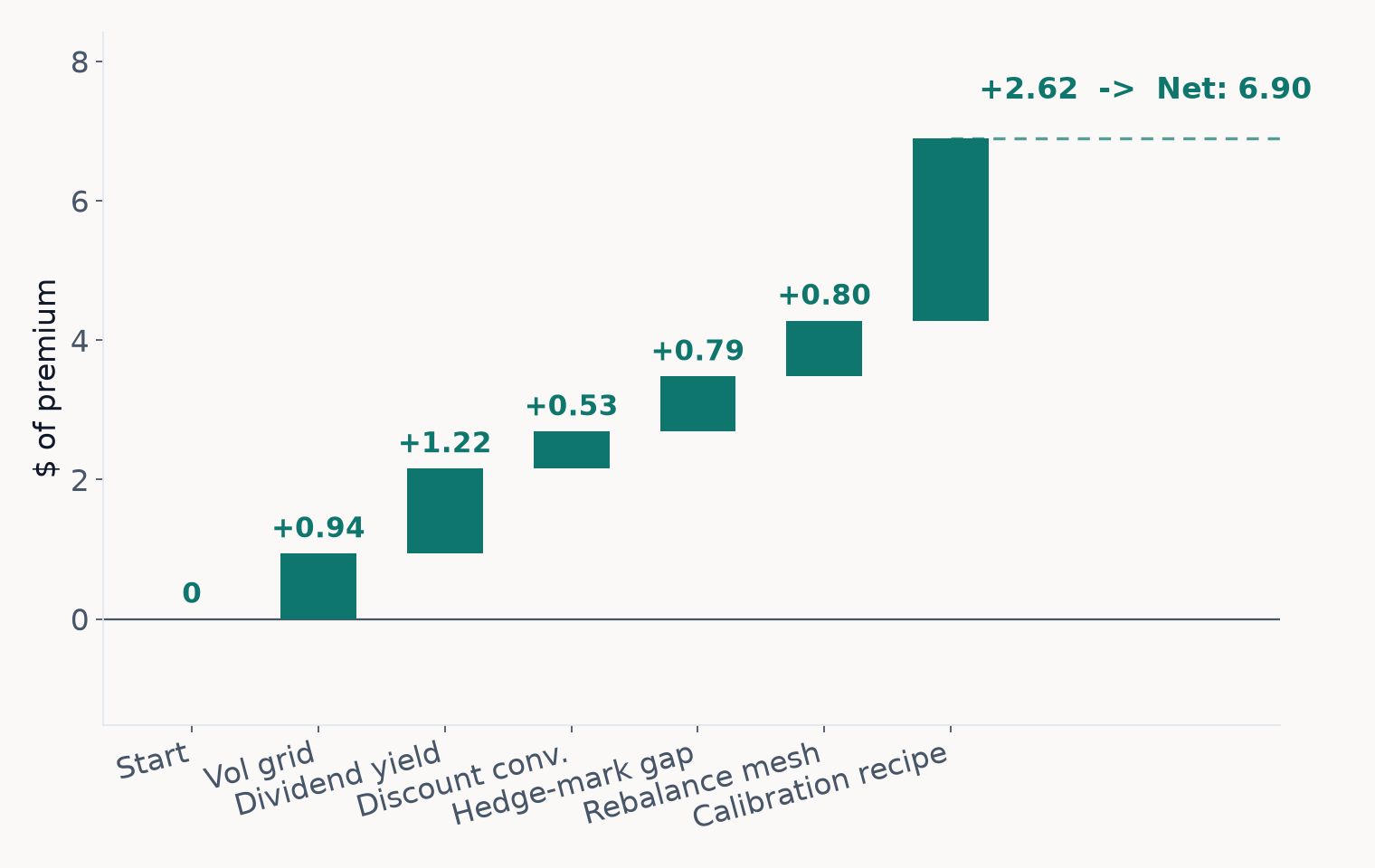
Notice which field is missing from the top of that list: volatility itself, the one the literature obsesses over, comes in fourth. The measurement grid, the dividend, and the calibration recipe, three fields that feel like plumbing, together dominate every genuinely model-level choice.
The gate
Refuse the misuse directly. Do not ship 10.45, or "edge versus 10.45," as equity alpha, as a CEH-001 point mark, or as proof that a challenger model beat Black-Scholes. That refusal has a name, DENY_BS_AS_ALPHA, and it exists because the worked number above is genuinely useful for one purpose only: showing what uniqueness looks like when every assumption holds, so a reader can see exactly how far a live, incomplete book is from that bargain. An AI system trained to reproduce Black-Scholes on simulated paths has learned to reproduce a solved heat equation. That is a legitimate benchmark for numerical accuracy. It is not evidence the system can price CEH-001, and a promotion ticket that conflates the two has confused a contrast object for a passport.
Book: Chapter 11 in Rulers Before Models.