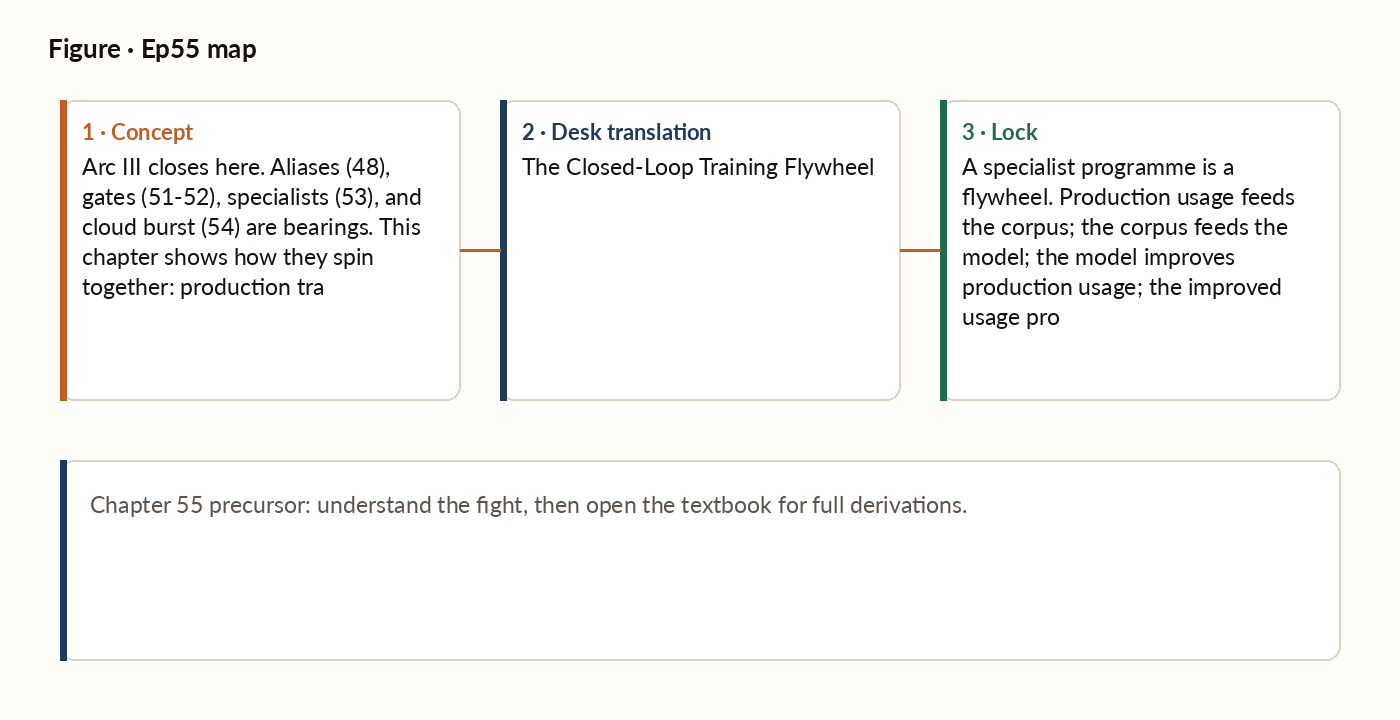
Appendix F.5-F.6 (after Part IX) extend the same discipline to belief memory and agent org design; this chapter closes the weight loop. A specialist programme is not a sequence of independent training cycles; it is a flywheel - a self-reinforcing loop in which production usage generates corpus, corpus improves the model, and the improved model generates better production usage, which generates better corpus. The disciplines of the prior chapters - service abstractions, priority gateways, verify passes, evaluation gates, promotion governance - are the bearings that let the flywheel turn smoothly. This chapter shows how the loop closes.
Figure 1. Concept map for this episode: fight, desk translation, what to lock.
Production traces as training fuel
Every interaction with the deployed model generates a structured record: the prompt, the tools called, the tool results, the model's answer, the verify-pass result, the eventual operator feedback. Aggregated, these records are the training corpus. The structure matters. A bare prompt-response log is recordings, not training data. A structured trace with the prompt, tool calls, results, and outcome recorded alongside it is training data, because each field can be used as a label or a filter during corpus assembly:
The operator-feedback signal: thumbs-up as a sparse but high-value reward
Most production traces are unlabelled - the user issued a query and went on with their day; no explicit feedback was given. A small fraction of traces are labelled by an operator who marked the response as good or bad, often through a thumbs-up or thumbs-down affordance. The labelled fraction is small - typically 1-5% of traces - but its value per trace is high. A thumbs-up is a positive preference signal: the operator, having read the answer, thought it was worth reading. A thumbs-down is a negative preference signal: the operator thought the response missed the mark, even though it was worth reacting to at all. Both signals, sparse as they are, are far more informative than an unlabelled trace.
Corpus drift detection
A flywheel that turns indefinitely is one that measures its own corpus over time. The corpus this week should resemble the corpus last week - same distribution of topics, same balance of positive/negative labels, same difficulty distribution - unless the platform's usage has genuinely shifted.
The compounding moat: why velocity matters more than raw quality
The closing argument of Part VIII is the most important: the rate at which a specialist programme improves matters more than the raw quality of any single cycle. A programme that promotes a 1% improvement weekly compounds, over a year, into a model that is 68% better than its starting point. A programme that promotes a 5% improvement quarterly compounds into a 22% improvement over the same year. The slower-but-higher-quality programme loses despite winning every individual race. The compounding nature of model improvements - each new baseline is the starting point for the next cycle's incremental gain - favours velocity. The fast programme reaches each capability milestone sooner, and each milestone reached sooner becomes the new baseline the next cycle compounds from.
Definition
A training trace is a structured record of one production interaction that contains every piece of information needed to (1) reproduce the interaction, (2) judge its quality, and (3) use it as a labelled example for future training. Minimum-honest fields: timestamp, prompt, tool calls, tool results, final answer, verify-pass outcome, latency, operator feedback (when present). Logs that lack any of these are recordings, not traces.
Worked picture
Week 1: 1,500 traces, 30 labelled (20 thumbs-up, 10 thumbs-down). The next cycle's DPO stage trains on 10 preference pairs (matched up/down on same prompt). The improvement is modest - a percentage point of preference accuracy. Week 12: 18,000 traces accumulated, 360 labelled. The DPO stage now trains on 120 preference pairs. The model's answers feel meaningfully more like what the operators want. Week 52: 80,000 traces, 1,600 labelled, 500+ pairs for DPO. The model's voice is now the team's voice. New operators joining the team comment that "the model sounds like one of us" - without anyone having written down what us sounds like. The corpus compounds because every week's traces are added to (not replaced by) the prior weeks'. The flywheel's output is the asymptote of operator-preference convergence.
What breaks in production
A tempting shortcut when natural pairs are thin: pair any thumbs-up with any thumbs-down, ignoring whether the questions match. The pair-count grows enormously; the DPO stage has plenty to train on. It is a bad idea. DPO assumes that the two responses in a pair address the same prompt - that the preference signal is "given this question, response A is better than response B". Mixing prompts means the preference signal is "given this question, response A is better than [an unrelated response to a different question]", which is not a coherent preference. The training corpus becomes noisy in a way the loss function cannot detect, and the model's output drifts in unpredictable directions. The discipline: pair by canonical question only. Where pairs cannot be found, accept the lower pair-count or use synthetic negatives with the safeguards above. Never pair across questions.
Key idea
A specialist programme is a flywheel. Production usage feeds the corpus; the corpus feeds the model; the model improves production usage; the improved usage produces a better corpus. The disciplines of this part - service-layer abstractions, priority gateways, verify passes, evaluation gates, promotion governance, cloud-burst velocity - are the bearings on the flywheel. Maintained, they let the wheel turn faster every year, compounding into a model that no competitor can copy. Neglected, the wheel grinds to a halt, and the platform becomes a thin wrapper around someone else's frontier API. Build the flywheel; tend the bearings; turn the wheel. Part VIII continues in Appendix F.5-F.6 after Part IX (Chapters 52-55) - compile-first memory and agent company OS; orthogonal to fine-tuning but required before the book closes.