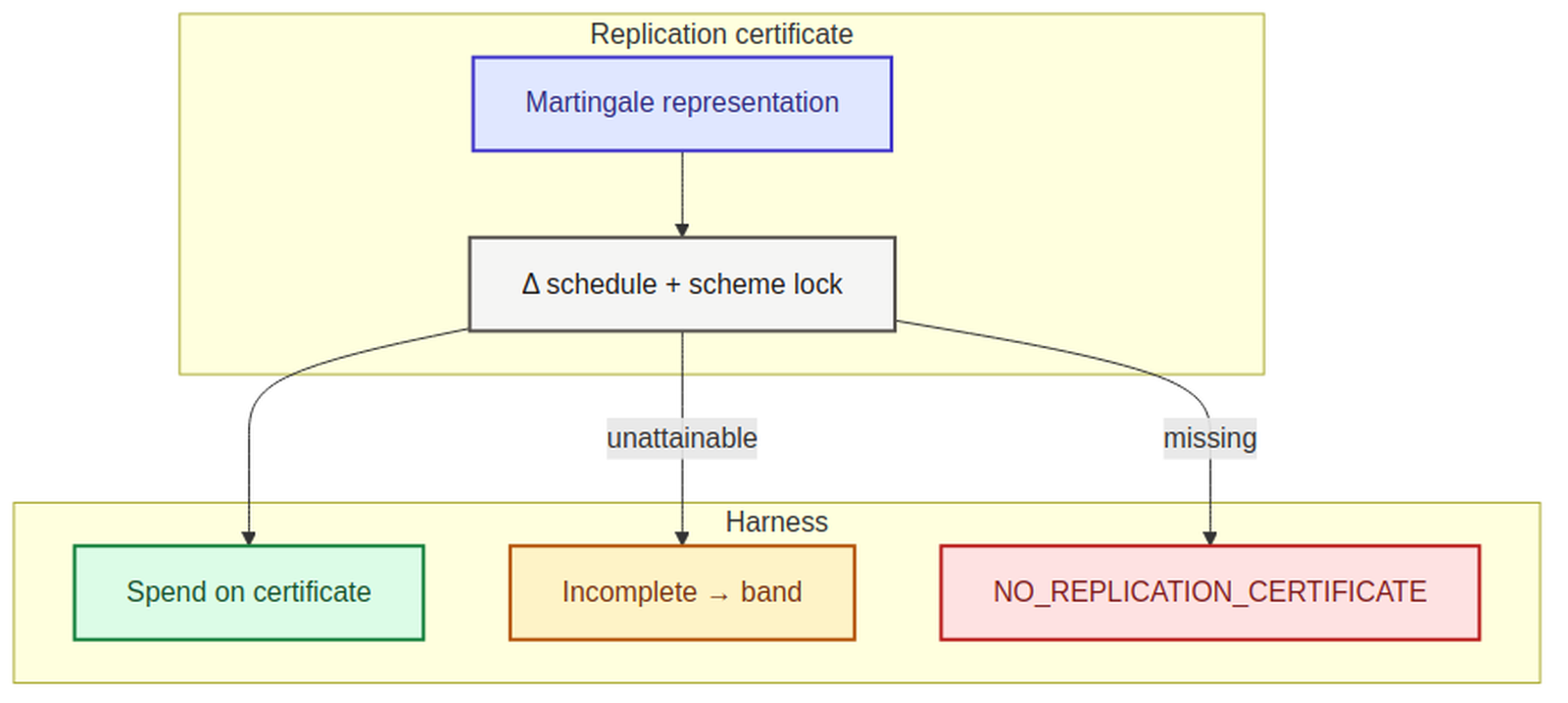
Simple claim: martingale representation hands you the delta the formula only implies; where it hands you nothing, the honest output is a band or refuse. The trench is replication certificate or Clearance deny.
The problem we left open
Problem in one line: martingale representation hands the Δ the formula only implies; where it hands nothing, the honest output is a band or refuse, not a Greek of a missing closed form.
Last time the failure was a subtraction. A closed form returned 10.45, a mark said 9.90, and the difference went into a column headed edge, even though changing nothing but the rebalancing mesh moved the same claim across 12.16, 9.54, and 9.97, a spread of 2.62 on a ten-point premium. The refuse code was DENY_BS_AS_ALPHA, and the argument was that a formula's output is a contrast, not a signal.
That leaves the gap this whole series has been walking toward. If a number is not sufficient, what is sufficient? What has to be true before a system may spend?
Three production headaches close out the list:
- Deltas obtained by differentiating whatever formula was available, which means no delta at all when no formula exists.
- Continuous hedge ratios shipped to a book that trades on a schedule, with discretization left to whoever wrote the execution loop.
- A binary promote/reject culture with no way to say this claim is priceable only within an interval, so intervals get collapsed and the collapse never appears in the record.
So the question for this last post is simple. If that is the failure mode, what does a real AI solution look like?
The solution, as one stack
The core idea: the artifact that authorizes spend is not a price, it is a replication certificate, an object saying here is the claim, here is the measure it is priced under, here is the portfolio that discharges it, here is how that portfolio executes on a real schedule, and here is what is left over. Where the certificate cannot be produced, the system does not produce a worse price. It produces a band, or it refuses. Five moves, one stack.
1. Get the delta from martingale representation, not from a Greek. Over a Brownian filtration, every martingale is its initial value plus a stochastic integral: M = M₀ + ∫γ dW. The discounted value of a claim is a Q-martingale, established when discounted wealth became the mark, so it has such a representation, with some integrand γ. The discounted wealth of a hedging portfolio is also a Q-martingale, with integrand Δ σ S D. Match the two and the hedge ratio falls out: Δ_t = γ_t/(σ S_t D_t).
This derives the hedge from the claim's own martingale structure rather than from the existence of a differentiable formula. Differentiating Black-Scholes gives Δ = Φ(d₁) for a vanilla call and nothing at all for a structure with no closed form. The representation route gives a Δ wherever the claim is attainable, exactly the set of cases where a Δ ought to exist.
2. Require the certificate as a whole object. A price alone is not promotable. The certificate carries the payoff definition, the measure card with θ, the Δ process, the financing leg, the path budget {F, S}, rebalancing frequency and spread allowance, and the residual card with its unpredictability test. Missing any field is NO_REPLICATION_CERTIFICATE. This is not bureaucracy; it is the minimum set of things whose absence has, somewhere in this series, produced a mark nobody could hold.
3. Lock the scheme that discretizes it. The Δ from representation is a continuous-time process; what executes is a schedule. The translation, step size, integrator, rebalancing trigger, is a modeling choice with its own error, and last post showed that choice moving prices by more than the edge. So it gets frozen and hashed. SCHEME_UNLOCKED fires when a hedge is promoted with a Δt a downstream process is free to change.
4. When the claim is not attainable, ship the band. Completeness is a property of a model, and the models where it holds are the ones simple enough to teach with. Real structures have jumps, illiquidity, and states no traded instrument spans. There the representation gives no exact Δ, and the correct output is the interval between what a super-replicating position costs and what a sub-replicating one fetches. Everything inside is arbitrage-free; picking a point requires a preference, and a preference is a decision the desk makes, not one a pricing service makes for it. Promoting a point inside a band is POINT_ON_INCOMPLETE: the failure this series has met in the tree, in the closed form, and here at the end.
5. Wire the certificate to the permit, with three verdicts. The gate returns one of three things. Allow: certificate complete, residual test passing, scheme locked, position may be sized. Refuse: a required field missing, the measure undeclared, the residual leaning, or the model inadmissible. Inconclusive: the claim is attainable only within a band, or the mesh spread exceeds the effect being claimed. Inconclusive is not a soft allow. It is escalate-only, humans keep marking, rights do not widen, nothing gets sized.
Put together: Δ from representation, a certificate rather than a price, a locked scheme, a band where completeness fails, and a three-way verdict at the gate. That is the closing object of the hedge plane.
The example: CEH-001, certified and refused
| Certificate field | Pass | Fail then gate |
|---|---|---|
| Payoff definition hash | Complete | SCHEDULE_INCOMPLETE (S2-02) |
| Measure card + θ | Present | MEASURE / DENSITY undeclared |
| Δ from representation (not only Φ(d₁)) | Exists | No attainable Δ then band / refuse |
| Financing leg + path budget | Self-financing | Account break (S2-15) |
| Scheme (Δt, spreads) | Locked | SCHEME_UNLOCKED |
| Residual unpredictability test | Pass | Hedge not discharging claim |
| BS edge 10.45 vs 9.90 with free mesh | , | Mesh span 2.62 > edge 0.55 |
| Dual CEH 1.50 / 2.10 | Two certificates | 1.80 has no certificate then deny |
Same never-traded note, one last time. Spread frame near 1.50, curve frame near 2.10, denied midpoint 1.80.
Take the leg that is replicable, the vanilla-equivalent piece, S = K = 100, r = 5%, σ = 20%, τ = 1. The certificate reads: value 10.45, Δ = Φ(d₁) = 0.637 shares, financing leg −K e^{−rτ}Φ(d₂) = −53.23. Those are not a formula and two Greeks; they are a portfolio. Hold 0.637 shares, borrow 53.23, and the arithmetic 63.68 − 53.23 = 10.45 says the price is the position. Attach θ = 0.25, the mesh and spread budget, and the residual series from the account reconciliation, and if the residual test passes the gate can allow it.
Now the rest of the note, which is why CEH-001 has been the example all along. It is never-traded, and parts of its payoff depend on states no available instrument spans. Martingale representation gives no exact integrand there, so there is no Δ and no certificate, and the correct output is the band, roughly [6.5, 8.0] on the comparable leg against the tree's 7.14.
The verdict is therefore split, and that is the right shape. Replicable leg: allow, with a certificate. Unspanned part: inconclusive, with a band and an escalation. Not a blended number, and not one note-level mark carrying an unstated mixture of certified and uncertified components.
And 1.80 is refused for the last time, now for the most complete reason available. No Δ produces it, so it is not the cost of a portfolio. It is not an endpoint of the band, so it is not a replication bound. No θ generates it, so it is not the output of any measure. Two frames disagreeing at 1.50 and 2.10 is real information about an instrument that is genuinely hard to value. Averaging them destroys that information and hands back confidence in exchange.
The flow in one breath
Problem: closed forms, wrong coins, and free meshes produced “edge” without a holdable Δ. Solution: replication certificate from martingale representation, or super/sub-replication bands when exact Δ does not exist. Example: CEH certified hedge vs incomplete structure refused into a band; midpoint 1.80 never certifies.
What to lock (Part II close)
- No size / lease without a replication certificate (or explicit incomplete-market band).
- Δ from representation (or tree schedule), not only differentiation of a formula that may not exist.
- Certificate packs: payoff, measure+θ, Δ process, financing, scheme, residual test.
SCHEME_UNLOCKEDif rebalancing frequency can change downstream without re-cert.- Incomplete markets: output [sub, super] costs, not a fake unique price.
- CEH dual frames: two certificates or dual bands; 1.80 deny-by-default for the whole series.
- Agents propose; harness certifies. Series 1 refuse culture + Series 2 cash/measure/hedge spine.
Clearance coupling: replication certificate or refuse. That is the honest close of Part II, equity desk math that can still say no.