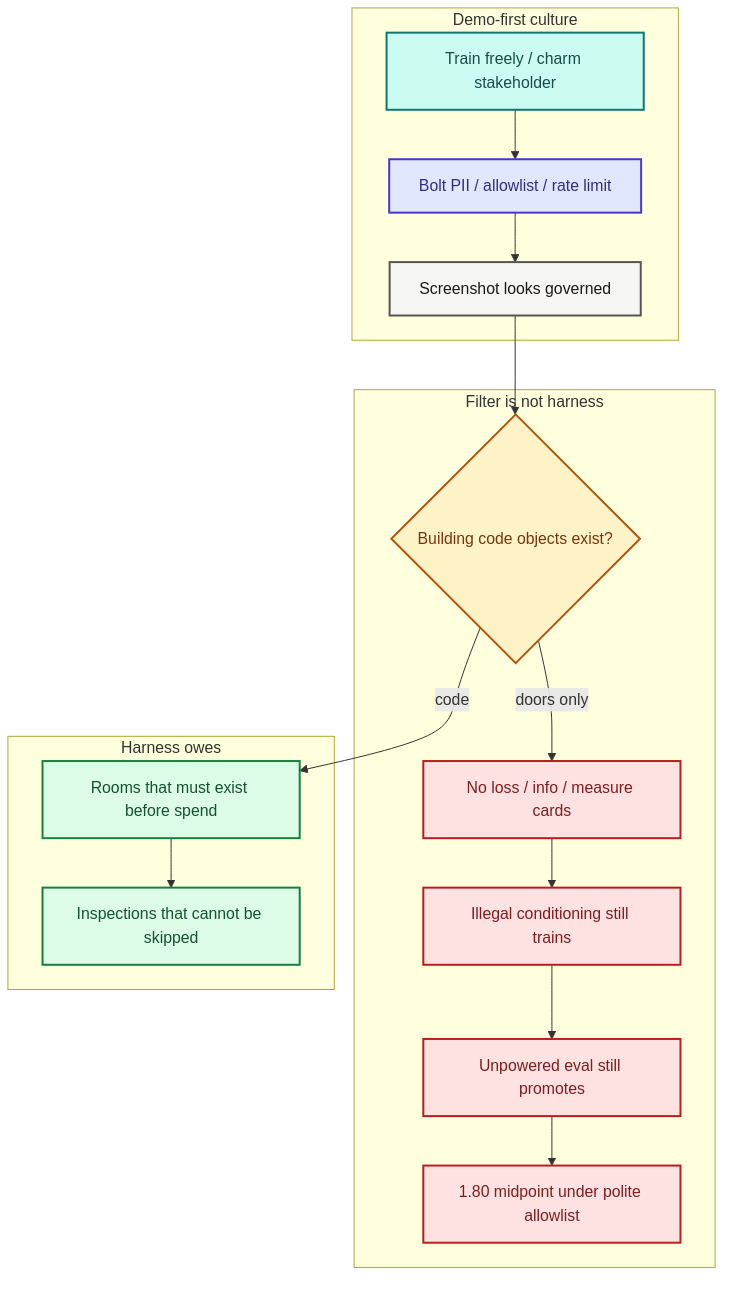
Most teams I meet still treat safety like gift wrap: train freely, demo hard, bolt filters on at the end.
The model already learned. The agent already charmed a stakeholder. Then someone asks about PII, prompt injection, tool allowlists, rate limits. Those controls matter. They are also the wrong shape if you pretend they finish the system. A content filter does not lock a measurement frame. A gateway deny does not create a loss card. An after-the-fact prompt does not make an exam powered.
This post is about bolted guardrails. The failure mode where pipelines stay incomplete because the demo path never had to become a harness.
What a harness is that a bolted filter is not
A filter answers: should this string / tool call / destination be allowed right now. A harness answers: which objects must exist, and which checks must pass, before training, promotion, or spend can proceed. Filters are necessary doors. A harness is the building code that says which rooms must exist and which inspections cannot be skipped.
When teams bolt filters after the demo, they usually get the doors. They skip the building code. Bad features still reach the registry. Illegal conditioning still trains. Unpowered evals still promote. Midpoint theater still ships under a polite allowlist. The system looks governed in a screenshot. It is unfinished in the places capital actually fails.
I care about this because agent demo culture rewards fluent end-to-end paths. The path that impresses on Tuesday is almost never the path that blocks bad data on Monday or refuses an underpowered champion on Thursday. Retrofitting safety onto a demo path is how you get theater with a security team CC'd.
There is also a timing trap. After applause, every new hard gate looks like regression. The stakeholder already saw the agent mark and hedge. Asking for a frozen eval pack or a loss card now feels like bureaucracy attacking momentum. That social fact is why bolting-on wins. It preserves the demo emotion while adding a visible control. Emotion is not an architecture review.
Why bolting-on feels like shipping
Filters are visible. Harness failures are absences. You can show a denied tool call in a log. You cannot easily show the loss card that never existed, the info contract nobody wrote, or the hard eval slice that was never frozen. Organizations under demo pressure buy the visible control and defer the invisible one. Deferral becomes architecture.
There is also a category error that keeps repeating. People hear guardrails and think only of model output filters. Decision geometry, near-winner crowds, stakeable ranges, typed rights, as-of clocks, path budgets, loss cards, shortcut groups, information contracts, measure honesty, live breakers, claim receipts: those are also guardrails. They just live earlier and deeper. If your glossary starts and ends at the gateway, you will keep bolting paint onto a missing chassis.
How this shows up in production systems
1. Train-then-pray pipelines. Feature stores accept whatever joins. Training runs complete. Only serving gets a content filter. Contaminated labels and shortcut cues are already in weights.
2. Prompt patches as architecture. A bad mark style appears in a demo. Someone adds a system prompt: do not average conflicting frames. Prompts help. They are not a substitute for a gate that consumes frame disagreement as a first-class object.
3. Gateway theater. Allowlists, rate limits, and PII redaction go live. Autopilot still spends on an unpowered calm-pack champion because promotion never spoke to the eval harness. The gateway did its job. The decision system did not have one.
4. Demo-path lock-in. The first end-to-end path becomes sacred because executives saw it. Later controls must not break the demo. So checks become advisory. Advisory checks are how unfinished systems keep their polish.
A CEH-001 demo that looks finished
Stakeholder demo: an agent marks the never-traded structure, cites a curve story near 2.10, hedges in simulation, writes a clean paragraph. Applause. Week later: bolt on PII scrubbing, a tool allowlist, and a rate limit. Security signs. Promotion opens tiny size.
What never entered the path: a frozen dual-frame contract that keeps 1.50 and 2.10 visible, a crowd probe that would have shown flat near-winners, ranges with coverage instead of swagger, a loss card that forbids midpoint peace as an objective, an information contract for as-of features, a powered eval gate, or claim receipts that bind numbers to tool ids. The agent can still invent 1.80 under pressure because nothing in the harness made dual-frame disagreement expensive. The filters will not notice. They are watching for secrets and bad URLs, not for measurement theater.
Read that carefully. The bolted stack reduced one class of harm and left the original model-risk object untouched. That is not half done. That is miscategorized done.
I have watched the same pattern with rate limits. Traffic is capped. Tool rights look tidy. The model still promotes on an unlocked calm pack. The agent still averages frames when the brief is vague. The gateway did not fail. The team asked it to be a whole risk system, which is a job no edge filter can hold.
What stacks quietly assume
Many stacks assume safety is a serving concern. Training quality, eval honesty, and decision objects can stay informal if the gateway looks strict. Agent platforms amplify the assumption: if the demo loop completes, the product exists. Completeness of the loop is not completeness of the risk chain.
Another quiet assumption: that you can add decision geometry later without retraining habits, rewriting promotion, and breaking demos. Later means never under delivery pressure. Shift-left is not a slogan here. It is the only time the controls still have use.
A third assumption is softer and just as expensive: that naming the missing objects in a roadmap is almost the same as installing them. Roadmaps do not fail closed. Harnesses do. If the happy path can skip the object, the object is optional, and optional model-risk controls die on contact with a release date.
What I take from this as systems work
I do not trust a financial AI path whose first serious controls arrive after applause. In engineering language: block bad data and illegal features before train, bind training to explicit objectives and information rules, keep powered evals in promotion, let serving filters enforce rights without being allowed to bypass Clearance, and keep living cards that say what the system actually is.
Building reliable AI infrastructure, at least for me, is less about wrapping a demo in filters and more about making the boring objects unavoidable on the happy path.
Curious whether others bolted gateway controls first and only later discovered the real hole was missing decision objects upstream.