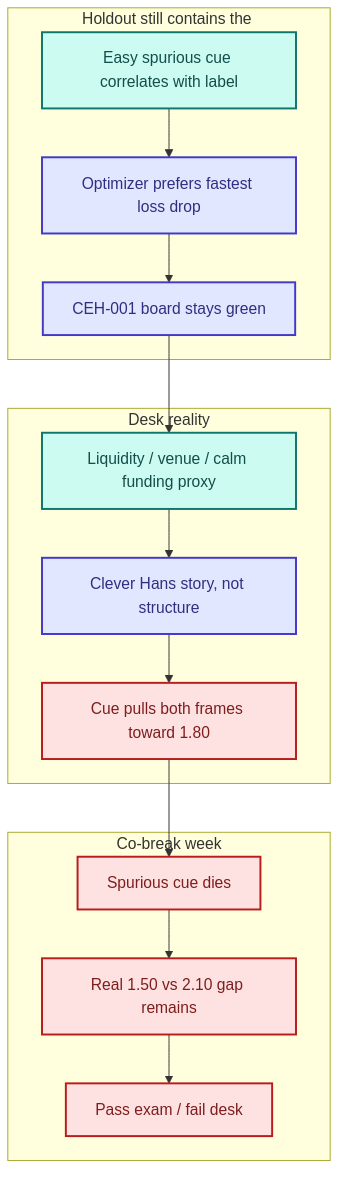
I keep catching models that pass every holdout by latching onto a cue that was never the economic story, only a training accident.
They name the loss. They track the card. Then the learner still solves that loss with a cheat code. A decision rule that works on the training exam because an easy cue correlates with the answer there, then fails when that cue stops tracking the thing you actually care about. In vision research they call it texture instead of shape. On a desk it looks like a liquidity proxy, a venue tag, a calm-regime funding print, or a vendor field that happens to line up with marks in quiet years.
Under the hood this is not mysticism. Supervised learning and many agent rewards prefer whatever reduces loss fastest. Easy spurious cues often reduce loss faster than hard economic structure. The optimizer is not evil. It is efficient at the wrong story.
I started caring about this after watching a green CEH-001 board die in one co-break week while every seed flipped the same way. That is not unlucky seed noise. That is a shared cheat. If your near-winner cloud is narrow because every seed found the same weather vane, crowd width is not evidence of truth. It is evidence of synchronized superstition.
What a shortcut is in plain language
A shortcut is a feature or pattern that predicts the target in the data you trained on, without being the reason the target is true in the world you will mark in. Correlation on the exam. Fragility in production. Holdout accuracy can look excellent because the holdout still contains the same cheat.
That is why a crowd of near-winners can look tight and still be worthless. Ten seeds can all discover the same shortcut. Crowd width then measures agreement among Clever Hanses. The gate sees a narrow cloud and smiles. The desk discovers the truth on a co-break week when the cue flips and every seed flips with it.
I care about this because it survives every other good habit. You can lock rulers, card losses, and freeze exams, and still promote a weather vane if nobody tried to kill the easy cues on purpose.
Why finance is fertile ground for shortcuts
Markets are full of stable-looking accidents. A product family trades mostly on one venue. A structure only appears in certain rate regimes. A vendor score is built from overlapping inputs you already use. An agent tool returns a field that leaks mild future information in research joins but not in the story you tell yourself. Each accident is a free point of loss reduction until the accident ends.
Independence theater makes it worse. Teams treat columns as separate stories and never ask whether the model is using column A as a stand-in for hidden factor B. Separate columns are not independent causes. Shortcut learning is what happens when you optimize against correlations and call the result understanding.
How this shows up in production AI
1. Calm-year heroes. CEH-001 marks look accurate while spreads and curves move in familiar bands. A funding or quote-frequency cue carries the prediction. In a jump week the cue breaks. Confidence swagger may still be high for a day, because swagger was trained on the same cheat.
2. Frame laundering through features. Spread-frame and curve-frame were locked. A shared shortcut feature can still pull both frames toward a social midpoint because both heads learned the same non-causal cue. Disagreement disappears for the wrong reason. That is fake peace, not invariance.
3. Agent tool shortcuts. The agent learns that calling Vendor X first works because Vendor X correlates with the label in the demo set. Tool policy becomes superstition. Rights splits cannot save you if the proposer is proposing from a haunted cue.
4. Importance plots that flatter the cheat. Feature importance on in-distribution data will celebrate the shortcut. Teams then explain the model using the very thing that will fail. Explainability without shift probes is storytelling.
There is also a quieter production version. Feature stores keep adding vendor fields that look free. Each field is a little gift of correlation. Over a year the model becomes a collage of gifts. Then one vendor changes methodology and your mark jumps for reasons that never appear in the economic story you tell risk committees.
Walk CEH-001 as a thought process
Training world: quiet years; quote intensity correlates with fair marks. Model learns: high quote intensity leans toward a 1.80-ish compromise region. Holdout: same quiet correlation, green board, tight crowd. Live co-break: quotes vanish while true frame gap stays near 0.60 to 0.95. Shortcut dies. Marks scramble. The peace number reappears as panic average. Ranges explode late, after autonomy already felt earned.
Read the failure carefully. The ruler was locked. The loss card existed. As-of might even have been clean. The model still never learned the dual-frame economics. It learned a weather vane that pointed the right way in summer.
The mathematical shadow is conditional dependence you did not model: the target and the cue look linked given the training regime, then unlink when the regime changes. Joint stress packs can expose that. They cannot invent the probe pack you refused to build.
What current practice quietly assumes
It assumes that whatever minimizes loss on a random holdout is close to the causal story. It assumes importance on training-like data is importance in stress. It assumes that if many seeds agree, they agreed on truth. Often they agreed on the same shortcut.
What I take from this as systems work
I do not trust holdout greens, tight crowds, or pretty importance plots until someone has tried to kill the easy cues on purpose. In engineering language: maintain a suspect-cue list, build group and ablation packs, run invariance swaps that should not flip the decision, gate on worst-group pain not only average pain, and bind promotion to those probes the same way you bind loss cards.
Curious how others catch Clever Hans features in market models before a co-break week teaches the lesson live.