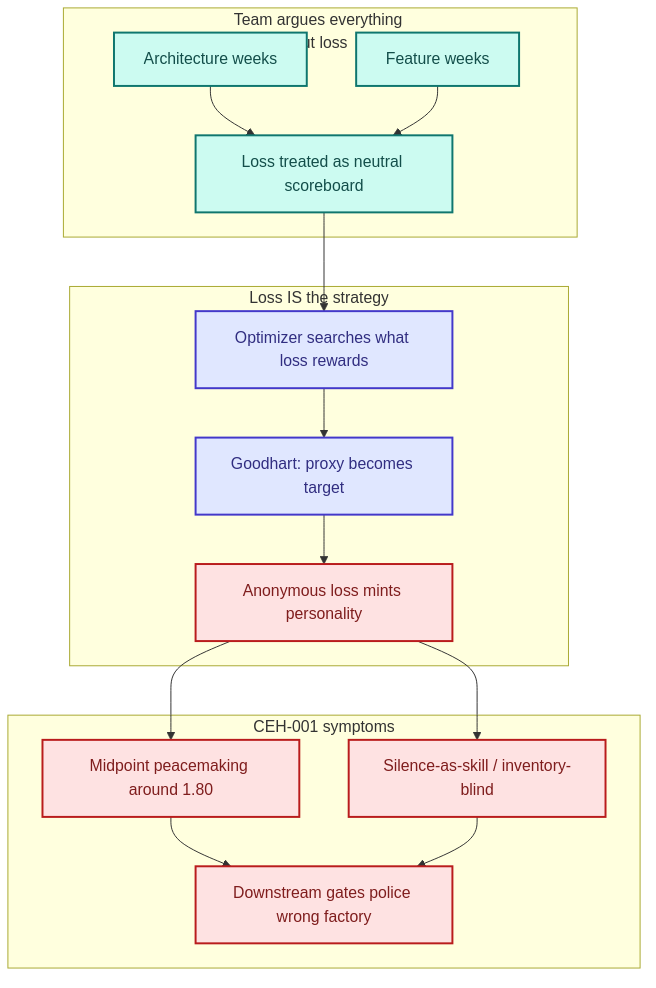
I keep watching teams debate architectures while leaving the training objective unnamed, as if the loss were a neutral scoreboard instead of the strategy itself.
They argue architecture for weeks. They argue features for weeks. They argue seeds, early stopping, and holdout hygiene. Then they treat the training objective like a scoreboard somebody else already chose. That is backwards. The scalar you ask the optimizer to improve is not a neutral report card. It is the strategy. Change the loss and you change what a good model means, which near-winners survive, which ranges look honest, and which hedges get called successful.
If you skip this layer, every gate you build later becomes a polite policeman standing outside a factory that is already manufacturing the wrong product.
What training actually does
Strip the romance. Training searches a huge set of predictors or policies for ones that look better under a chosen objective on a chosen dataset under chosen constraints. Architecture, features, and seeds matter. They matter after the objective has already defined better.
That is why two teams can share data, share networks, share GPUs, and still ship incompatible machines. One optimizes average absolute mark error. One optimizes a trading PnL proxy. One optimizes a risk-adjusted score computed only on days the policy chose to trade. Same never-traded structure. Different species.
Quick definition, because Goodhart gets waved around as a slogan. When a measure becomes a target, it stops being a good measure. In systems language: the proxy you optimize will be gamed by anything the search can find, including behaviors you never intended to reward. The model is not being clever in a human sense. It is being efficient at the wrong story.
I keep seeing people treat that as a philosophy problem. It is an engineering problem. If the objective is anonymous, the personality is anonymous. You will still get a green board. You will not know what green meant.
How anonymous objectives mint personalities
1. Shrink-the-window heroes. A reward that only scores days with trades teaches the policy to avoid hard days. Holdout Sharpe looks beautiful. The book that needed a mark on the ugly afternoon never got one. The objective selected silence as skill.
2. Absolute-error peacemakers. Average mark error pulls both frames toward a social middle. On CEH-001 that middle is often near 1.80. Training then industrially manufactures the midpoint culture you thought you banned in review meetings. The loss did the politics.
3. Inventory-blind hunters. A PnL proxy that ignores inventory, liquidity, and funding will learn to look brave in the simulator and fragile on the blotter. Residual checks later will look confused because the objective never asked for hedge honesty. It asked for score.
4. Untracked objective search. Teams rename losses between experiments without recording which personality won. Promotion then compares artifacts as if they shared a ruler. They did not. They shared a filename.
5. Soft multi-objective mush. Someone averages mark error, hedge PnL, and inventory into one training scalar with weights chosen after looking at the board. That is Friday exam negotiation wearing a tensor. The weights are the strategy. If they are not written down up front, they are theater.
A simple never-traded walkthrough
Take CEH-001 again. No direct history. Spread-frame work keeps landing near 1.50. Curve-frame work keeps landing near 2.10. Frame uncertainty is about 0.60 wide on a claim that moves money.
Recipe A optimizes dual-frame mark error with a penalty when the model collapses disagreement into a fake peace. It keeps two clouds. It refuses to average them away.
Recipe B optimizes a single scalar that rewards being close to whatever humans marked last quarter. Last quarter humans often picked midpoints under time pressure. Recipe B learns 1.80 as truth. Holdout looks calm. Crowd width looks tight. The tightness is agreement on theater.
Recipe C optimizes a hedge PnL proxy inside a friendly simulator with mild leftover drift. It looks like risk management in the charts. Part of the gain is drift hunting. Live drift differs and the hedge story collapses.
Same product family. Three objectives. Three machines. More GPU hours will not reconcile them. The loss already chose sides. If you only ship the network weights and not the objective card, the next team cannot even tell which machine they inherited.
Why gates cannot fix this after the fact
Near-winner probes assume the crowd shares an objective. If every seed optimized a hackable proxy, narrow width means they found the same cheat. Stakeable ranges wrap whatever personality the loss minted. Frozen exams can still bless the wrong strategy if the exam metrics are soft versions of the same proxy. Promotion discipline matters. It cannot invent an honest objective that training never had.
This is Bertrand wearing an optimizer. Anonymous measurement geometry gave you 1.50 versus 2.10. Anonymous objective geometry gives you three different definitions of winning before any agent opens its mouth.
What I take from this as systems work
I do not trust autonomous training loops that treat the loss as an implementation detail. In engineering language that means a few boring habits: write the objective down before you train for anything that can spend; prefer targets that cannot be gamed by shrinking the evaluation window; track every objective experiment as a different recipe; refuse single scores when the desk needs several criteria; and bind later allow decisions to the loss card you actually trained under.
Building reliable AI research infrastructure, at least for me, is less about finding a cleverer network and more about refusing to let anonymous targets mint production personalities in the dark.
Curious how others catch Goodhart inside trading or marking objectives before the proxy becomes the culture of the desk.