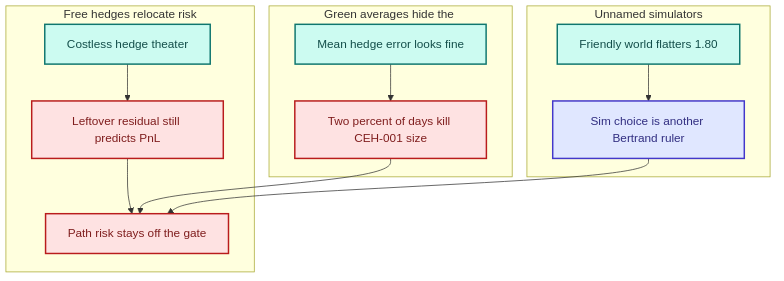
I keep seeing path-level AI work invent comfort three different ways, and each one feels quantitative until capital meets the bad day.
Pointwise gates can look fine and the desk can still get hurt across a path. Once you start talking hedges and simulations, not only marks, three comfort machines show up. They feel like engineering. They are lullabies. I keep seeing them after teams already did careful work on frames, crowds, ranges, rights, and clocks. Path theater is the next place certainty gets manufactured.
Comfort machine one: averages that hide the day that matters
Ninety-eight percent of days green is a lullaby if the other two percent are the only days the never-traded structure exists in size. Mean reward, mean error, mean hedge quality all invite the law of large numbers to do work it was not hired for. Concentration results tell you when averages settle. They do not tell you that the average is the right objective for a desk that dies on the tail path.
Agents make this worse by optimizing for demo smoothness. A policy that is politely good almost always and violently wrong once will win many leaderboards. You need run-level budgets, not only slice-level smiles. If one breach day can be averaged away, it will be. I have watched teams celebrate a mean improvement that came entirely from making quiet days quieter while the ugly day got worse.
Comfort machine two: unnamed simulation as another ruler
Bertrand said the ruler decides the unbiased answer. A simulator is a ruler for paths. If you do not name the world, you cannot contest it. Friendly noise, wrong dependence, missing jump structure, fantasy liquidity: each produces a different optimal hedge. Training a policy against one unnamed world and shipping it into another is Bertrand with a progress bar.
On the familiar structure, a friendly sim can make a midpoint mark near 1.80 look hedgeable with neat little trades. A second named world, with costs and co-breaks, shows the same policy leaking. If only the friendly world is in CI, promotion is theater. The team did not validate a hedge. They validated a story about a world they never declared.
The undeclared world is especially dangerous because it feels objective. Code ran. Numbers appeared. Charts moved. Nobody had to confess a measurement choice. The measurement choice was still there, buried in the simulator defaults.
Comfort machine three: free trades wearing hedge clothing
A hedge is a policy evaluated under costs, constraints, and residual behavior on named worlds. A free trade is an action that looks good because friction was set to zero, or because the objective ignored the leftover risk that still predicts P&L. If leftovers are still a free lunch, you did not hedge. You relocated risk into a blind spot.
Deep learning hedge engines are powerful here and dangerous for the same reason: they will optimize whatever story you told them. Tell them a costless fairy tale and they will return a fairy-tale policy with beautiful curves. The curves are not lying about the objective. The objective was lying about the desk.
How the three machines reinforce each other
Unnamed friendly sim
average-green score across paths
costless hedge looks optimal
promote policy
live path with costs + co-break
surprise P&L; swagger returns
Read that slowly. Capacity without named worlds, path budgets, and costed objectives just overfits the lullaby. More GPU hours will not invent the missing objects. A sterner system prompt will not invent a second world.
A simple pricing-and-hedge example
Spread-frame near-winners still live near 1.50. Curve-frame near-winners still live near 2.10. Someone proposes 1.80 as peace and asks for a hedge. In World F, zero costs, calm noise, the policy looks tidy. In World S, costs on and a co-break week, the same policy breaches a path budget and leftovers still predict P&L. If CI only saw World F, you promoted a story about 1.80 being manageable. You did not promote a hedge.
Notice the continuity with earlier posts without needing a map. Midpoint theater tried to invent peace between frames. Path theater tries to invent manageability for that peace. Both are social objects wearing decimals and charts.
I also see a vocabulary trap. Teams say hedge when they mean trade that reduced a Greek in a frictionless toy. Greeks can be useful diagnostics. They are not a substitute for path budgets, named worlds, and residual honesty. If your language cannot distinguish those jobs, your CI will not either.
Average-green culture has a hiring effect too. It rewards people who make charts smoother. It under-rewards people who force an ugly day into the exam. Over time the org loses the muscle to keep the bad day visible. That is how lullabies become process.
On CEH-001 style structures, the bad day is often the only day the position is large. Averaging across a year of tiny marks is how you convince yourself a rare instrument is tame.
What I take from this as systems work
I do not trust path-level autonomy until whole runs are scored against failure budgets, until at least two named worlds must pass, and until hedges are trained and judged with costs and residual honesty.
In engineering language:
- Score trajectories against budgets, not only means.
- Name simulation worlds; refuse friendly-only promotion.
- Keep costs and trading limits on in anything that can mint a spend right.
- Fail packs when leftovers still look like free lunch.
- Scope allows to the worlds that actually passed.
Building reliable AI infrastructure, at least for me, is less about a smoother demo curve and more about making the path ruler and the cost story impossible to leave unnamed.
Curious which of the three comfort machines bit others first: average metrics, simulator mismatch, or costless hedge demos.