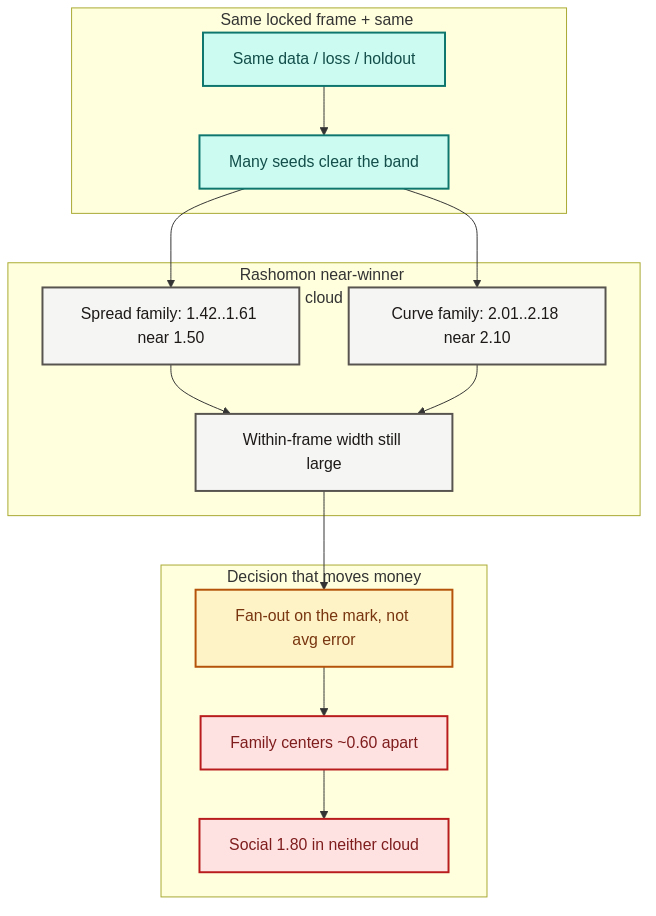
Here is a systems problem I keep running into when people talk about letting AI decide after the model is trained.
You can hand an AI the same data, the same training loss, the same holdout checks, and still not get a unique decision ready for capital. The board looks flat. Eighteen out of twenty seeds pass. Someone says we are done. Then two seeds that both won disagree on the number that actually moves money.
In the last posts I used Bertrand's Paradox to say you cannot ask for an unbiased answer before you lock the ruler. This post is the twin after learning starts. Even inside one locked frame, training success is not the same thing as a unique answer.
Quick definition, because this gets waved away as seed noise
An ML pipeline is the full recipe used to train and check a predictor: filters, features, architecture, random seeds, early stopping, holdout slices. That pipeline is underspecified when many different predictors can clear the same checks about equally well.
Those predictors are not identical machines. They only look interchangeable if the only question you ask is average error on yesterday's quiet distribution. Ask the question that spends, and the set fans out.
That is Bertrand after learning. Bertrand had one question and several valid ways to define random. Underspecification has one training win condition and several near-equal ways to satisfy it. The math can look clean in every member of the set. The decision object is still not unique.
Why train harder often does not close the set
People reach for more epochs, bigger nets, tighter in-distribution accuracy. Those moves help when the failure was under-fitting. They often leave the freedom intact when the failure is multiplicity.
If validation only checks an average that many predictors can match, the optimizer has no reason to collapse onto one decision-relevant answer. Same lesson as maximum entropy without geometric constraints. Optimization fills the freedom it was never told to remove.
There is a second trap: the checks can be easy in the wrong place. Two models can agree on common cases and disagree on the rare structure, the jump week, or the exact contract you mark. Leaderboard culture rewards the easy place. Desk risk lives in the hard place.
Modern research keeps rediscovering this in vision, language, medicine, genomics: models that look equivalent on standard holdout can separate hard once you care about robustness, fairness, or a shifted world. Finance has the same disease with worse consequences, because the shifted world is where the P&L lives.
How this shows up in production systems
1. The illusion of a unique model
A desk trains twenty seeds for an unlisted structured derivative that has never traded. Eighteen pass the same holdout band. The team celebrates the model. There is no the model. There is a cloud of near-winners. Picking one seed because its ID is lowest, or because a chart looked pretty, is a human lottery dressed as engineering.
2. The arbitrage trap inside one firm
Two agents can both be locally credible members of that cloud. One lives in a spread frame (marks from rate gaps) and lands near 1.50. One lives in a curve frame (marks from yield-curve shape) and lands near 2.10. Both passed training. Both can sound careful.
If they are allowed to act on the gap, you may be trading measurement multiplicity, not opportunity. Bertrand named this across rulers. Underspecification says it survives inside one ruler when learning still leaves a crowd.
3. Credibility collapse under shift
Models that looked interchangeable on quiet months can separate when liquidity thins or the structure behaves oddly. Same training success. Different deployment selves. If your monitoring only watches average error, you learn about the break after capital already moved.
And when the disagreement finally becomes visible for a second, someone averages 1.50 and 2.10 into 1.80 and calls it compromise. That number was never in either family. It is a social object wearing a decimal. Underspecification does not get healed by averaging the symptoms.
A simple pricing example
Keep the never-traded structure from before (call it CEH-001). Two desks can both be serious and still live in different frames. Here is the short dictionary, because the labels get waved at without being cashed out.
A spread is a gap between two rates, for example an issuer yield versus a benchmark, or one tenor versus another. Spread-frame work treats those gaps (and related absolute/spread coordinates) as the main ruler for the mark.
A yield is an interest rate implied by a bond or swap price for a maturity. A yield curve is those yields lined up across maturities. Curve-frame work treats continuous curve metrics, level, slope, shape, as the ruler instead of raw spreads.
Same claim. Different geometry. That is why one honest family clusters near 1.50 and the other near 2.10. Now refuse the fantasy that each frame has one model. Look inside each family after honest re-seeding:
Spread-frame near-winners (five seeds; all pass the same holdout board):
marks: 1.42 1.48 1.50 1.55 1.61
within-family width = highest − lowest = 1.61 − 1.42 ≈ 0.19
(how far siblings still disagree after they all "won")
Curve-frame near-winners (five seeds; all pass the same holdout board):
marks: 2.01 2.08 2.10 2.14 2.18
within-family width = highest − lowest = 2.18 − 2.01 ≈ 0.17
The gap between family centers is about 2.10 − 1.50 = 0.60.
That 0.60 is frame conflict, not seed noise inside one frame.
Silent midpoint people reach for: 1.80 (in neither cloud, not a seed, not a frame)
Read that slowly. Width 0.19 and 0.17 are not mysticism. They are just high minus low inside one allowed frame. Even after you lock a ruler, each frame can still hand you a band, not a point. Across frames the bands may not even touch, here the spread cloud tops out near 1.61 and the curve cloud starts near 2.01. A production system that prints one float and a green checkmark has thrown away the only information that made the risk legible: the AI price was never unique.
This is why we trained it is not a risk answer. Training answered a different question: can some recipe meet the board. The desk question is: given everything that still meets the board, how wide is the decision, and do allowed frames overlap enough to act.
What I take from this as systems work
I do not trust fully autonomous marking on thin structures until the near-optimal set is forced into the open. Champion culture hides it. Confidence theater on one seed does not delete the siblings that also passed. Prompt tuning does not erase a multiplicity the loss never punished.
In engineering language, that means a few boring habits:
- Treat near-winners as a set, not a single registry file.
- Score disagreement on the decision that spends, not only on average loss.
- Probe the hard slice, not only the quiet holdout.
- Make width and frame gap first-class risk objects before any auto-spend.
- Refuse silent midpoints that sit in no cloud.
Building reliable AI infrastructure, at least for me, is less about crowning a champion faster and more about measuring whether the exam still admits many answers where money moves.
Curious how others detect near-equal models that still disagree on the decision that matters, before one seed gets crowned and automated.