The quietest class of failure
Measure errors are the quietest class of failure in a research stack. A leakage bug produces an impossible score, loud and obvious. A rank-deficient covariance produces a phantom riskless portfolio, loud once anyone checks. A measure error produces a number that is plausible, systematic, and wrong in the same direction every single day — every call marked up, every put marked down, every hedge residual carrying a drift the desk reads as skill. It survives code review because the code is correct. It survives output review because the output looks right. Only a test built for this specific failure catches it, which is what this chapter's six experiments are: apparatus a desk can run in an afternoon, each producing a number that either supports a hedge claim or refuses it.
"Remove the drift" has four different meanings, and they cost differently
Take a series of 250 daily returns, realised daily standard deviation 1.2649%, sample mean 6 basis points a day. "Remove the drift" sounds like one instruction. It is at least four, and they are not interchangeable.
The one that costs nothing: replace the physical probability with the risk-neutral one computed from the card — the market price of risk θ = (α-r)/σ, which for α=0.10, r=0.05, σ=0.20 is exactly 0.25. This removes exactly the drift the theory says to remove, and estimates nothing, because it comes from the card, not the data.
The one almost every notebook runs, usually in one line, usually uncommented: subtract the sample mean. Price what that actually does. The sample mean of 0.0006/day annualises to 15.00% of return removed. The standard error of that same sample mean annualises to 20.00%. So the procedure subtracts fifteen points of annual return on the strength of an estimate that is a 0.75-sigma object — statistically indistinguishable from zero. And it isn't neutral: whatever real drift existed is now sitting in the residual with a distorted sign, and the residual is exactly what every downstream honesty test examines.
The one that actually works: hedge first, then de-mean the hedged residual, not the raw return. Hedging cuts the daily standard deviation from 1.2649% to 0.08%, a factor of 15.81 in standard deviation, 250 in variance.
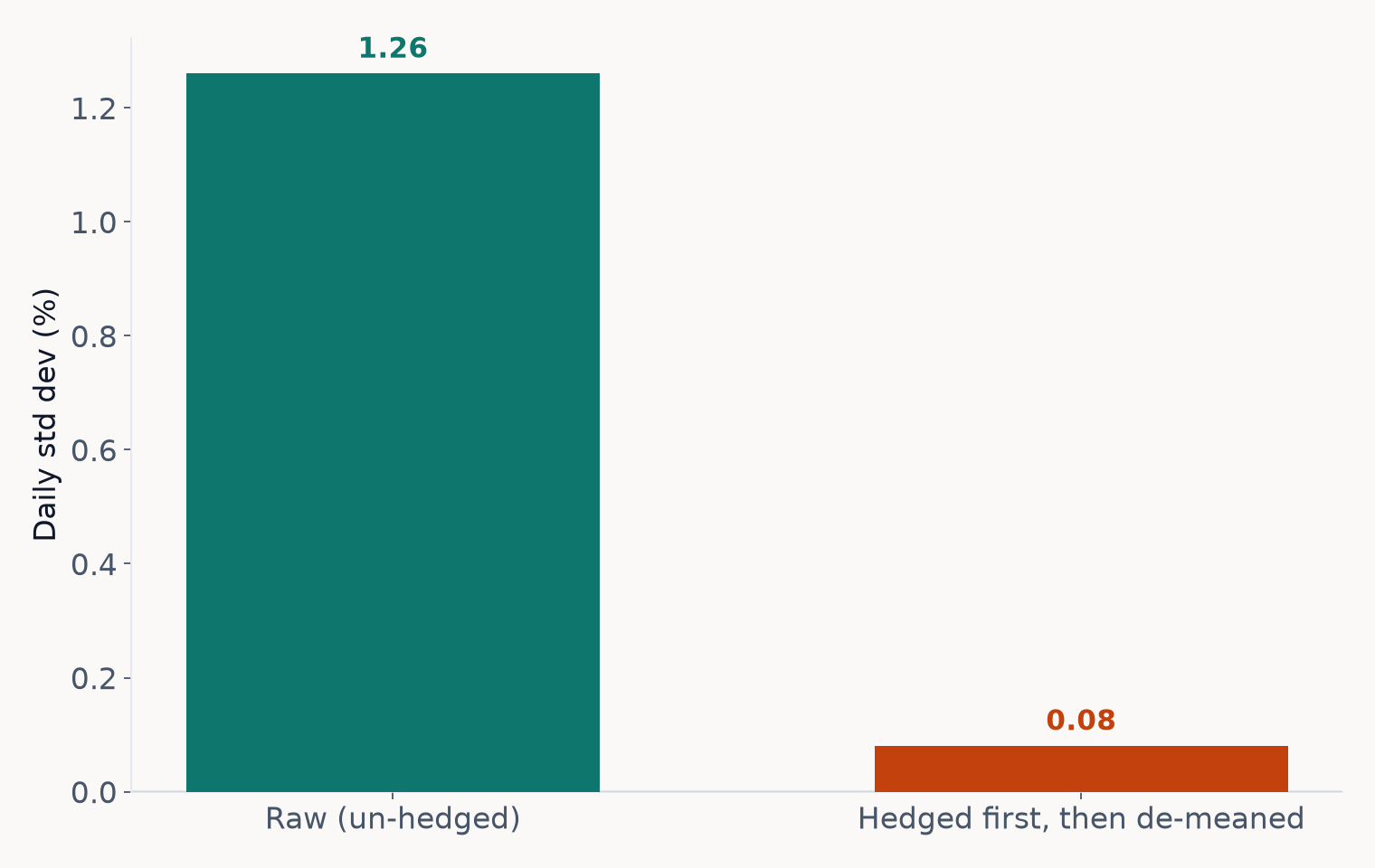
Redo the same arithmetic in that reduced space and the standard error of the residual's annualised mean falls to 1.26%. The same 15% drift, if it were still present, would now be an 11.9-sigma object. Sixty-four years of data needed to see the drift with raw returns becomes sixty-four days once hedged. Nothing about the statistics changed. What changed is that hedging removed the variance that was hiding the drift in the first place.
Five clean correlations that are not actually clean
A hedged residual still has to pass a battery, not one test, and the battery's whole point shows up in a case where every individual number looks fine. Run a re-estimated hedge on a 250-day CEH-001 exposure. Every per-lag correlation between the residual and its own past comes back under the carded threshold of 0.25: 0.13, 0.11, 0.09, 0.08, 0.07. Five checks, five greens.
But the five numbers are all positive and decay in exactly the pattern real persistent structure produces. A joint test sees what the per-lag list cannot. The Ljung-Box statistic on those five lags, with n=250, comes out to Q(5) = 12.32 against a χ²5 critical value of 11.07 — a p-value of 0.031. The residual has structure at the three-percent level while no individual lag came anywhere near its own threshold.
The general lesson a per-lag list cannot express: a set of small, same-signed correlations is stronger evidence than one large one, and threshold-per-lag testing is exactly blind to it. There's a second reason to prefer the joint test beyond blindness. Five independent per-lag tests at 5% each carry a family-wise false-positive rate of 1 - 0.955 ≈ 22.6% — a card that fires on any single lag crossing its line will cry wolf on a clean hedge roughly one time in four, which is precisely how residual gates get switched off by an exhausted operator. One joint statistic, one degree-of-freedom count, is both more sensitive to the failure that matters and less prone to the false alarm that destroys the gate's credibility.
Why the lab exists at all
None of this is subtle once it is on a table. It is invisible until it is. A measure error, an under-hedged residual, a de-meaning step that quietly ate real signal, all of them produce a number that looks like skill and reads clean on a dashboard built to check one thing at a time. The lab's six experiments exist because "the hedge works" is a claim, and a claim earns a card field only after it has survived the specific instrument built to catch the specific way it usually fails.
Book: Chapter 29 in Rulers Before Models.